

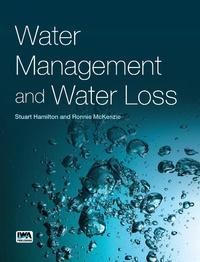
Water Management and Water Loss
Published on 15. October 2014
204 pages
978-1-78040-636-7 (ISBN)
Description

Water Management and Water Loss contains a selection of papers and articles written by various internationally recognised specialists in the field of water loss reduction. The articles have been drawn together from IWA conferences during the past 5 years and provide details of how water losses from Municipal distribution systems can be reduced.
The book provides useful background information and reference materials to help explain the different approaches and interventions that are used to reduce water losses. Numerous real case studies are provided that highlight the processes and methodologies employed around the world to reduce water losses. Water Management and Water Loss covers many aspects of water loss control including, pressure management, leak detection and repair, Internal plumbing losses and retrofitting, community involvement and education/awareness, schools education and leak repair projects.
Authors: Stuart Hamilton, Hydrotec Ltd.,Thorpe Underwood, Northants, UK and Ronnie McKenzie, Groenkloof, Pretoria, South Africa
The book provides useful background information and reference materials to help explain the different approaches and interventions that are used to reduce water losses. Numerous real case studies are provided that highlight the processes and methodologies employed around the world to reduce water losses. Water Management and Water Loss covers many aspects of water loss control including, pressure management, leak detection and repair, Internal plumbing losses and retrofitting, community involvement and education/awareness, schools education and leak repair projects.
Authors: Stuart Hamilton, Hydrotec Ltd.,Thorpe Underwood, Northants, UK and Ronnie McKenzie, Groenkloof, Pretoria, South Africa
More details
Language
English
Place of publication
London
United Kingdom
Target group
College/higher education
Professional and scholarly
File size
25,11 MB
ISBN-13
978-1-78040-636-7 (9781780406367)
Copyright in bibliographic data and cover images is held by Nielsen Book Services Limited or by the publishers or by their respective licensors: all rights reserved.
Schweitzer Classification
Other editions
Additional editions
Stuart Hamilton | Ronnie McKenzie
Water Management and Water Loss
Book
10/2014
IWA Publishing
€179.50
Shipment within 3-4 weeks
Content
- Cover
- Copyright
- Contents
- Chapter 1: Introduction
- 1.1 The Technology Matrices
- 1.1.1 Main pipelines only - high pressure
- 1.1.2 Main pipelines only - low pressure
- 1.1.3 Domestic and mains fittings - high pressure
- 1.1.4 Domestic and mains fittings - low pressure
- Chapter 2: Leak detection technologies
- 2.1 Method A: Gas Injection Method
- 2.2 Method B: Manual Listening Stick
- 2.3 Methods C and D: Leak Noise Correlation
- 2.4 Method C: Correlation Using Accelerometers
- 2.5 Method D: Correlation Using Hydrophones
- 2.6 Method E: In-Line Leak Detection Techniques
- 2.6.1 Tethered systems
- 2.6.2 Free swimming systems
- 2.7 Method F: Noise Loggers - Non-Correlating
- 2.8 Method G: Electronic Amplified Listening Devices
- 2.8.1 Step testing
- 2.8.2 Principles of step testing
- Chapter 3: Principles of pressure management
- 3.1 Introduction
- 3.1.1 Basics of pressure management
- 3.1.2 Concepts of pressure management
- 3.1.3 Fixed outlet control
- 3.1.4 Time control
- 3.1.5 Flow control
- 3.1.6 Intelligent and closed-loop control
- 3.1.7 When to use advanced pressure control
- 3.1.8 Some large advanced pressure management installations
- 3.1.9 Khayelitsha: City of Cape Town - 2001
- 3.1.10 Sebokeng: Emfuleni Local Municipality - 2005
- 3.1.11 Mitchell's Plain: City of Cape Town - November 2008
- 3.1.12 Conclusions
- References
- Chapter 4: The repair or replace dilemma
- 4.1 Definitions of Repair and Replace
- 4.2 The Durability of a Network
- 4.3 Deterioration of a Distribution System
- 4.4 Factors Affecting the Risk of Failure of Water Distribution Pipes
- 4.5 Definition of Mains Failure
- 4.6 The Importance of Information
- 4.6.1 Problems with information collection
- 4.6.2 The 'Garbage In, Garbage Out' (GIGO) principal
- 4.6.3 Minimum requirements
- 4.6.4 Developing information systems
- 4.7 Distribution Performance Measures
- 4.7.1 The importance of measuring performance
- 4.7.2 Performance measures for distribution
- 4.7.3 CARE W
- 4.7.4 Cost information
- 4.7.5 Environmental factors
- 4.7.6 Configuring the data
- 4.8 A Mains Failure Database
- 4.8.1 Why mains failure information is needed
- 4.8.2 National failure databases
- 4.9 Starting from Scratch
- 4.9.1 Compiling a mains asset database
- 4.9.2 Capturing repair information
- 4.9.3 Collecting additional information
- 4.9.4 Organising the information
- 4.10 Analysing the Information
- 4.10.1 The simplest approach
- 4.10.2 Use of a GIS system
- 4.11 Dealing with High Burst Rates
- 4.11.1 How to decide if the failure rate is too high?
- 4.11.2 Pressure control to reduce failure rates
- 4.11.3 Increase of failure rates with increased pressure
- 4.11.4 Identifying mains replacement projects
- 4.12 Cost Benefit Studies
- 4.12.1 The need for cost benefit studies
- 4.12.2 Calculating direct costs
- 4.12.3 Potential savings
- 4.12.4 Comparing capital and operational costs
- 4.12.5 Indirect costs and triple bottom line approaches
- 4.13 Predicting Future Trends
- 4.13.1 Why predict the future?
- 4.13.2 Models available
- 4.14 Avoiding Leakage in New Systems
- 4.14.1 Choice of material
- 4.14.2 Contract requirements
- 4.15 Further Research
- References
- Chapter 5: Community awareness and education
- 5.1 Introduction
- 5.1.1 Importance of community awareness and education
- 5.1.2 Objectives of community awareness education
- 5.1.3 Methodologies for implementation
- 5.1.4 Lessons learnt
- Bibliography
- Chapter 6: Meter logging and recording
- 6.1 Introduction
- 6.1.1 General
- 6.1.2 Importance of logging
- 6.1.3 Interpretation of minimum night flows
- 6.1.4 Assessing the minimum night flow
- 6.1.5 Normal night use
- 6.1.6 Background leakage
- 6.1.7 Calculation of unexplained bursts
- 6.1.8 Using minimum night flow for leakage management
- 6.1.9 Live logging of flows at bulk consumer meters
- References
- Chapter 7: Large consumer meter consolidation and improvements: Planning, implementation and benefits
- 7.1 Introduction
- 7.1.1 Planning and policies
- 7.1.2 Implementation
- 7.1.3 Results
- 7.1.4 Conclusion
- References
- Chapter 8: Software tools to assist with water loss reduction in municipal systems
- 8.1 Introduction
- 8.1.1 Background
- 8.1.2 AQUALITE: Water balance software
- 8.1.3 SANFLOW: Background night flow analysis model
- 8.1.4 ECONOLEAK: Economics of leakage model
- 8.1.5 PRESMAC: Pressure management model
- 8.1.6 WDM scorecard
- 8.2 Latest Results from the NRW Assessments
- Bibliography
- Chapter 9: International case studies from around the world
- Chapter 9.1: Application in water loss reduction project in Bosnia and Herzegovina
- 9.1.1 Introduction
- 9.1.2 Water Balance Evaluation Software - Calculeakator
- 9.1.3 Water Loss Reduction Project in DMA KUZICI (TUZLA)
- 9.1.4 Conclusion
- References
- Chapter 9.2: Large scale water loss management improvement programme in Zagreb (Croatia) water distribution network
- 9.2.1 Introduction
- 9.2.2 DMAs and PMAs - Starting Points
- 9.2.3 Design of DMA/PMA
- 9.2.4 Implementation
- 9.2.5 Results
- 9.2.6 Conclusion
- References
- Chapter 9.3: Analysis of the water losses from the aspect of central water meters in objects of collective housing
- 9.3.1 Introduction
- 9.3.2 Description of the Problem
- 9.3.2.1 Example problem 1 - leakage in buildings
- 9.3.2.2 Example problem 2 - leakage in buildings
- 9.3.2.3 Example problem 3 - leakage in buildings
- 9.3.2.4 Example problem 4 - water meter diameter
- 9.3.3 Analysis
- 9.3.3.1 User coverage
- 9.3.3.2 Water consumption and flat-rate collection
- 9.3.3.3 Analysis - losses due to flat-rate collection of payment
- 9.3.3.4 Results of the analysis
- 9.3.4 Conclusion
- References
- Chapter 9.4: Water loss management in Novi Sad water utility, Serbia
- 9.4.1 Introduction
- 9.4.2 Pressure Management
- 9.4.3 District Metered Areas and Basic Real Loss Performance Indicators
- 9.4.3.1 Micro metered areas
- 9.4.4 Active Leakage Control and the Pilot DMAs
- 9.4.5 Water Price Policy and Water Meter Inaccuracies
- 9.4.6 Strategy 2014
- 9.4.7 Conclusion
- References
- Chapter 9.5: Continuous acoustic monitoring - evolution of an innovation in the USA
- Chapter 9.6: Establishing the first validated dataset of North American water utility water audit data
- 9.6.1 Methodology
- 9.6.2 Results
- 9.6.2.1 Analysis of DV scores in dataset
- 9.6.2.2 Trend review
- 9.6.2.3 System size
- 9.6.2.4 Climate
- 9.6.2.5 Connection density
- 9.6.2.6 Cost data
- 9.6.2.7 Improving Data Validity
- 9.6.3 Conclusions
- References
