

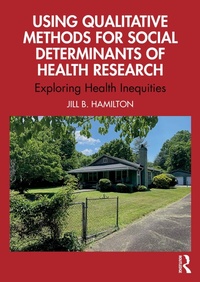
Using Qualitative Methods for Social Determinants of Health Research
Exploring Health Inequities
Published on 24. February 2026
148 pages
978-1-040-55037-3 (ISBN)
Description

This book provides researchers, faculty, and students with a comprehensive resource for applying qualitative methods in Social Determinants of Health (SDOH) research among underrepresented communities.
Addressing a significant gap in existing literature, this book extends beyond traditional qualitative texts by offering targeted instruction on utilizing these methods to explore social, cultural, environmental, and political factors that shape health inequities. It is an extension of texts that define qualitative research, distinguish qualitative from quantitative research, and provide instruction or guidance on ways to implement, analyze, and evaluate this methodology in populations experiencing illness events. Key features include practical guidance on conducting qualitative research throughout the entire study process-from planning and data collection to analysis and dissemination. The author draws on over 20 years of experience, integrating real-world examples that illustrate the effective use of qualitative methods in diverse contexts.
Ideal for researchers and faculty in nursing, public health, medicine, theology, and divinity, it serves as a resource for emerging and experienced scholars who may be initiating new projects on SDOH, integrating SDOH into existing research, and/or adapting measures or interventions for cultural relevance among underrepresented communities. It is also a vital resource for those teaching and mentoring students in rigorous and innovative SDOH research.
Addressing a significant gap in existing literature, this book extends beyond traditional qualitative texts by offering targeted instruction on utilizing these methods to explore social, cultural, environmental, and political factors that shape health inequities. It is an extension of texts that define qualitative research, distinguish qualitative from quantitative research, and provide instruction or guidance on ways to implement, analyze, and evaluate this methodology in populations experiencing illness events. Key features include practical guidance on conducting qualitative research throughout the entire study process-from planning and data collection to analysis and dissemination. The author draws on over 20 years of experience, integrating real-world examples that illustrate the effective use of qualitative methods in diverse contexts.
Ideal for researchers and faculty in nursing, public health, medicine, theology, and divinity, it serves as a resource for emerging and experienced scholars who may be initiating new projects on SDOH, integrating SDOH into existing research, and/or adapting measures or interventions for cultural relevance among underrepresented communities. It is also a vital resource for those teaching and mentoring students in rigorous and innovative SDOH research.
More details
Language
English
Place of publication
London
United Kingdom
Publishing group
Taylor & Francis Ltd
Target group
College/higher education
Illustrations
20 Tables, black and white
File size
9,90 MB
ISBN-13
978-1-040-55037-3 (9781040550373)
Copyright in bibliographic data and cover images is held by Nielsen Book Services Limited or by the publishers or by their respective licensors: all rights reserved.
Schweitzer Classification
Other editions
Additional editions
Jill Hamilton
Using Qualitative Methods for Social Determinants of Health Research
Exploring Health Inequities
Book
approx. 02/2026
1st Edition
Routledge
€77.50
Not yet published

Jill Hamilton
Using Qualitative Methods for Social Determinants of Health Research
Exploring Health Inequities
Book
approx. 02/2026
1st Edition
Routledge
€210.70
Not yet published
Person
Jill Hamilton, PhD, MRPL, RN is a tenured Professor at the Nell Hodgson Woodruff School of Nursing and Affiliate Professor at Candler School of Theology at Emory University in Atlanta, Georgia, USA. Dr. Hamilton earned a BSN, MSN, and PhD in nursing from the University of North Carolina at Chapel Hill, a BS in Accounting from North Carolina Central University, and completed postdoctoral training in the nursing care of older adults at the Oregon Health & Science University.
Content
Acknowledgements
Preface
Chapter 1. Engaging Community Research Design, Implementation, Evaluation, and Dissemination
Chapter 2. Cultivating and Maintaining Relationships in Community
Chapter 3. Research Questions Appropriate for SDOH and Community Engaged Research
Chapter 4. The use of existing conceptualizations and theories with qualitative methods
Chapter 5. Sampling Strategies for SDOH Topics in Community Engaged Research
Chapter 6. The Art and Science of Data Collection for SDOH in Community Engaged Research (Part 1)
Chapter 7. The Art and Science of Data Collection for SDOH in Community Engaged Research (Part 2)
Chapter 8. Rigor in Qualitative Research
Chapter 9. Coding Schemes
Chapter 10. Qualitative Analysis Strategies
Chapter 11. Success in the academy as a Qualitative Researcher
Preface
Chapter 1. Engaging Community Research Design, Implementation, Evaluation, and Dissemination
Chapter 2. Cultivating and Maintaining Relationships in Community
Chapter 3. Research Questions Appropriate for SDOH and Community Engaged Research
Chapter 4. The use of existing conceptualizations and theories with qualitative methods
Chapter 5. Sampling Strategies for SDOH Topics in Community Engaged Research
Chapter 6. The Art and Science of Data Collection for SDOH in Community Engaged Research (Part 1)
Chapter 7. The Art and Science of Data Collection for SDOH in Community Engaged Research (Part 2)
Chapter 8. Rigor in Qualitative Research
Chapter 9. Coding Schemes
Chapter 10. Qualitative Analysis Strategies
Chapter 11. Success in the academy as a Qualitative Researcher
