

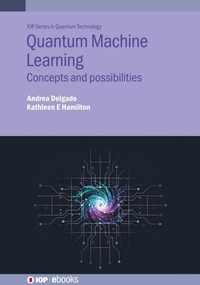
Quantum Machine Learning
Description

The scope of the book spans from the fundamental postulates of quantum mechanics and quantum algorithms that underpin QML, to advanced topics including variational quantum algorithms, quantum neural networks, and quantum generative models. It covers both the theoretical formulations, such as expressivity, generalization bounds, and kernel methods, and practical applications, ranging from optimization and pattern recognition to simulation and sensing. The text also explores hybrid quantum-classical workflows, error mitigation strategies, and benchmarks that connect algorithmic development to near-term hardware implementations. By the end of this book, readers gain a holistic view of the current state, promises, and challenges of QML, as well as directions for future research in this rapidly evolving field.
Key Features:
- A chapter on quantum generative models.
- Accessible reference text useful for both students and researchers.
- Case studies
More details
Other editions
Additional editions
Persons
Dr Andrea Delgado is a Research Scientist in the Physics Division and the Quantum Information Science Group at Oak Ridge National Laboratory. Her research focus is on quantum computing applications to high-energy physics. This work combines a scientific interest in extending our knowledge of the fundamental blocks of the universe and how they interact with each other and building better tools to analyze the data from large-scale particle physics experiments such as the LHC. Andrea's research interests include developing data analysis tools for high-energy physics experiments, including machine learning and quantum computing. She received her Ph.D. from Texas A&M University.
Dr Kathleen Hamilton is a Research Scientist in the Quantum Information Science Group at Oak Ridge National Laboratory. Her research covers many different aspects of NISQ-era quantum machine learning including designing new models for sequence prediction, quantum reservoir computing, using machine learning workflows to benchmark near-term quantum devices, and incorporating error mitigation into variational circuit training. She has been a member of the Program Committee for the International Conference on Neuromorphic Systems (ICONS) from 2019-2021, and the Algorithms Track for IEEE's 2020 Quantum Week. She received her Ph.D. from the University of California at Riverside, her M.S. from the University of New Hampshire, and her B.S. from Mary Washington College. She is a member of the American Physical Society and the Society of Industrial and Applied Mathematics.
Content
Preface
Author biographies
1 Introduction
2 Quantum information processing
3 Information encoding
4 Quantum computing for inference
5 Quantum variational optimization
6 Variational classifiers and neural networks
7 Quantum generative models
8 Theory, expressivity, and learning bounds
