

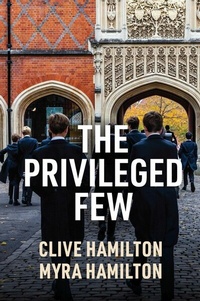
The Privileged Few
Description

Male and white privilege are on the decline, yet elite privilege has gone from strength to strength. The privileges enjoyed by the rich and powerful are not only unfair but cause widespread harm, from the everyday slights and humiliations visited on those lower down the scale to the distortions in the labour market when elites use their networks to secure plum jobs, not least in new domains such as professional sports.
In this book, Clive Hamilton and Myra Hamilton show that elite privilege is not a mere by-product of wealth but an organising principle for society as a whole. They explore the practices and processes that sustain, legitimise and reproduce elite privilege and show how we are all implicated in the system, both facilitating it and tolerating its harmful effects.
Building on their original fieldwork and a wide range of other sources, the authors paint a vivid picture of the micropolitics of elite privilege, highlighting in particular the vital role played by exclusive private schools. Ranging across topics as diverse as 'glamour suburbs', philanthropy, Rhodes scholarships and super-yachts, The Privileged Few delves beneath attempts at concealment to expose how the elites keep getting away with it.
More details
Other editions
Additional editions
Persons
Myra Hamilton is an Associate Professor in Work and Organisational Studies at the University of Sydney Business School. She is a sociologist and social policy scholar with a focus on inequalities arising from gender, age and social disadvantage. A principal concern of her work is inequalities in the sphere of work. Her research explores how public and workplace policies can build equity and wellbeing over the life course.
Content
1. Understanding elite privilege
2. The micropolitics of elite privilege
3. The geography of privilege
4. Replicating privilege: Elite schools
5. Sites of privilege
6. The power of giving
7. The privilege blender
8. Hiding and justifying privilege
9. Psychic harms
10. Economic and social harms
11. Contesting privilege
CHAPTER ONE
Introduction
It was the same during the Great Plague of London in 1665-6. As the Covid-19 virus spread in the early months of 2020, and London began to shut down, wealthy families fled the city for their sanctuaries in the country. Others took to their yachts or flew to Caribbean islands. Estate agents fielded inquiries from the super-rich for 'mansions with bunkers'.1 Newspaper stories reporting the flight of the rich attracted a torrent of bitter and cynical comments from the public. The author Lynsey Hanley captured the mood.
Our experiences of the lockdown are shaped by class. How can they not be, when the rich have escaped to second homes, when bus drivers and nurses are dying on their jobs, and when our ability to tolerate large amounts of time at home or to properly self-isolate is determined by how much space we have at our disposal?2
It was the same in the United States, with an exodus from New York's up-market districts to the Hamptons, the vacation playground of the rich and famous. One wealthy philanthropist who joined the migration from the city wondered whether, with the pandemic and Black Lives Matter protests, she and her friends would ever return.3
In July 2021, Sydney was in the grip of its worst outbreak of the pandemic and struggling to cope with its highest daily caseload on record. The whole city was in lockdown: workplaces and schools were closed to all but essential workers and movement around the city was strictly limited. The worst affected local government area was Fairfield, the city's most disadvantaged, with extensive poverty and high levels of low-paid work in essential services such as retail, care work and warehousing.4 As it reeled from burgeoning case numbers, Fairfield also had among the lowest vaccination rates in the state, and not because of vaccine hesitancy. The New South Wales government imposed a much stricter lockdown on Fairfield and the surrounding local government areas than on the rest of Sydney and the state. Students in the area were being schooled at home, many in situations where both parents were working and education levels were low.5 Home schooling was pushing many of them to breaking point.
It was a different story for children at Sydney's elite private schools. As experts worried that school students in Fairfield were falling further behind, students at Scots College, an exclusive private school, were permitted by the government, in an apparent exemption from the lockdown restrictions, to travel to the school's outdoor education campus in the picturesque Kangaroo Valley for a six-month camp. There, Year 9 students would undergo 'a rite of passage into manhood', according to the school's website, a place where they would be 'challenged physically, spiritually, emotionally, socially and academically', developing in a way that 'would set Scots boys apart'.6
Soon after, students at the elite private school Redlands (Sydney Church of England Coeducational Grammar School, where fees for senior students are A$42,000 per year) were permitted by the NSW government to travel to their Jindabyne campus, in the snowfields of the Snowy Mountains. Over their third term, at a cost of an additional A$17,000 each, students of Years 9 and 10 would combine intensive study with eleven hours a week of ski or snowboard training from qualified instructors and race coaches, opening doors for students interested in a career of competitive international snow sports.7
In July 2021, a surge in Delta strain case numbers prompted the Australian government to halve the number of Australians permitted to enter Australia from abroad each week. Thirty thousand citizens were stuck overseas on a waiting list to fly home to Australia.8 Among them, stranded in India, were more than two hundred unaccompanied Australian children who had travelled to India with their grandparents before the border closures and had been unable to reunite with their parents since.9
At the same time, stories were emerging about wealthy individuals and celebrities experiencing no such barriers. Flying into Australia on private jets, they were granted exemptions from state-controlled quarantine in designated hotels and instead allowed to sequester themselves in luxury homes and estates.10
These incidents, widely reported and discussed in the community, soured the euphoric feeling of 'we are all in this together' that had marked the opening weeks of the pandemic restrictions. It seemed to many that the veil had been lifted, revealing the ways people with privilege can bend or sidestep rules that apply to the rest of the community. The public expressed dismay and anger at news stories about special treatment for wealthy businesspeople and celebrities. They resented it when children at elite private schools left the city for retreats while students at public schools in less affluent suburbs suffered at home, learning online in cramped conditions while their parents buckled under the strain of work and care. Social media and media comment sites lit up with aggravation. 'This surely is a joke.' 'One rule for them another for the rest of us.'
In short, the pandemic and lockdown experience suggested that a minority of people in privileged positions were granted special benefits and rights withheld from the rest. Watching this unfold prompted us to ask, 'How does that work?' 'What are its social impacts?' This book is our attempt to answer these questions.
§
When we stop to consider it, elite privilege is a richly complex object of study. Yet as a social phenomenon it is under-researched.11 It's true that research related to elite privilege is extensive - including studies of inequality, the role of exclusive schools, luxury consumption practices and money in politics. But elite privilege as such has received little scholarly attention. The absence of critical attention serves to normalise it, to allow the practices and norms that sustain it to go unchallenged, and to disguise its social impacts.
Using evidence drawn mainly from contemporary Australia, our goal is to make visible the characteristics of elite privilege, the beliefs, attitudes and processes that underlie its reproduction, and its effects. What, in fact, is elite privilege? Is it coterminous with wealth or with influence or power? How, exactly, is elite privilege used to evade rules? How do elites signal that a benefit is to be granted to them and why do others respond by bestowing it on them? What are the ways by which social institutions and political structures sustain elite privilege? What are the emotional and practical effects of elite privilege on people at different levels of the socio-economic spectrum? What is the relationship between elite privilege, social exclusion and economic inequality?
While there are extensive bodies of literature on male privilege and white privilege, our focus is on elite privilege, the advantages and benefits conferred on the basis of having wealth or influence. Of course, elite privilege is interwoven with and amplified by male privilege and white privilege, giving rise to complex questions of 'intersectionality', which we consider later. Even so, we will argue that the distinctiveness of elite privilege is occluded when it is corralled with more common usages of 'privilege'. Nevertheless, we will see that recent work on male and white privilege can shed new light on the dynamics of elite privilege.
In the last decade or two, reflecting sharp increases in inequality, considerable scholarly attention has been directed to the super-rich or the 'one percent'. Thomas Piketty's work Capital in the Twenty-First Century (2014) supercharged the debate.12 Piketty's historical data on the accumulation of greater wealth by elites led him to write of the emergence of a new 'patrimonial capitalism'.13 The renewed interest is a return to questions of distribution after some decades in which social researchers had been preoccupied by questions of identity or recognition.14 The surge of interest in the super-rich has concentrated on how they accumulate wealth and how they spend it, with some attention to the ways the wealthy shape policy and social arrangements to their own advantage.
Welcome as this new scholarship is, elite privilege is not the same as wealth. While often associated with wealth, elite privilege refers to the exclusive advantages and benefits that are socially conferred. These advantages are associated not just with wealth but with influence, two resources that are often but not always coupled. Two people with the same fortune can enjoy quite different levels of elite privilege, and some people with limited wealth enjoy many privileges. Elites in politics, media, the professions, academia and culture, where high status need not be linked to wealth, often enjoy extensive privileges. The cultural elite, for example, includes celebrities whose cultural influence may give them privileged status and access, irrespective of their wealth. An economic approach to studying elite privilege, therefore, limits our understanding. So, while our primary focus will be on wealthy elites, it is not their economic assets as such that are of most interest. And we keep in mind elites in other fields where forms of 'capital' other than wealth allow them to receive...
