

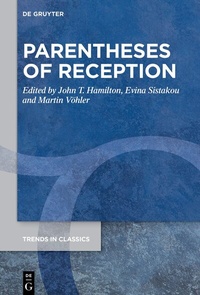
Parentheses of Reception
Description

The rhetorical figure of the parenthesis is proposed to reconsider classical reception as a site where Graeco-Roman antiquity is simultaneously 'in' and 'to the side of' the receptive work. The chapters in this volume offer fresh approaches to the history and theory of classical reception by considering parenthetic structures across eras, artistic media and disciplines.
More details
Other editions
Additional editions
Persons
John T. Hamilton , Harvard University, Cambridge, Mass. USA; Evina Sistakou , Aristotle University, Thessaloniki, Greece; Martin Vöhler , Aristotle University, Thessaloniki, Greece.
Content
- Intro
- Preface
- Contents
- List of Figures
- Introduction
- Part I: Parenthesis in Ancient Literature
- Roman Comedy and (Greek) Comedy
- Fragmenting a Conversation on otium: Catullus 51.1-16 as Parenthesis between Calvus and Ennius
- Silent Witnesses and Implausible Judgements: Echoes of Direct Speech in Catullus' Song of the Parcae (Catull. 64)
- Filling Narrative Gaps and Bracketing Information in (Pseudo)Senecan Tragedy
- Part II: Parenthesis in Modern Literature
- The 'Hidden' Flirt with Antiquity: A Parenthesis in C.P. Cavafy's Early Poetical Work
- A Part Apart: Niobe in Günter Grass's Tin Drum
- Lyric Digression, Parenthesis, Asides: Horace and Dylan
- Rethinking Ovidian Womanhood in Carol Ann Duffy's "Eurydice"
- Part III: Parenthesis in Theatre
- Three Witches - Three Unities: Aristotle in Macbeth
- Embracing Antiquity: Brecht's Antigone-Model 1948
- Part IV: Parenthesis in Scholarship
- Philology as Parenthesis: Philological Theory around 1800 and its Contemporary Potentials (Friedrich Schlegel, August Boeckh)
- Artemidorus and the Question of Method in Freud's Interpretation of Dreams
- Rachel Bespaloff Reads (Homer)
- Antiquity's Parenthesis and the Poetics of Dissociative Time: Political Outsideness and Futurity in and through Foucault's Cynic Parrhesia
- Part V: Parenthesis in Translation
- Translating for the Dead: Moshe Ha-Elion's Homeric Translations into Salonican Ladino
- Inside and Outside: David Hadbawnik's Verse Version of Vergil's Aeneid
- Part VI: Parenthesis in Art and Cinema
- Reversible Nestings of the Mythic and the Real (Velázquez, Feast of Bacchus)
- Illustration in and to the Side of Eighteenth-Century Antiquarianism
- Fragment-Bodies: Rodin's and Rilke's Torsos
- The Classics in Viennese Modernity: A Hesiodic Parenthesis in Gustav Klimt's Beethoven Frieze
- On Parenthetical Receptions of the Classical: Intermediality, Nesting, and the Gender of the Universal (Twombly's Achilles, Woodman's Daphne)
- Narrative and Parenthesis: From Homeric Simile to Cinematic Flashback
- List of Contributors
- Index
