

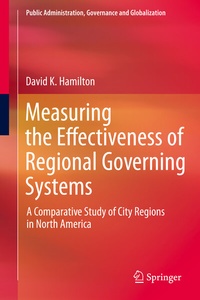
Measuring the Effectiveness of Regional Governing Systems
Description

Regional governance is a topical public policy issue and is receiving increased attention from scholars, government officials and civic leaders. As countries continue to urbanize and centralize economic functions and population in metropolitan regions, the traditional governing system is not equipped to handle policy issues that spill over local government boundaries. Governments have utilized four basic approaches to address the regional governing problem: consolidating governments, adding a regional tier, creating regional special districts, and functional cooperative approaches. The first two are structural approaches that require major (radical) changes to the governing system. The latter two are governance approaches that contemplate marginal changes to the existing governance structure and rely generally on cooperation with other governments and collaboration with the nongovernmental sector.
Canada and the United States have experimented with these basic forms of regional governance. This book is a systematic analysis of these basic forms as they have been experienced by North American cities. Utilizing cases from Canada and the United States, the book provides an in-depth analysis of the pros and cons of each approach to regional governance. This research provides an additional perspective on Canadian and U.S. regional governance and adds to the knowledge of Canadian and United States governing systems. This study contributes to the literature on the various approaches to regional governance as well as bringing together the most current literature on regional governance.
The author develops a framework of the values that a regional governing system should provide and measures to assess how well each basic approach achieves these values. Based on this assessment, he suggests an approach to regional governance for North American metropolitan areas that best achieves these values.
More details
Other editions
Additional editions
Content
- Intro
- Measuring the Effectiveness of Regional Governing Systems
- Preface
- Contents
- Chapter 1: Regional Governance in North America
- The Metropolitan Governance Problem
- Basic Regional Governing Systems
- Functions of a Regional Governing System
- Measuring the Effectiveness of Regional Governance Systems
- Purpose of the Book
- References
- Chapter 2: Local Government and Regionalism in North American: Background and Historical Development
- Development of Local Government in America
- Development of Local Government in Canada
- Efficiency and Economy Versus Access and Participation
- Provision of Local Government Services
- Local Government in the Intergovernmental System
- Local Government Political Power
- The Decentralization Movement
- Concluding Thoughts
- Notes
- References
- Chapter 3: Restructuring Governments in Urban Areas: First Iteration
- Pressures to Reform Local Government
- Annexation and Consolidation
- The Case of New York Consolidation
- Tiered Forms of Regional Government in the USA
- Regional Government in Canada
- Impact on Local Government in Ontario from the Toronto Restructuring
- Process of Restructuring Government
- Template for Ratification of Proposed Structural Changes
- Note
- References
- Chapter 4: Restructuring Government: The Abandonment of Metropolitan Government
- Events Leading up to the Restructuring of Toronto
- Opposition to the Toronto Amalgamation
- Amalgamation in Quebec
- Assessment of the Montreal Restructuring
- Business and Political Support for Radical Restructuring
- References
- Chapter 5: Cooperative and Collaborative Regionalism
- Cooperative Regionalism
- Collaboration with Nongovernmental Organizations
- Application of Regime Theory to the Regional Level
- Private Sector and Regionalism
- Elements of Regional Collaboration
- Public Sector Involvement and Support for Regional Collaboration
- Comparative Case Study of Collaborative Regionalism
- Notes
- References
- Chapter 6: Regional Governance by Special District
- Portland Regional District
- The Twin Cities Metropolitan Council
- Vancouver Regional Governance
- Regional Planning in Vancouver
- Providing Regional Services in Vancouver
- Advantages and Disadvantages of Regional Governance of the Vancouver Special District Model
- Concluding Thoughts
- References
- Chapter 7: The Costs of Radical Structural Change: The Case of Toronto and Hamilton
- Toronto Restructuring
- Organizing Services
- Downloading Services
- Financial Profile of the New City
- Hamilton Restructuring
- Financial and Administrative Profile
- Assessing the Costs of Radical Restructuring
- References
- Chapter 8: Measuring the Effectiveness of Regional Governing Systems
- Support for Centralized Governing Systems
- Consolidated Versus Tiered Centralized Governing Structure
- Support for Decentralized Governing Systems
- Evaluating Centralized and Decentralized Governing Systems on Service Delivery Measures
- Evaluating Centralized and Decentralized Governing Systems on Quality-of-Life Measures
- Disparities
- Economic Development
- Case of New York on Quality-of-Life Measures
- Conclusion
- References
- Chapter 9: Does Regionalism Detract from Local Democracy? The Impact of Government Scale on Participation
- Introduction
- Ways People Participate in Governance
- Participation and Regional Government
- Citizen Participation and Public Apathy
- Citizen Participation and Efficient Government
- Special Districts and Citizen Participation
- Community Attachment and Participation
- Centralization, Community Autonomy, and Participation
- Concluding Thoughts
- Notes
- References
- Chapter 10: Assessing the Future of Regional Governance in North America
- The Future of Regional Governance in North American Urban Areas
- The Future of Decentralized Regional Governing Systems
- A Model for the Future
- A European Union Model as Applied to Metropolitan Areas
- Determining the Preferred Regional Governing System
- The Bottom Line
- References
- Author Index
- Subject Index
