

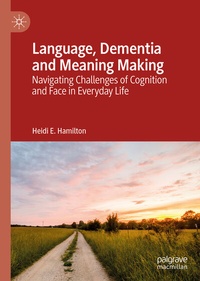
Language, Dementia and Meaning Making
Description

Reviews / Votes
"This book offers the most complex and up-to-date understanding of the social nature of human cognition. Hamilton takes us on a journey-at once personal and yet at once universal-from her first book on dementia and conversations to the present one on understanding memory as dynamic, evolving, fluid and fully sociolinguistic. This is a very necessary read for all scholars researching issues of memory, language and sociocognition." (Vaidehi Ramanathan, Professor of Linguistics, University of California, USA)
"In a deeply-researched discussion as remarkable for its clarity as for its emphasis on empathetic interaction, Hamilton asks these questions not only for us but also for our partners with dementia: How is it that we can say we know - and how do we use those memories we can access - to recognize and share our knowing in our efforts to make meaning when we are talking to another person? How do those efforts to make meaning help or hinder speakers with and without dementia in retaining self-worth, a positive self-image, a "face?" Hamilton draws on a lifetime of thought and research to involve readers with "the complexity of meaning making", whether the speaker is looking for a word, performing fragments of a song, recalling immediate events, or reconstituting previous aspects of ones' life." (Boyd H. Davis, Bonnie E. Cone Professor of Teaching in Applied Linguistics/English and Professor of Gerontology at University of North Carolina, Charlotte, USA)
More details
Other editions
Additional editions
Person
Content
Chapter 1: Knowing, remembering and performing in everyday life with dementia.- Chapter 2: Struggling to find the right words.- Chapter 3: Forgetting facts about oneself.- Chapter 4: Recalling what just happened.- Chapter 5: Recounting personal experiences from long ago.- Chapter 6: Engaging with physical objects in the here-and-now.- Chapter 7: Performing memory.- Chapter 8: Connections.
