

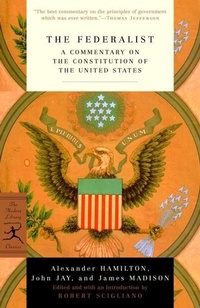
The Federalist
A Commentary on the Constitution of the United States
Published on 3. November 2010
688 pages
978-0-307-76975-6 (ISBN)
Description

The series of essays that comprise The Federalist constitutes one of the key texts of the American Revolution and the democratic system created in the wake of independence. Written in 1787 and 1788 by Alexander Hamilton, James Madison, and John Jay to promote the ratification of the proposed Constitution, these papers stand as perhaps the most eloquent testimonial to democracy that exists. They describe the ideas behind the American system of government: the separation of powers; the organization of Congress; the respective positions of the executive, legislative, and judiciary; and much more. The Federalist remains essential reading for anyone interested in politics and government, and indeed for anyone seeking a foundational statement about democracy and America.
This new edition of The Federalist is edited by Robert Scigliano, a professor in the political science department at Boston College. His substantive Introduction sheds clarifying new light on the historical context and meaning of The Federalist. Scigliano also provides a fresh and definitive analysis of the disputed authorship of several sections of this crucial work.
This new edition of The Federalist is edited by Robert Scigliano, a professor in the political science department at Boston College. His substantive Introduction sheds clarifying new light on the historical context and meaning of The Federalist. Scigliano also provides a fresh and definitive analysis of the disputed authorship of several sections of this crucial work.
More details
Other editions
Additional editions
Alexander Hamilton | John Jay | James Madison
The Federalist
A Commentary on the Constitution of the United States
Book
09/2001
Modern Library Inc
€21.30
Article exhausted; check different version

Alexander Hamilton | etc.
Federalist
Book
11/2000
Random House Inc
€39.83
Article exhausted; check different version
Persons
Robert Scigliano is a professor in the political science department at Boston College and a leading authority on the Constitution.
Content
- Intro
- Title Page
- Copyright
- Dedication
- Editor's Introduction
- Contents
- No. 1 - Deliberation on a new constitution. -Hamilton
- No. 2 - The question: one government or separate confederacies.-Jay
- No. 3 - Less likely to give just causes of war.-Jay
- No. 4 - Less likely to invite hostility and insult.-Jay
- No. 5 - Separate confederacies would lead to quarrels and wars.-Jay
- No. 6 - Wars would follow if disunited.-Hamilton
- No. 7 - Causes of war in a disunited America. -Hamilton
- No. 8 - Consequences of such wars.-Hamilton
- No. 9 - Constitution consolidates the states into one confederate republic.-Hamilton
- No. 10 - An extensive republic a remedy for mischiefs of faction.-Madison
- No. 11 - Utility of union regarding commerce. -Hamilton
- No. 12 - Its utility regarding revenue.-Hamilton
- No. 13 - Its utility regarding government expenses. -Hamilton
- No. 14 - Proposed union not too large for republican government.-Madison
- No. 15 - Its great defect: can only legislate for states. -Hamilton
- No. 16 - The need for a government that reaches persons.-Hamilton
- No. 17 - The proposed government will not absorb state powers.-Hamilton
- No. 18 - Examples of ancient confederations. -Madison (and Hamilton)
- No. 19 - Examples of existing ones.-Madison (and Hamilton)
- No. 20 - Conclusion: such confederations wrong in theory, violent in practice.-Madison (and Hamilton)
- No. 21 - Other defects of present confederation. -Hamilton
- No. 22 - Continuation.-Hamilton
- No. 23 - Objects of the national government. Common defense.-Hamilton
- No. 24 - Government needs power to have such armies. -Hamilton
- No. 25 - The power should be in national government, not states.-Hamilton
- No. 26 - Neither Britain nor any state prohibits such armies.-Hamilton
- No. 27 - Military force less likely to be used to execute laws than in opponents' plan.-Hamilton
- No. 28 - Military force will be needed at times to preserve public peace.-Hamilton
- No. 29 - National government must have control of state militia.-Hamilton: HAMILTON
- No. 30 - The power must be unrestricted.-Hamilton
- No. 31 - Fears of federal usurpation considered. -Hamilton
- No. 32 - States will have concurrent power to tax. -Hamilton
- No. 33 - The sweeping and supremacy clauses explained.-Hamilton
- No. 34 - Financial needs of the new government. -Hamilton
- No. 35 - The House will attend to all interests and feelings.-Hamilton
- No. 36 - Several matters regarding taxation considered.-Hamilton
- No. 37 - Introduction: the Convention's difficulties. -Madison
- No. 38 - Continued.-Madison
- No. 39 - Constitution is strictly republican
- is both federal and national.-Madison
- No. 40 - Whether Convention was authorized to propose it.-Madison
- No. 41 - Powers vested: foreign safety (including taxation).-Madison
- No. 42 - Powers: foreign relations, relations among states.-Madison
- No. 43 - Miscellaneous powers.-Madison
- No. 44 - Restrictions on the states, the sweeping clause.-Madison
- No. 45 - Whether the mass of powers will endanger the states.-Madison
- No. 46 - Same: which level of government people will favor.-Madison
- No. 47 - Complete separation of powers not required.-Madison
- No. 48 - Some blending of powers is necessary. -Madison
- No. 49 - How to maintain separation: special conventions?-Madison (or Hamilton)
- No. 50 - How to maintain: periodic conventions? -Madison (or Hamilton)
- No. 51 - How to maintain: make the parts check each other. Also, a federal system divides power further.-Madison (or Hamilton)
- No. 52 - Qualifications: electors, elected. Two-year term: safe.-Madison (or Hamilton)
- No. 53 - Two-year term: necessary or useful. -Madison (or Hamilton)
- No. 54 - Apportionment: counting slaves for representation.-Madison (or Hamilton)
- No. 55 - House size: large enough to be safe. -Madison (or Hamilton)
- No. 56 - Large enough to know people's interests. -Madison (or Hamilton)
- No. 57 - Will be sympathetic to mass of people. -Madison (or Hamilton)
- No. 58 - Will increase with population.-Madison (or Hamilton)
- No. 59 - Congressional regulation of elections. -Hamilton
- No. 60 - Congressional regulation.-Hamilton
- No. 61 - Congressional regulation.-Hamilton
- No. 62 - Qualifications of members
- election
- equal representation
- size and duration in office. -Madison (or Hamilton)
- No. 63 - Size and duration, continued.-Madison (or Hamilton)
- No. 64 - Treaty power.-Jay
- No. 65 - Other powers: consent to executive appointments
- impeachments.-Hamilton
- No. 66 - Impeachments, continued.-Hamilton
- No. 67 - Misrepresentations, e.g., power to fill Senate vacancies.-Hamilton
- No. 68 - Method of election.-Hamilton
- No. 69 - Compared with British king and New York governor.-Hamilton
- No. 70 - Energy in the executive. First ingredient: Unity.-Hamilton
- No. 71 - Second ingredient: duration in office-four-year term.-Hamilton
- No. 72 - Duration in office, continued: reeligibility. -Hamilton
- No. 73 - Third ingredient-adequate provision for support. Fourth ingredient-competent powers: the veto.-Hamilton
- No. 74 - Competent powers, continued: commander in chief, require opinions, pardons.-Hamilton
- No. 75 - Competent powers: Treaties.-Hamilton
- No. 76 - Powers: Appointments.-Hamilton
- No. 77 - Powers: Appointments, continued. Other powers.-Hamilton
- No. 78 - Duration in office: good behavior. Why needed.-Hamilton
- No. 79 - Provisions for support and for removal. -Hamilton
- No. 80 - Extent of the judicial power.-Hamilton
- No. 81 - The Supreme Court and inferior courts. -Hamilton
- No. 82 - Relations between federal and state courts. -Hamilton
- No. 83 - Trial by jury.-Hamilton
- No. 84 - Absence of Bill of Rights, liberty of press, etc.-Hamilton
- No. 85 - Not perfect but good. Should adopt and seek to amend.-Hamilton
- Appendices - Declaration of Independence, July 4, 1776
- Articles of Confederation, March 1, 1781
- Constitution and Amendments, March 4, 1789-May 7, 1992
- Select Bibliography
