

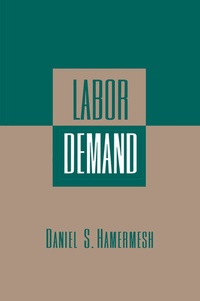
Labor Demand
1st Edition
Published on 20. July 2022
460 pages
978-0-691-22299-8 (ISBN)
Description

In this book Daniel Hamermesh provides the first comprehensive picture of the disparate field of labor demand. The author reviews both the static and dynamic theories of labor demand, and provides evaluative summaries of the available empirical research in these two subject areas. Moreover, he uses both theory and evidence to establish a generalized framework for analyzing the impact of policies such as minimum wages, payroll taxes, job- security measures, unemployment insurance, and others. Covering every aspect of labor demand, this book uses material from a wide range of countries.
More details
Other editions
Additional editions

Daniel S. Hamermesh
Labor Demand
Book
01/1996
Princeton University Press
€84.90
Shipment within 10-20 days
Daniel S. Hamermesh
Labor Demand
Book
03/1993
Princeton University Press
€86.66
Article exhausted; check different version
Person
Daniel S. Hamermesh is Edward Everett Hale Centennial Professor of Economics at the University of Texas at Austin. He is the coauthor of The Economics of Work and Pay, and he is a major contributor to the Handbook of Labor Economics.
Content
- Cover Page
- Title Page
- Copyright Page
- Dedication Page
- Contents
- List of Figures
- List of Tables
- Preface
- Chapter One: The Study of Labor Demand
- I. What Is the Demand for Labor?
- II. Is Labor Demand Merely a Branch of Production Theory?
- III. Why Synthesize the Study of Labor Demand, and Why Do It Now?
- IV. What Will Be Considered, and What Will Not Be?
- Part One : The Static Demand for Labor
- Chapter Two: The Static Theory of Labor Demand
- I. Introduction
- II. Labor Demand with One Input
- III. Labor Demand with Two Inputs
- IV. Labor Demand with Several Inputs
- V. Labor Demand in Nonprofit Organizations
- VI. The Distinction between Workers and Hours, and the Cost of Labor
- VII. The Demand for Hours in a Heterogeneous Work Force
- VIII. Summary, and Prospects for the Theory of Static Labor Demand
- Chapter Three: Wage, Employment, and Substitution Elasticities
- I. What We Need to Infer
- II. Problems of Data, Method, and Classification
- III. Estimates of the Elasticity of Demand for Homogeneous Labor
- IV. Studies of the Demand for Heterogeneous Labor
- V. Studies of Substitution between Workers and Hours
- VI. Conclusions-What We Know, and What We Don't Know
- Chapter Four: Employment Demand and the Birth and Death of Firms
- I. Introduction
- II. The Birth of Plants
- III The Death of Plants
- IV. Employment Shocks and the Plow of Jobs
- V. The Role of Wages in Plant Openings and Closings
- VI. Conclusions and Extensions
- Chapter Five: Static Demand Policies
- I. Introduction
- II. Classifying Policies That Affect the Equilibrium Demand for Labor
- III. P-General Policies
- IV. P-Specific Policies
- V. Type Q Policies
- VI. Conclusions and New Directions
- Appendix
- Part Two : The Dynamic Demand for Labor
- Chapter Six: The Dynamic Theory of Labor Demand
- I. Introduction-the Nature of Dynamics
- II. The Costs of Adjusting Labor Demand-Characteristics and Direct Evidence
- III. Adjustment of the Demand for Hohiogeneous Labor-No Cooperating Factors
- IV. Adjusting the Demand for Employment and Hours
- V. Adjustment with Several Factors of Production
- VI. Implicit Contracts, Temporary Layoffs, and Other Margins
- VII. Effort, Productivity, and Demand Shocks
- VIII. Conclusions, and Prospects for the Theory of Dynamic Labor Demand
- Chapter Seven: Estimates of the Dynamics of Employment and Hours
- I. Dynamic Issues
- II. The Speed of Adjustment of Demand for Workers and Hours
- III. Correlates of the Speed of Adjustment of Labor Demand
- IV. The Size and Structure of Adjustment Costs
- V. Returns to Labor and to Scale
- VI. Conclusions and Difficulties
- Chapter Eight: Dynamic Demand Policies
- I. Purposes and Typology
- II. Policies Affecting Hiring Costs
- III. Policies Affecting the Cost of Layoffs
- IV. Policies Affecting Internal Adjustment Costs
- V. Policies Affecting the Dynamics of Employment and Hours
- VI. Conclusions, and the Need for Serious Evaluation
- Part Three: Some Applications
- Chapter Nine: Labor Demand and the Macroeconomy
- I. Introduction
- II. Labor Demand and Macroeconomic Equilibria
- III. Labor Demand, Technical Change, and Wage Inequality
- IV. Job Creation and Labor Demand
- V. Conclusions
- Chapter Ten: Labor Demand and the Economics of Development
- I. Introduction-Is This Chapter Necessary?
- II. Labor Demand in the Model of the Agricultural Household
- III. Market Interventions in the Modern Sector
- IV. Choice of Technology-Scarce Factors in Economic Development
- V. Other Applications of Labor Demand in Development
- VI. Conclusions
- Chapter Eleven: Conclusions, Data Requirements, and New Directions
- I. What Has Been Accomplished?
- II. The Need for Improved Data
- III. Where Should the Study of Labor Demand Go?
- References
- Index
