

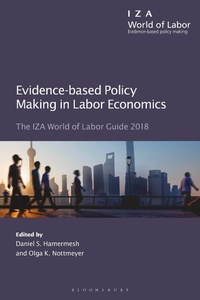
Evidence-based Policy Making in Labor Economics
The Iza World of Labor Guide 2018
1st Edition
Published on 20. September 2018
272 pages
978-1-4729-6399-4 (ISBN)
Description

IZA World of Labor provides a reliable and concise guide to the best thinking and research on labor economics for decision makers, advisors, and interested citizens concerned with labor market issues worldwide.
Written by well-known labor economists, this volume presents research findings on key policy issues in a compact and readable format, as distillations of comprehensive evidence-based research with concise policy recommendations.
Designed to act as a quick reference, this guide brings together summaries of over 100 articles published on the IZA World of Labor website to give busy policy advisors, journalists, researchers, policymakers and concerned citizens in every country around the world instant access to authoritative guidance on key policy topics. These include summaries of the current state of specific country labor markets; the effects of climate change; part-time employment; multiple job-holding; motherhood wage penalty; big data; and labor market outcomes of trans people.
Written by well-known labor economists, this volume presents research findings on key policy issues in a compact and readable format, as distillations of comprehensive evidence-based research with concise policy recommendations.
Designed to act as a quick reference, this guide brings together summaries of over 100 articles published on the IZA World of Labor website to give busy policy advisors, journalists, researchers, policymakers and concerned citizens in every country around the world instant access to authoritative guidance on key policy topics. These include summaries of the current state of specific country labor markets; the effects of climate change; part-time employment; multiple job-holding; motherhood wage penalty; big data; and labor market outcomes of trans people.
More details
Edition
1. Auflage
Language
English
Place of publication
London
United Kingdom
Target group
Professional and scholarly
ISBN-13
978-1-4729-6399-4 (9781472963994)
Copyright in bibliographic data and cover images is held by Nielsen Book Services Limited or by the publishers or by their respective licensors: all rights reserved.
Schweitzer Classification
Other editions
Additional editions
Daniel S. Hamermesh | Olga K. Nottmeyer
Evidence-based Policy Making in Labor Economics
The IZA World of Labor Guide 2018
Book
09/2018
Bloomsbury Information
€50.95
Article exhausted; check different version
Persons
Daniel S. Hamermesh is Distinguished Scholar, Barnard College, USA, Emeritus Professor of Economics at the University of Texas at Austin, USA, and at Royal Holloway University of London, UK, and Editor-in-Chief of IZA World of Labor
Olga K. Nottmeyer holds a PhD in Economics and is Managing Editor of IZA World of Labor
Olga K. Nottmeyer holds a PhD in Economics and is Managing Editor of IZA World of Labor
Content
- Half-title
- Title
- Copyright
- Contents
- Acknowledgments
- Competing interests
- About IZA
- Editorial board
- Introduction
- Section I: Program evaluation
- 1. Maternity leave versus early childcare-What are the long-term consequences for children?
- 2. How to reduce workplace absenteeism
- 3. The influence of occupational licensing and regulation
- 4. Job search monitoring and assistance for the unemployed
- 5. Do post-prison job opportunities reduce recidivism?
- Section II: Behavioral and personnel economics
- 6. Multitasking at work: Do firms get what they pay for?
- 7. Relative pay, effort, and labor supply
- 8. Working in family firms
- 9. The value of hiring through employee referrals in developed countries
- 10. Gender differences in corporate hierarchies
- 11. Production spillovers: Are they valued?
- 12. Skill utilization at work: Opportunity and motivation
- 13. Relative deprivation in the labor market
- Section III: Migration and ethnicity
- 14. Why does unemployment differ for immigrants?
- 15. Family-friendly and human-capital-based immigration policy
- 16. The portability of social benefits across borders
- 17. Racial wage differentials in developed countries
- 18. Measuring flows of international migration
- 19. Demographic and economic determinants of migration
- 20. Is high-skilled migration harmful to tax systems' progressivity?
- 21. Economic effects of differences in dialect
- Section IV: Labor markets and institutions
- 22. Trade and labor markets: Lessons from China's rise
- 23. How does monetary policy affect labor demand and labor productivity?
- 24. Why does part-time employment increase in recessions?
- 25. Aggregate labor productivity
- 26. Firm size and business cycles
- 27. Working hours: Past, present, and future
- 28. Competitiveness, labor market institutions, and monetary policy
- 29. Hours vs employment in response to demand shocks
- 30. Unemployment and the role of supranational policies
- 31. Compensating displaced workers
- 32. How should job displacement wage losses be insured?
- 33. Why is youth unemployment so high and different across countries?
- 34. Multiple job-holding: Career pathway or dire straits?
- 35. Effects of regulating international trade on firms and workers
- 36. Defining informality vs mitigating its negative effects
- 37. International trade and economic insecurity
- 38. Do firms' wage-setting powers increase during recessions?
- 39. How does international trade affect household welfare?
- Section V: Transition and emerging economies
- 40. One-company towns: Scale and consequences
- 41. The automotive industry in Central Europe: A success?
- 42. The changing nature of jobs in Central and Eastern Europe
- 43. Do trade unions in Central and Eastern Europe make a difference?
- 44. Returns to language skills in transition economies
- 45. Wage policies in the public sector during wholesale privatization
- 46. Can diversity encourage entrepreneurship in transition economies?
- 47. Political connectedness and formal finance in transition economies
- 48. Youth unemployment in transition economies
- 49. The happiness gap between transition and non-transition countries
- Section VI: Development
- 50. Managerial quality and worker productivity in developing countries
- 51. Adult literacy programs in developing countries
- 52. Microfinance and rural non-farm employment in developing countries
- 53. Fighting employment informality with schooling
- 54. How digital payments can benefit entrepreneurs
- 55. Is teacher certification an effective tool for developing countries?
- Section VII: Environment
- 56. Does hot weather affect human fertility?
- 57. Climate change and the allocation of time
- 58. Air pollution and worker productivity
- 59 Air pollution, educational achievements, and human capital formation
- Section VIII: Education and human capital
- 60. The role of cognitive and socio-emotional skills in labor markets
- 61. The value of financial literacy and financial education for workers
- 62. Rethinking the skills gap
- 63. Does education strengthen the life skills of adolescents?
- 64. Do social interactions in the classroom improve academic attainment?
- 65. Does homeownership affect education outcomes?
- 66. Central exit exams improve student outcomes
- Section IX: Demography, family, and gender
- 67. Trans people, well-being, and labor market outcomes
- 68. How does the one child policy impact social and economic outcomes?
- 69. The complex effects of retirement on health
- 70. The rise of secularism and its economic consequences
- 71. Motherhood wage penalty may affect pronatalist policies
- 72. How do candidates' looks affect their election chances?
- 73. Fertility decisions and alternative types of childcare
- 74. Do anti-discrimination policies work?
- Section X: Data and methods
- 75. The need for and use of panel data
- 76. Measuring employment and unemployment
- 77. What is the role for molecular genetic data in public policy?
- 78. Measuring individual risk preferences
- 79. Gross domestic product: Are other measures needed?
- 80. Big Data in economics
- 81. Replication in labor economics
- 82. The usefulness of experiments
- Section XI: Country labor markets
- 83. The labor market in Australia, 2000-2016
- 84. The labor market in Austria, 2000-2016
- 85. The labor market in Belgium, 2000-2016
- 86. The labor market in Brazil, 2001-2015
- 87. The labor market in Canada, 2000-2016
- 88. The Chinese labor market, 2000-2016
- 89. The Danish labor market, 2000-2016
- 90. The labor market in Finland, 2000-2016
- 91. The changing of the French labor market, 2000-2017
- 92. The labor market in Germany, 2000-2016
- 93. The labor market in India since the 1990s
- 94. The labor market in Ireland, 2000-2016
- 95. The labor market in Israel, 2000-2016
- 96. The labor market in Italy, 2000-2016
- 97. The labor market in Japan, 2000-2016
- 98. The labor market in the Netherlands, 2001-2016
- 99. The labor market in New Zealand, 2000-2017
- 100. The labor market in Norway, 2000-2016
- 101. The labor market in Poland, 2000-2016
- 102. The labor market in South Korea, 2000-2016
- 103. The labor market in Spain, 2002-2016
- 104. The labor market in Sweden since the 1990s
- 105. The labor market in Switzerland, 2000-2016
- 106. The labor market in the UK, 2000-2016
- 107. The labor market in the US, 2000-2016
- Author index
- Subject index
