

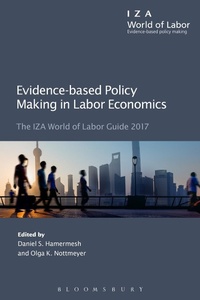
Evidence-based Policy Making in Labor Economics
The Iza World of Labor Guide 2017
1st Edition
Published on 7. September 2017
320 pages
978-1-4729-5071-0 (ISBN)
Description

Evidence-based Policy Making in Labor Economics distills and condenses the best thinking and research on labor economic issues to enable decision makers make better informed policy decisions.
Written by well-known labor economists worldwide, research findings on key policy issues are presented in a compact and readable format, as distillations of comprehensive evidence-based research with concise policy recommendations. Designed to act as a quick reference, this guide brings together summaries of over 100 articles published on IZA World of Labor to give busy policymakers and political advisors worldwide instant access to reliable and up-to-date guidance on key policy topics including: asylum and immigration policy, youth unemployment and life-long learning, innovation, and technological change.
Written by well-known labor economists worldwide, research findings on key policy issues are presented in a compact and readable format, as distillations of comprehensive evidence-based research with concise policy recommendations. Designed to act as a quick reference, this guide brings together summaries of over 100 articles published on IZA World of Labor to give busy policymakers and political advisors worldwide instant access to reliable and up-to-date guidance on key policy topics including: asylum and immigration policy, youth unemployment and life-long learning, innovation, and technological change.
More details
Edition
1. Auflage
Language
English
Place of publication
London
United Kingdom
Target group
Professional and scholarly
ISBN-13
978-1-4729-5071-0 (9781472950710)
Copyright in bibliographic data and cover images is held by Nielsen Book Services Limited or by the publishers or by their respective licensors: all rights reserved.
Schweitzer Classification
Other editions
Additional editions
Daniel S. Hamermesh | Olga K. Nottmeyer
Evidence-based Policy Making in Labor Economics
The IZA World of Labor Guide 2017
Book
09/2017
Bloomsbury Information
€50.95
Shipment within 10-20 days
Persons
Daniel S. Hamermesh is Professor in Economics at Royal Holloway University of London, UK, Sue Killam Professor Emeritus in the Foundation of Economics at the University of Texas at Austin, USA, and Editor-in-Chief of IZA World of Labor.
Olga K. Nottmeyer holds a PhD in Economics and is Managing Editor of IZA World of Labor.
Olga K. Nottmeyer holds a PhD in Economics and is Managing Editor of IZA World of Labor.
Content
- Cover
- Half-title
- Title
- Copyright
- Contents
- Acknowledgments
- Competing interests
- Editorial board
- Introduction
- Section: Program evaluation
- 1 Job search requirements for older unemployed workers
- 2 Start-up subsidies for the unemployed: Opportunities and limitations
- 3 Parental leave and maternal labor supply
- 4 Financing high-potential entrepreneurship
- 5 The dynamics of training programs for the unemployed
- 6 Labor market policies, unemployment, and identity
- 7 How can temporary work agencies provide more training?
- 8 Public or private job placement services-Are private ones more effective?
- 9 What effect do vocational training vouchers have on the unemployed?
- 10 Do in-work benefits work for low-skilled workers?
- 11 How to minimize lock-in effects of programs for unemployed workers
- Section II: Behavioral and personnel economics
- 12 Working-time autonomy as a management practice
- 13 Does government spending crowd out voluntary labor and donations?
- 14 The labor market consequences of impatience
- 15 Should firms allow workers to choose their own wage?
- 16 Do social interactions in the workplace lead to productivity spillover among co-workers?
- 17 Internal hiring or external recruitment?
- 18 Profit sharing: Consequences for workers
- 19 Incentives for prosocial activities
- 20 Are overhead costs a good guide for charitable giving?
- 21 Employee incentives: Bonuses or penalties?
- 22 Are happy workers more productive?
- 23 How do social networks affect labor markets?
- 24 The pros and cons of workplace tournaments
- 25 Can firms oversee more workers with fewermanagers?
- Section III: Migration and ethnicity
- 26 Legalizing undocumented immigrants
- 27 Integrating refugees into labor markets
- 28 Where do immigrants retire to?
- 29 How immigration affects investment and productivity in host and home countries
- 30 What are the consequences of regularizing undocumented immigrants?
- 31 Feminization of migration and trends in remittances
- 32 The effect of emigration on home-country political institutions
- 33 Ethnic networks and location choice of immigrants
- 34 How does migration affect child labor in sending countries?
- 35 Migration and female genital mutilation
- 36 Can market mechanisms solve the refugee crisis?
- 37 Ethnic enclaves and immigrant economic integration
- 38 The changing nature of citizenship legislation
- 39 Immigrants' occupational mobility-Down and back up again
- Section IV: Labor markets and institutions
- 40 Corporate income taxes and entrepreneurship
- 41 Do skills matter for wage inequality?
- 42 The effects of public sector employment on the economy
- 43 Income inequality and social origins
- 44 Do youths graduating in a recession incur permanent losses?
- 45 Effects of entering adulthood during a recession
- 46 Does broadband infrastructure boost employment?
- 47 Do global value chains create jobs?
- 48 Are part-time workers less productive and underpaid?
- 49 How is new technology changing job design?
- 50 The rise and fall of piecework
- 51 The effect of the internet on voting behavior
- 52 The effects of minimum wages on youth employment and income
- 53 Privatizing sick pay: Does it work?
- 54 Does employee ownership improve performance?
- 55 The economics of employment tribunals
- 56 How important is career information and advice?
- 57 Do product market reforms stimulate employment, investment, and innovation?
- 58 Efficiency wages: Variants and implications
- 59 Low-wage employment
- 60 Conditions for high-potential female entrepreneurship
- Section V: Transition and emerging economies
- 61 Do institutions matter for entrepreneurial development?
- 62 The mortality crisis in transition economies
- 63 Inequality and informality in transition and emerging countries
- 64 Institutions and the support for market reforms
- 65 Foreign direct investment and employment in transition economies
- 66 Cash wage payments in transition economies:Consequences of envelope wages
- 67 Should agricultural employment in transition economies be encouraged?
- 68 Childcare expansion and mothers' employment in post-socialist countries
- 69 Family structure and children's educational attainment in transition economies
- 70 Female poverty and intrahousehold inequality in transition economies
- 71 Encouraging women's labor force participation in transition countries
- 72 Does religiosity explain economic outcomes?
- 73 Upgrading technology in Central and Eastern European economies
- 74 Wage coordination in new and old EU member states
- 75 The effects of privatization on exports and jobs
- Section VI: Development
- 76 Does unemployment insurance offer incentives to take jobs in the formal sector?
- 77 Employment and rebellion in conflicted and fragile states
- 78 Do economic reforms hurt or help the informal labor market?
- 79 Trade liberalization and poverty reduction
- 80 Access to public transport and labor informality
- 81 Do family and kinship networks support entrepreneurs?
- 82 Do payroll tax cuts boost formal jobs in developing countries?
- 83 What can be expected from productive inclusion programs?
- 84 Can cash transfers reduce child labor?
- 85 Can higher education reduce inequality in developingcountries?
- 86 How do adult returns to schooling affect children's enrollment?
- 87 Are apprenticeships beneficia lin sub-Saharan Africa?
- Section VII: Environment
- 88 Impacts of regulation on eco-innovation and job creation
- 89 Climate change, natural disasters, and migration
- Section VIII: Education and human capital
- 90 How manipulating test scores affects school accountability and student achievement
- 91 Can universal preschool increase labor supply of mothers?
- 92 Income contingent loans in higher education financing
- 93 Age at school entry: How old is old enough?
- 94 For long-term economic development, only skills matter
- 95 How effective is compulsory schooling as a policy instrument?
- 96 Skills or jobs-Which comes first?
- 97 Do schooling reforms also improve long-term health?
- 98 University autonomy: Improving educational output
- 99 Parental employment and children's academic achievement
- 100 What is the economic value of literacy and numeracy?
- Section IX: Demography, family, and gender
- 101 The relationship between recessions and health
- 102 Gender differences in risk attitudes
- 103 Should common law marriage be abolished?
- 104 Is maternal employment related to childhood obesity?
- 105 Gender wage discrimination
- 106 Disability and labor market outcomes
- 107 Female education and its impact on fertility
- 108 The effects of recessions on family formation
- 109 Gender differences in competitiveness
- 110 The economics of mental health
- 111 Gender differences in wages and leadership
- 112 Do child care policies increase maternal labor supply?
- 113 Women's labor force participation
- 114 How does grandparent childcare affect labor supply?
- Section X: Data and methods
- 115 Using instrumental variables to establish causality
- 116 Measuring entrepreneurship: Type, motivation, and growth
- 117 Meta-regression analysis: Producing credible estimates from diverse evidence
- 118 Identifying and measuring economic discrimination
- 119 Disentangling policy effects into causal channels
- 120 Why do we need longitudinal survey data?
- 121 Maximum likelihood and economic modeling
- 122 Can "happiness data" help evaluate economic policies?
- 123 Estimating the return to schooling using the Mincer equation
- 124 Gravity models: A tool for migration analysis
- 125 Performance measures and worker productivity
- 126 Using linear regression to establish empirical relationships
- 127 Can lab experiments help design personnel policies?
- Author index
- Subject index
