

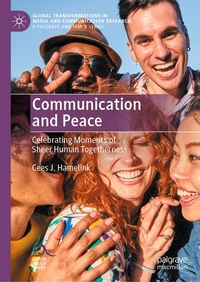
Communication and Peace
Description

This book provides a robust conceptualization of peace. Hamelink defines peace as conceived of moments of celebrating human togetherness, with deep fractures that polarize society standing in the way of collectively celebrating togetherness and posing a serious existential risk to humanity. 'Deep dialogue' is the form of human cooperative communication that is needed to build communities that can overcome polarization. This is the most difficult form of human conversation as it is based upon trust, mutuality, patience and freedom, and requires safe, non-threatening spaces, but this book explains how to overcome the essential obstacles that prevent this dialogue. To curate a 'deep dialogue' we must turn to humanity's unique resource: our ability to communicate pro-socially and cooperatively.
Reviews / Votes
"For far too many media and communication scholars, the notion of "peace" is an unexamined, ghostly North Star. In this unique, scholarly and personal exploratory expedition Cees J. Hamelink dramatically remedies such a troubling and debilitating vacuum." (Oliver Boyd-Barrett, Professor Emeritus, Bowling Green State University, USA)"We live in a world of increasingly perilous global crises. It is imperative that we better understand the roles and responsibilities of communication in, for and about peace. Cees J. Hamelink provides a refreshingly accessible, thoughtful and panoramic entree into this urgent field. He makes a persuasive case for deep dialogue and compassion-filled communication as fundamental to both the practice and pursuit of peace." (Simon Cottle, Professor of Media and Communication, Cardiff University, UK)
More details
Other editions
Additional editions
Person
Cees J. Hamelink is Emeritus Professor of Global Communication at the University of Amsterdam, Netherlands. He is also Athena Professor of Human Rights and Public Health at the Vrije Universiteit, Amsterdam, Netherlands. He is Honorary President of the International Association for Media and Communication Research (IAMCR) and has authored 18 monographs on media, culture, and communication rights.
