

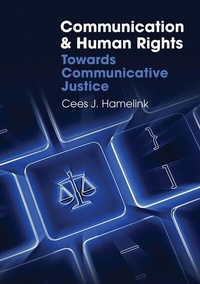
Communication and Human Rights
Description

In this book, Cees J. Hamelink guides the reader through the historical evolution of communication and human rights. In this original framework, he discusses topics such as the right to communicate and freedom of expression, as well as major challenges posed by the environmental crisis and digital technologies. With authority, he passionately argues that 'communicative justice' is the ultimate goal of applying the international human rights regime to different forms of communication. This goal can only be achieved if we manage to move from the prevailing 'thin' liberal conception of human rights to a 'thick' cosmopolitan conception of them.
Written by one of the world's leading scholars in this area, this wide-ranging book will be of interest to students of media and communication, human rights scholars, as well as practitioners, activists and anyone interested in applying the notion of justice to the basis of human existence: communication.
More details
Other editions
Additional editions
Person
Content
Preface
It will be the dominated and excluded themselves who will be in charge of constructing a new symmetry; it will be a new real, historical, critical, consensual community of communication.
Enrique Dussel
The question that inspired me to write this book is, how should we communicate with each other in order to live and flourish together? At the heart of this question I found the permanent challenge presented by the two types of power that are intrinsic to human life: destructive and constructive power. Power can be conceived of not only in the adversarial and competitive sense but can also, in the spirit of mutuality and solidarity, be seen as a reciprocal process of empowerment (Freire, 1970, 69). Hannah Arendt saw power as 'the human ability not just to act but to act in concert' (1968, 44). Power can both destroy and build human togetherness. The abuse of power ruins compassion, whereas the other face of power strengthens it. To be effective, both types of power need communication. The international human rights regime that developed after the Second World War focused primarily on the protection of all against the abuse of power by governments, governmental agencies, judiciary institutions, corporate entities and powerful individuals. Such protective provisions encompass recognition of the inherent dignity and the equal and inalienable rights of all members of the human family, the right to life, liberty and security of the person, the right not to be subjected to torture or to cruel, inhuman or degrading treatment or punishment, and the right not to be subjected to arbitrary arrest, detention or exile. Human rights also defend constructive power and self-empowerment through provisions on the freedom of movement, the right to marry and to found a family, the freedom of thought, conscience and religion, the freedom of opinion and expression, and the right to take part in the government of one's country. In Media and Conflict (Hamelink, 2011) I focused on the destructive power of communication in processes of escalating evil. In Communication and Peace (Hamelink, 2019) I discussed the constructive power of communication to create 'sheer human togetherness' (Hannah Arendt) through 'deep dialogue'. What remained on my agenda was the question of how to develop a mode of communication that would do justice to the human capacity for compassion. Since compassion is central to human rights, I want to explore whether the international human rights regime can guide us to a practice of communicative justice.
The opportunity offered by Polity Press to explore the significance of the relationship between communication and human rights posed a peculiar challenge because I had already written so much on the topic. Drawing on material I had developed over the past years I would have to extend that writing and thinking into a new perspective on the connection between communication and human rights. I wanted to find out why so little of what was on paper - often in abstract moral language - found its way into concrete communicative behaviour. Why could we not manage to translate the guidance inherent to the principles in the international human rights regime into a human rights-based communication practice?
Accordingly, I first set out to examine the values that had guided communication before human rights were encoded in international law after the Second World War. From there I followed developments until the United Nations World Summit on the Information Society in the early twenty-first century and dusted off the debates on the controversial issue of a right to communicate. I began to see what had gone wrong. In most work on communication and human rights we had ignored Article 28 of the Universal Declaration of Human Rights, which provides that 'Everyone is entitled to a social and international order in which the rights and freedoms set forth in this Declaration can be fully realized.' Human rights hold the promise of a fairer and more just future. Human communication holds the promise of mutual understanding as the basis of a world in which we can flourish together. These promises confront the reality of today's social and international order in which justice and understanding often seem part of a distant future. The war that erupted in Eastern Europe in early 2022 is a depressing reminder of how human rights claims clash with destructive power. Human rights are on a collision course with a world of extractive, exploitative and inegalitarian economics and politics, with colonial practices that continue unhindered and with impunity, and with racism that keeps haunting black lives. Human rights provide protection of free speech. But however crucial this may be, in the prevailing social order and its political and economic interests this protection is symbolic only. It barks but it does not bite. Such protection will be discretional and usually to the advantage of the winners. In societies that exclude and degrade people, human rights are the eternal losers.
In 2022, we live in a world in which the human rights claims remain wishful thinking. They can only be realized if we position them in a social and international order that fundamentally differs from the prevailing inegalitarian, abusive and predatory order. The connection between communication and human rights implies that there should be symmetry in the communicative actions between humans. This can only be realized when we liberate ourselves from exploitative, oppressive human relations and transform them into a convivial and caring order. The transformation to a human rights friendly social order demands that we reflect on the question of whether the societal arrangement that prevails in our life measures up to the standards that human rights set out for living together.
Human rights and human communication are mutually interdependent. Human rights need communication in the form of education and consciousness-raising, reporting and exposing violations and violators - particularly the institutional and structural perpetrators - and offering platforms for dialogue about a new social order. Communication needs human rights as standards for free speech, privacy, cultural participation, protection against incitements to violence, and the promotion of non-humiliating communicative behaviour.
The human rights articulated in the international human rights regime embody a set of moral principles that are seen by people around the globe as protective standards of humaneness and as conditions for living together, but also as political justification for intervention in sovereign countries in attempts to change their current regimes. Their codification in hard or soft law instruments is part of a process of moral evolution in which humans have developed a distinction between acts they consider right and those they label as wrong. Human rights are also the result of a long history of reflection on the question why we should do what is right. Important guidance in this respect was provided by the recognition of the inherent dignity of all people. This principle was recognized in human history as essential to cooperation, which itself is a central feature of human life. Dignity and cooperation are principles that require, for their implementation, institutional support. They need functioning moral institutions. The moral institution that was created in the wake of the Second World War, and that became the guardian of human rights, was the United Nations.
This institutional embedding did not mean that human rights would proceed uncontested however. They are part of a continuing political debate in which adversaries have very different interpretations of what a human rights culture could mean. What one person may see as protection of the dignity of all people, the other may see as undesirable leniency for the evil bastards. Neoliberals will have a perspective on human rights that differs from the human rights expectations that socialists will entertain. Where some will applaud human rights as instruments of self-empowerment, others will reject them as tools of neo-colonialism. Human rights provide currently the only universally available set of standards and institutional practices to protect the dignity of all human beings. It is in the interest of all people that they be respected. The defence of human rights is accepted virtually everywhere. But as Lukes observes, the principle of the defence of human rights 'is also violated virtually everywhere' (1993, 20).
The human species does not distinguish itself by a historical record that radiates benignity. For most of its history, the human being occupied himself (and to a more limited extent: herself) with an impressive variety of humiliating acts against fellow human beings. Against this gross indecency of human history more enlightened individuals have committed themselves to the articulation and codification of basic moral standards that are intended to restrain human aggression, arbitrariness and negligence. Most of such moral prescriptions had a limited scope in terms of the agents they addressed and/or the geographies they covered. This changed dramatically in 1945, when in response to the assaults against human dignity during the Second World War, the United Nations began to develop a universal framework of moral standards.
The novelty of this international human rights regime was the articulation of the age-old struggle for the recognition of human dignity into a catalogue of legal rights. Moreover, the political discourse shifted from the 'rights of man' to the more comprehensive 'human rights'. The defence of fundamental...
