

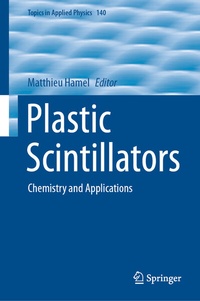
Plastic Scintillators
Description

This book introduces the physics and chemistry of plastic scintillators (fluorescent polymers) that are able to emit light when exposed to ionizing radiation, discussing their chemical modification in the early 1950s and 1960s, as well as the renewed upsurge in interest in the 21st century. The book presents contributions from various researchers on broad aspects of plastic scintillators, from physics, chemistry, materials science and applications, covering topics such as the chemical nature of the polymer and/or the fluorophores, modification of the photophysical properties (decay time, emission wavelength) and loading of additives to make the material more sensitive to, e.g., fast neutrons, thermal neutrons or gamma rays. It also describes the benefits of recent technological advances for plastic scintillators, such as nanomaterials and quantum dots, which allow features that were previously not achievable with regular organic molecules or organometallics.
More details
Other editions
Additional editions
Person
Dr. Matthieu Hamel is a scientist from the French Alternative Energies and Atomic Energy Commission (CEA). He defended a Ph.D. thesis in 2005 on phosphoro-sulfurated platinum complexes as anti-tumor drugs. His first experience in the world of plastic scintillators was in 2006 with a postdoctoral position at the CEA. In 2008, he moved back to bioorganic chemistry with the synthesis of antimalarial compounds at the University of Montpellier, France. In late 2009, he was granted a permanent position at the CEA as a materials chemist for the preparation and the characterization of fluorescent polymers for the detection of threats, mostly for nuclear and radiological risks. His expertise lies in the design, characterization and application of plastic scintillators. To date, he has coordinated two French National Research Agency (ANR) projects and several security projects supported by the French Ministry of Defense.
