

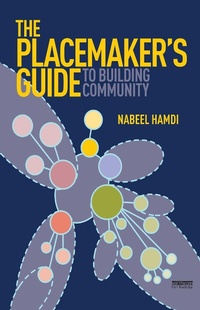
The Placemaker's Guide to Building Community
1st Edition
Published on 12. August 2010
272 pages
978-1-136-54097-4 (ISBN)
Description

From the author of Small Change comes this engaging guide to placemaking, packed with practical skills and tools that architects, planners, urban designers and other built environment specialists need in order to engage effectively with development work in any context.
Drawing on four decades of practical and teaching experience, the author offers fresh insight into the complexities faced by practitioners when working to improve the communities, lives and livelihoods of people the world over. The book shows how these complexities are a context for, rather than a barrier to, creative work. The book also critiques the single vision top down approach to design and planning. Using examples of successful professional practice across Europe, the US, Africa, Latin America and post-tsunami Asia, the author demonstrates how good policy can derive from good practices when reasoned backwards, as well as how plans can emerge in practice without a preponderance of planning. Reasoning backwards is shown to be a more effective and inclusive way of planning forwards with significant improvements to the quality of process and place. The book also offers a variety of methods and tools for analyzing the issues, engaging with communities and other stakeholders for design and settlement planning and for improving the skills of all involved in placemaking.
Ultimately the book serves as an inspiring guide, and a distillation of decades of practical wisdom and experience. The resulting practical handbook is for all those involved in doing, learning and teaching placemaking and urban development world-wide.
Drawing on four decades of practical and teaching experience, the author offers fresh insight into the complexities faced by practitioners when working to improve the communities, lives and livelihoods of people the world over. The book shows how these complexities are a context for, rather than a barrier to, creative work. The book also critiques the single vision top down approach to design and planning. Using examples of successful professional practice across Europe, the US, Africa, Latin America and post-tsunami Asia, the author demonstrates how good policy can derive from good practices when reasoned backwards, as well as how plans can emerge in practice without a preponderance of planning. Reasoning backwards is shown to be a more effective and inclusive way of planning forwards with significant improvements to the quality of process and place. The book also offers a variety of methods and tools for analyzing the issues, engaging with communities and other stakeholders for design and settlement planning and for improving the skills of all involved in placemaking.
Ultimately the book serves as an inspiring guide, and a distillation of decades of practical wisdom and experience. The resulting practical handbook is for all those involved in doing, learning and teaching placemaking and urban development world-wide.
Reviews / Votes
'Essential reading for effectively dealing with the challenges of urban poverty reduction by learning from a wealth of global experience.' - Mohamed El Sioufi, Head of the Shelter Branch, UN-HABITAT'Nabeel Hamdi is a humane visionary who never forgets that it is the people, not the experts, who must have the loudest voices in the building of communities. This important book distils the work of a lifetime spent making the world a better place.' -Tim Smit, founder of the Eden Project, UK
'Hamdi again sets new benchmarks for his simplicity in approach, yet profundity in the underlying principles of participatory planning. Essential reading for anyone who thought they already knew everything about planning with communities.' -Manu Gupta, Director SEEDS, Chairperson, Asian Disaster Reduction & Response Network
'A must read for anyone who has a vested interest in the process of placemaking through participatory planning ... It provides through example the methods and tools for creating partnerships through participatory planning as agents of change.'- Professor Emeritus W. Mike Martin, University of California Berkeley, USA
'Based on Hamdi's extensive fieldwork in India, sir Lanka, Ecuador, Peru, South Africa and Thailand, this book will motivate development planners, Architects, and community organizers to not only learn from but also enjoy the uncertainties of the development process.' -Bish Sanyal, Ford International Professor of Urban Development and Planning and Director, Massachusetts Institute of Technology, USA
'Filled with the coherent contradictions we never learned in design studio - 'scaling down to scale up - work backward to move forward'. Hamdi takes the reader on a transit walk through the reality of the bottom billion of the economic pyramid. It is this process of being present and attentive to the vision of the community that enables the best development workers to participate fully in the process of community based design in spite of our experience.' - Steven Weir, VP Global Program Development, Habitat for Humanity International, USA
'Overall, this easy-to-read book with a narrative style provides practical tools for urban designers, planners, architects, and other built-environment specialists. With this book, readers will be well equipped with practical techniques to understand the multifaceted dimensions of placemaking and provided with knowledge of many cases, from both global North and South, where different aspects of urban development and design have been realized worldwide.' -Mohammed Radfar, Northumbria University, Urban Research and Practice
'The Placemaker's Guide is an enjoyable and thought provoking read. It proposes a brave new world where people's problems, needs and aspirations form the framework for design solutions.' - Jane Manning, Urban Design Group Journal
'In a book that is a compilation of his life's work and experiences, Nabeel Hamdi challenges the reader to rethink what constitutes place, who serves as the placemaker, how one creates place, and whether the lessons of the past can enable us to create sustainable and adaptable communities that nurture and are nurtured by the residents who inhabit them.' - Nina P. David, Journalof Planning Education and Research
More details
Series
Language
English
Place of publication
London
United Kingdom
Publishing group
Taylor & Francis Ltd
Target group
Professional and scholarly
File size
3,07 MB
ISBN-13
978-1-136-54097-4 (9781136540974)
Copyright in bibliographic data and cover images is held by Nielsen Book Services Limited or by the publishers or by their respective licensors: all rights reserved.
Schweitzer Classification
Other editions
Additional editions
Nabeel Hamdi
The Placemaker's Guide to Building Community
Book
04/2010
1st Edition
Earthscan Ltd
€261.90
Shipment within 3-4 weeks
Nabeel Hamdi
The Placemaker's Guide to Building Community
Book
04/2010
1st Edition
Earthscan Ltd
€53.90
Shipment within 3-4 weeks
Person
Nabeel Hamdi qualified as an architect at the Architectural Association in London in 1968. He worked for the Greater London Council between 1969 and 1978, where his award-winning housing projects established his reputation in participatory design and planning. From 1981 to 1990 he was Associate Professor of Housing at the Massachusetts Institute of Technology (MIT), where he was later awarded a Ford International Career Development Professorship.
In 1997 Nabeel won the UN-Habitat Scroll of Honour for his work on Community Action Planning, and the Masters course in Development Practice that he founded at Oxford Brookes University in 1992 was awarded the Queen's Anniversary Prize for Higher and Further Education in 2001. He is currently Professor Emeritus at Oxford Brookes University.
Nabeel has consulted on participatory action planning and the upgrading of slums in cities to all the major international development agencies, and to charities and NGOs worldwide. He is the author of Housing without Houses (IT Publications, 1995), co-author of Making Micro Plans (IT Publications, 1988) and Action Planning for Cities (John Wiley and Sons, 1997) and editor of the collected volume Educating for Real (IT Publications 1996), and Urban Futures (Practical Action Publications 2005).
In 1997 Nabeel won the UN-Habitat Scroll of Honour for his work on Community Action Planning, and the Masters course in Development Practice that he founded at Oxford Brookes University in 1992 was awarded the Queen's Anniversary Prize for Higher and Further Education in 2001. He is currently Professor Emeritus at Oxford Brookes University.
Nabeel has consulted on participatory action planning and the upgrading of slums in cities to all the major international development agencies, and to charities and NGOs worldwide. He is the author of Housing without Houses (IT Publications, 1995), co-author of Making Micro Plans (IT Publications, 1988) and Action Planning for Cities (John Wiley and Sons, 1997) and editor of the collected volume Educating for Real (IT Publications 1996), and Urban Futures (Practical Action Publications 2005).
Content
Prologue
1. The Evolution of Development and the Placemakers' Tools - A Short Introduction
Part I: Place, Time and Clutter - Learning from Practice
Reflection: Listening to Communicate - David Sanderson
2. The Bad, the Good, the Ugly
3. Profiling Vulnerability
Part II: Placemaking and the Architecture of Opportunity
Reflection: Getting answers to questions you don't ask - Anshu Sharma
4. Toolkits
5. Knowledge
6. Participation in Practice
7. Interventions: Site Plans and House plans, Buffaloes and Mushrooms
Part III: Placemakers - Responsible Practice and the Question of Scale
Reflection: The Invisible Stakeholder - Charles Parrack
8. PEAS: about sociable practice
9. Reasoning to Scale
10. Targeting Constraints
11. Learning and Communication
12. Reducing Dependency, Cultivating Ownership
13. Building Livelihoods
Part IV: Teaching
Reflection: The Mess of Practice - Rumana Kabir
14. The Intervention Studio
15. The Placemakers Code
Notes and References
1. The Evolution of Development and the Placemakers' Tools - A Short Introduction
Part I: Place, Time and Clutter - Learning from Practice
Reflection: Listening to Communicate - David Sanderson
2. The Bad, the Good, the Ugly
3. Profiling Vulnerability
Part II: Placemaking and the Architecture of Opportunity
Reflection: Getting answers to questions you don't ask - Anshu Sharma
4. Toolkits
5. Knowledge
6. Participation in Practice
7. Interventions: Site Plans and House plans, Buffaloes and Mushrooms
Part III: Placemakers - Responsible Practice and the Question of Scale
Reflection: The Invisible Stakeholder - Charles Parrack
8. PEAS: about sociable practice
9. Reasoning to Scale
10. Targeting Constraints
11. Learning and Communication
12. Reducing Dependency, Cultivating Ownership
13. Building Livelihoods
Part IV: Teaching
Reflection: The Mess of Practice - Rumana Kabir
14. The Intervention Studio
15. The Placemakers Code
Notes and References
