

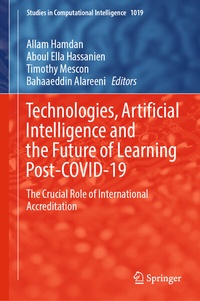
Technologies, Artificial Intelligence and the Future of Learning Post-COVID-19
The Crucial Role of International Accreditation
Published on 17. February 2022
XII, 711 pages
978-3-030-93921-2 (ISBN)
Description

This book aims to assess the experience of education during COVID-19 pandemic and explore the future of application of technologies and artificial intelligence in education.
Education delivery requires the support of new technologies such as artificial intelligence (AI), the Internet of Things (IoT), big data, and machine learning to fight and aspire to new diseases. The academic community and those interested in education agree that education after the corona pandemic will not be the same as before.
The book also questions the role of accreditation bodies (e.g., AACSB, etc.) to ensure the effectiveness and efficiency of technology tools in achieving distinguished education in times of crisis.
More details
Series
Language
English
Place of publication
Cham
Switzerland
Publishing group
Springer International Publishing
Target group
Professional and scholarly
Product notice
Reflowable
Illustrations
XII, 711 p. 113 illus., 96 illus. in color.
File size
10,71 MB
ISBN-13
978-3-030-93921-2 (9783030939212)
DOI
10.1007/978-3-030-93921-2
Schweitzer Classification
Other editions
Additional editions
Allam Hamdan | Aboul Ella Hassanien | Timothy Mescon
Technologies, Artificial Intelligence and the Future of Learning Post-COVID-19
The Crucial Role of International Accreditation
Book
02/2022
Springer
€246.09
Shipment within 7-9 days
Persons
Content
Using Student Opinions to Guide Investments in As-sessment Methods.- The Future of Education After Covid-19, What is the role of Technology.- Technology Role in Education to Overcome COVDI -19 Challenges.- E- Learning and its Application in Universities during Coronavirus Pandemic.- The Influence of Artificial Intelligence on Smart Learning: An Overview.- Dynamics of Inclusive and Lifelong Learning Prospects through Massive Open Online Courses (MOOC): A.- The Impact of Artificial Intelligence on Instructional Leadership.
