

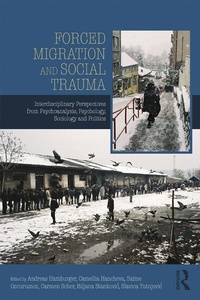
Forced Migration and Social Trauma
Interdisciplinary Perspectives from Psychoanalysis, Psychology, Sociology and Politics
1st Edition
Published on 31. October 2018
292 pages
978-0-429-77892-6 (ISBN)
Description

Forced Migration and Social Trauma addresses the topic of social trauma and migration by bringing together a broad range of interdisciplinary and international contributors, comprising refugee care practitioners, trauma researchers, sociologists and specialists in public policy from all along the Balkan refugee route into Europe. It gives the essence of a moderated dialogue between psychologists and psychoanalysts, sociologists, public policy and refugee care experts.
Migration is connected to social trauma and cannot be handled without being aware of this context. The way refugees are treated in the transit or target countries is often determined by the socio-traumatic history of these countries. Social trauma can be collectively committed and perpetuated, leaving transgenerational traces in posttraumatic and attachment disorders, uprootedness and loss of social and political confidence. Media and cultural artefacts like press, TV and the internet influence collective coping as well as traumatic perpetuation. This book shows how xenophobia in the refugee receiving or transit countries can be caused by projection rather than by experience, and that the way refugees are received and regarded in a country may be connected to the country's cultural-traumatic history. Refugees, who are often individually and collectively traumatised, experience multiple re-enactments; however, such retraumatisations between refugees and receiving populations or institutions often remain unaddressed. The split between welcoming and hostile attitudes sometimes leads to unconscious institutional defences, such as lack of cooperation between medical, psychotherapeutic, humanitarian and legal institutions.
An interdisciplinary and international exchange on migration and social trauma is necessary on all levels - this book gives convincing examples of this dialogue. Forced Migration and Social Trauma will be of great interest to all who are involved in the modern issues of refuge and migration.
Migration is connected to social trauma and cannot be handled without being aware of this context. The way refugees are treated in the transit or target countries is often determined by the socio-traumatic history of these countries. Social trauma can be collectively committed and perpetuated, leaving transgenerational traces in posttraumatic and attachment disorders, uprootedness and loss of social and political confidence. Media and cultural artefacts like press, TV and the internet influence collective coping as well as traumatic perpetuation. This book shows how xenophobia in the refugee receiving or transit countries can be caused by projection rather than by experience, and that the way refugees are received and regarded in a country may be connected to the country's cultural-traumatic history. Refugees, who are often individually and collectively traumatised, experience multiple re-enactments; however, such retraumatisations between refugees and receiving populations or institutions often remain unaddressed. The split between welcoming and hostile attitudes sometimes leads to unconscious institutional defences, such as lack of cooperation between medical, psychotherapeutic, humanitarian and legal institutions.
An interdisciplinary and international exchange on migration and social trauma is necessary on all levels - this book gives convincing examples of this dialogue. Forced Migration and Social Trauma will be of great interest to all who are involved in the modern issues of refuge and migration.
Reviews / Votes
"Psychoanalytically-informed literature on immigration has largely sidestepped the anguish of exiles and refugees. This book by Hamburger et al. rectifies this inattention and does so in a comprehensive and far-reaching manner. It addresses the suffering of adult and child refugees, host societies' ambivalence towards the newcomers, the containing and inciting role of media, and the ameliorative measures, both on an individual and societal basis, that aim to heal the trauma of geographical dislocation. Impressively, the book also elucidates the problems faced by those in caregiving roles vis-a-vis refugees and suggests ways to handle them. This is a serious, sophisticated and psycho-politically significant work in our times of radical demographic change and global turmoil."-Salman Akhtar, MD, Professor of Psychiatry, Thomas Jefferson University, Training and Supervising Analyst, Psychoanalytic Center of Philadelphia, USAMore details
Edition
1. Auflage
Language
English
Place of publication
London
United Kingdom
Publishing group
Taylor & Francis Ltd
Target group
College/higher education
Professional and scholarly
Illustrations
4 Halftones, black and white; 4 Illustrations, black and white
File size
22,72 MB
ISBN-13
978-0-429-77892-6 (9780429778926)
Copyright in bibliographic data and cover images is held by Nielsen Book Services Limited or by the publishers or by their respective licensors: all rights reserved.
Schweitzer Classification
Other editions
Additional editions

Forced Migration and Social Trauma
Interdisciplinary Perspectives from Psychoanalysis, Psychology, Sociology and Politics
Book
11/2018
Routledge
Unfortunately, price unknown
Available (delivery time upon request)
Andreas Hamburger | Camellia Hancheva | Saime OEzcueruemez
Forced Migration and Social Trauma
Interdisciplinary Perspectives from Psychoanalysis, Psychology, Sociology and Politics
Book
10/2018
1st Edition
Routledge
€196.60
Shipment within 10-20 days
Andreas Hamburger | Camellia Hancheva | Saime OEzcueruemez
Forced Migration and Social Trauma
Interdisciplinary Perspectives from Psychoanalysis, Psychology, Sociology and Politics
Book
10/2018
1st Edition
Routledge
€60.40
Shipment within 10-20 days
Persons
Andreas Hamburger is a professor of psychology at the International Psychoanalytic University, Berlin, Germany, a psychoanalyst (DPG), training analyst and supervisor (DGPT).
Camellia Hancheva is a senior assistant professor in developmental psychology, a psychotherapist and supervisor at Sofia University St. Kliment Ohridski, Bulgaria.
Saime Ozcurumez, PhD, is Director of the Human Mobility Processes and Interactions (HMPI) Research Lab and an associate professor in the Department of Political Science and Public Administration at Bilkent University, Ankara, Turkey.
Carmen Scher, MA, is Head of the International Office at the International Psychoanalytic University in Berlin, Germany.
Biljana Stankovic, PhD, is an assistant professor of psychology within the Faculty of Philosophy, University of Belgrade, Serbia.
Slavica Tutnjevic, PhD, is an assistant professor of developmental psychology within the Faculty of Philosophy, University of Banja Luka, Bosnia and Herzegovina.
Camellia Hancheva is a senior assistant professor in developmental psychology, a psychotherapist and supervisor at Sofia University St. Kliment Ohridski, Bulgaria.
Saime Ozcurumez, PhD, is Director of the Human Mobility Processes and Interactions (HMPI) Research Lab and an associate professor in the Department of Political Science and Public Administration at Bilkent University, Ankara, Turkey.
Carmen Scher, MA, is Head of the International Office at the International Psychoanalytic University in Berlin, Germany.
Biljana Stankovic, PhD, is an assistant professor of psychology within the Faculty of Philosophy, University of Belgrade, Serbia.
Slavica Tutnjevic, PhD, is an assistant professor of developmental psychology within the Faculty of Philosophy, University of Banja Luka, Bosnia and Herzegovina.
Content
Preface by Vamik Volkan; Preface by Ivan Krastev; Dreams to nightmares- welcoming culture, xenophobia and social trauma along the Balkan route: an introduction Andreas Hamburger, Camellia Hancheva, Saime Ozcurumez, Carmen Scher, Biljana Stankovic, Slavica Tutnjevic PART I: Refugees in public policy and social representation Introduction to Part I by Saime Ozcurumez Chapter 1: International Protection and Psycho-Social Support Services Saime Ozcurumez Chapter 2:Political Traumatisation and Trauma-Discourse Marcus Kumpfmueller Chapter 3: Social Trauma in International Refugee Legislation Jean-Jacques Petrucci & Andreas Hamburger Chapter 4: Visual constructions of 'refugeeness' and portrayal of flight in German newspapers Jelena Jovicic Chapter 5: Media Coverage of Refugees and Policy Processes: Serbia and the Refugee Crisis in the 2000s Momir Turudic Chapter 6: How "Words Matter": Reporting on Refugees and Migrants in Europe Zarka Radoja Chapter 7:Refugees in public policy and social representation: workshop results Andreas Hamburger PART II: Trauma and Migration: Psychological Aspects of forced Migration and Mental Health Introduction to Part II Trauma and Migration - Psychological Aspects of forced Migration and Mental HealthAndreas Hamburger & Camellia Hancheva Chapter 8: Syrian 'Guests' and the 'Receiving' Communities: Traumatization of Being an Outsider/Insider Gamze Ozcurumez Bilgili Chapter 9: Inner Emigration Horst Kaechele Chapter 10: How Can Refugees Heal? Reflections on Healing Practices across the Refugee Process - from Displacement to Integration, Return and Beyond Selma Porobic Chapter 11: Mental Health in Refugee children and youth Anastasia Zissi Chapter 12: Methods and ethics in refugee research Masa Vukcevic Markovic & Jovana Bjekic Chapter 13: Mental Health in Refugees: Workshop Results Nikola Atanassov, Dijana Duric, Aleksandra Hadzic, Camellia Hancheva, Horst Kaechele, Diana Ridjic, Marko Tomasevic PART III: Child Refugees Introduction to Part III Slavica Tutnjevic Chapter 14: Child Refugee: Transition, Migration and Transitional Phenomena Camellia Hancheva Chapter 15: "Here I found my place": Perspectives of Refugee Children in Serbia on Psychosocial Support Programmes Masa Avramovic & Biljana Stankovic Chapter 16: Former Child Refugees - Quarter of a Century Later Slavica Tutnjevic Chapter 17: Quest of Identity in Unattended Minor Refugees Leonie-Marie Anft Chapter 18: Child Refugees: Workshop Results Camellia Hancheva PART IV: Helpers, Volunteers and Vicarious Trauma Introduction to Part IV Biljana Stankovic Chapter 19: Volunteers and Refugee Identity Sotiris Chtouris & Anastasia Zissi Chapter 20: Yoga as a Mindfulness-based Intervention for Refugees and Helpers Stella Schreiber Chapter 21: Secondary Traumatization in Service Providers working with Refugees Masa Vukcevic Markovic & Marko Zivanovic Chapter 22: Helpers, Volunteers and Vicarious Trauma Biljana Stankovic
