

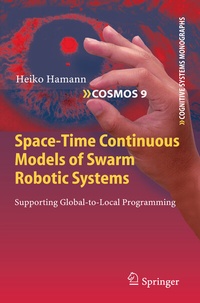
Space-Time Continuous Models of Swarm Robotic Systems
Supporting Global-to-Local Programming
1st Edition
Published on 18. May 2010
160 pages
978-3-642-13377-0 (ISBN)
Description

In this book, a generic model in as far as possible mathematical closed-formis developed that predicts the behavior of large self-organizing robot groups (robot swarms) based on their control algorithm. In addition, an extensive subsumption of the relatively young and distinctive interdisciplinary research field of swarm robotics is emphasized. The connection to many related fields is highlighted and the concepts and methods borrowed from these fields are described shortly.
More details
Other editions
Additional editions
Heiko Hamann
Space-Time Continuous Models of Swarm Robotic Systems
Supporting Global-to-Local Programming
Book
06/2010
Springer
€106.99
Shipment within 7-9 days
Content
and Purpose.- Fundamentals of Swarm Robotics - An Interdisciplinary Approach.- State-of-the-Art in Modeling and Design of Swarms.- A Framework of Models for Swarm Robotic Systems.- Validation by Results of Experiments and Simulations.- Conclusion and Outlook.
"Chapter 5 Validation by Results of Experiments and Simulations (p. 77-78)
Several case studies were carried out to approve the utility and to validate the accurateness of the proposed model. One of these studies is based on experiments with real robots the other studies were performed using simulators. Each of the following examples is a little research project of its own although the model framework is a great support. There is still a respectable amount of creativity and insight necessary to obtain a satisfying result. The aim of these case studies is not to compare the swarm algorithms to alternatives but rather to take them for granted and to check what can be predicted and with what accuracy.
5.1 Collision-Based Adaptive Swarm Aggregation
The swarm algorithm, that is investigated in this case study, was designed and experimentally evaluated by Schmickl et al. (2008). For the experiments 15 Jasmine swarm robots were used, which have been developed at the Institute for Process Control and Robotics here at the Universit¨at Karlsruhe (TH) in cooperation with the University of Stuttgart (Kornienko et al., 2005a; Szymanski and W¨orn, 2007).
In this scenario, these robots were controlled by a bio-inspired algorithm, which is derived from honeybees’ navigation behavior in a temperature gradient. The following speci?c modeling approach and the results were previously reported in a short form in Hamann and W¨orn (2008b), Hamann et al. (2008), and Schmickl et al. (2009). Further studies with focus on the symmetry breaking capabilities of this system are reported in Hamann et al. (2010).
5.1.1 The Swarm Robot “Jasmine”
The swarm robot Jasmine (see Figure 5.1 and Jasmine (2008)) was developed especially for swarm robot research. Despite its small size of about 30×30×30 mm3, it has good local communication abilities and a far distance scanning and distance measuring sensor. The good communication abilities result from six infrared sensors and emitters arranged around the robot with a displacement of 60 degrees. These sensors are also used for short distance measurements.
The far distance measuring sensor is hooked to the front of the robot. Two differentially driven wheels give this robot a high manoeuvrability at a high speed. Generation three of the robot, that was used here, has an Atmel Mega 168 micro-controller with 1 Kbyte RAM and 16 Kbyte Flash. A single LiPo battery pack is suf?cient for up to two hours of motion and optical encoders are available that allow odometric measurements in the mm-range."
Several case studies were carried out to approve the utility and to validate the accurateness of the proposed model. One of these studies is based on experiments with real robots the other studies were performed using simulators. Each of the following examples is a little research project of its own although the model framework is a great support. There is still a respectable amount of creativity and insight necessary to obtain a satisfying result. The aim of these case studies is not to compare the swarm algorithms to alternatives but rather to take them for granted and to check what can be predicted and with what accuracy.
5.1 Collision-Based Adaptive Swarm Aggregation
The swarm algorithm, that is investigated in this case study, was designed and experimentally evaluated by Schmickl et al. (2008). For the experiments 15 Jasmine swarm robots were used, which have been developed at the Institute for Process Control and Robotics here at the Universit¨at Karlsruhe (TH) in cooperation with the University of Stuttgart (Kornienko et al., 2005a; Szymanski and W¨orn, 2007).
In this scenario, these robots were controlled by a bio-inspired algorithm, which is derived from honeybees’ navigation behavior in a temperature gradient. The following speci?c modeling approach and the results were previously reported in a short form in Hamann and W¨orn (2008b), Hamann et al. (2008), and Schmickl et al. (2009). Further studies with focus on the symmetry breaking capabilities of this system are reported in Hamann et al. (2010).
5.1.1 The Swarm Robot “Jasmine”
The swarm robot Jasmine (see Figure 5.1 and Jasmine (2008)) was developed especially for swarm robot research. Despite its small size of about 30×30×30 mm3, it has good local communication abilities and a far distance scanning and distance measuring sensor. The good communication abilities result from six infrared sensors and emitters arranged around the robot with a displacement of 60 degrees. These sensors are also used for short distance measurements.
The far distance measuring sensor is hooked to the front of the robot. Two differentially driven wheels give this robot a high manoeuvrability at a high speed. Generation three of the robot, that was used here, has an Atmel Mega 168 micro-controller with 1 Kbyte RAM and 16 Kbyte Flash. A single LiPo battery pack is suf?cient for up to two hours of motion and optical encoders are available that allow odometric measurements in the mm-range."
