

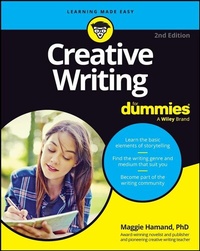
Creative Writing For Dummies
Description

Ever dream of writing a book, article, poem, or play that means something to you--and maybe to someone else as well? Do you have an idea you're ready to get down on paper? In Creative Writing For Dummies, you'll learn how to unleash your creative side and become a confident and productive writer.
Discover the essential elements of storytelling, including structure, characterization, setting, dialogue, and plot, as you navigate the countless ways you can express yourself with the written word. Explore the media and methods you can use to help find an audience--from traditional to self-publishing, social media, blogging, and more!
Creative Writing For Dummies also shows you how to:
* Write in all sorts of different formats, including screenplays, scripts, creative nonfiction, poetry, short stories, novels, and beyond
* Navigate the world of social media and learn how it can contribute to getting your work read by more people in more places
* Understand the new, online nature of contemporary journalism and the proliferation of news and blogging sites
A can't-miss roadmap to getting your first--or hundred-and-first--story, poem, or script committed to paper, Creative Writing For Dummies is an essential read for aspiring, amateur, and professional writers everywhere.
More details
Other editions
Additional editions
Person
Content
PART 1: GETTING STARTED 5
CHAPTER 1: You and Your Writing 7
CHAPTER 2: Getting into the Write Mindset 25
CHAPTER 3: Finding Material to Work With 39
PART 2: INTRODUCING THE ELEMENTS OF CREATIVE WRITING 51
CHAPTER 4: Creating Characters 53
CHAPTER 5: Giving Characters a Voice with Dialogue 67
CHAPTER 6: Choosing a Narrator 81
CHAPTER 7: Describing Your World 95
CHAPTER 8: Plotting Your Way 107
CHAPTER 9: Setting Up a Solid Structure 125
CHAPTER 10: From Drafting to Rewriting and Editing: Making Your Work Shine 141
PART 3: WRITING FICTION 153
CHAPTER 11: When Less is More: Crafting Short Stories 155
CHAPTER 12: Writing the Novel 171
CHAPTER 13: Once Upon a Time: Writing for Children 187
CHAPTER 14: Penning Plays 201
CHAPTER 15: Writing Screenplays 213
CHAPTER 16: Rhymes and Reasons: Writing Poetry 227
PART 4: EXPLORING NONFICTION 239
CHAPTER 17: Breaking into Journalism 241
CHAPTER 18: Writing from Life: Giving a Voice to the Past 255
CHAPTER 19: Crafting Narrative Nonfiction 273
CHAPTER 20: Travel Writing: Tales for Armchair Explorers 285
CHAPTER 21: All About Blogging 293
PART 5: FINDING AN AUDIENCE 301
CHAPTER 22: Finding Professionals to Publish Your Book 303
CHAPTER 23: Staying in Control with Self-Publishing 321
CHAPTER 24: Becoming a Professional 341
PART 6: THE PART OF TENS 357
CHAPTER 25: Ten Top Tips for Writers 359
CHAPTER 26: Ten Ways to Get Noticed 365
INDEX 371
Chapter 1
You and Your Writing
IN THIS CHAPTER
Finding out why you want to write
Discovering what sort of writing is for you
Developing your talent
Creative writing starts with you - with your imagination, personality, and interests. Only you know what you want to write about and how you like to work. Only you can choose to spend time working at your poetry or prose to help your words communicate to others.
People often ask, can everyone write? Well, (almost) everyone can write, in the sense of creating a sentence and then stringing another after it, and so on. However, in contrast with other artistic skills, such as playing the violin or painting in oils, or crafts such as pottery and carpentry, people sometimes fail to realize that writing for an audience - writing to communicate to others - also requires study, hard work, and practice.
We all spend our lives telling stories, and in that sense, everyone does indeed have a book in them - or, if not a whole book, then at least a tale or two - but that doesn't mean to say everyone is prepared to work at it in such a way that, as a piece of art, it communicates itself to other people.
This book gives you all the tools you need to take yourself seriously as a writer and develop your craft as best you can. And this chapter is a great place to start because it encourages you to embark on a journey of discovery and to develop the attitude you need to carry your chosen task through to the end.
Focusing on Writing as Well as You Can
A world of difference exists between writing for yourself and writing for others. Both are perfectly valid and can be approached in much the same way. Whether you're aiming to record your experiences for your children, to write for therapy or personal development, or to get a novel published, you want to write as well as you can. Doing so doesn't mean you need to think of yourself as a genius, but it does involve stretching yourself and learning as much about writing as you can.
When you start writing, don't think too much about whether your work will get published. After all, on passing your third grade violin exam, you may congratulate yourself on having got so far, but you wouldn't rush off a letter to Carnegie Hall to ask if you could put on a solo recital. Considering other people's opinions of your writing - whether they like it, or will be interested in it, or whether it will suit the current market - is death to true creativity.
J. R. R. Tolkien spent years writing a history of an imaginary country, inventing languages and mythology and timelines and maps, purely for himself. He never thought anyone else would be interested in it. When his publishers asked him for a sequel to The Hobbit, he used this material as the basis for The Lord of the Rings, a work that went on to become one of the best-selling novels of all time. Completely unexpectedly, something in the deep recesses of Tolkien's imagination connected with a vast number of people, all over the world. Yet at the time his publisher, Stanley Unwin, was so convinced the novel wouldn't sell that he cynically offered Tolkien a profit-sharing deal - because he believed no profits would accrue!
By digging deep into yourself and your imagination, you can find the theme that you really want to write about, that gives you the greatest pleasure, and presents you with the greatest challenge - and paradoxically this subject is most likely to be the one that most interests others. So write for yourself and forget about what other people think until much, much later in the process.
Examining Why You Want to Write
Before you begin to write, ask yourself why you want to do so. If the reason is that you think writing's the easiest way for you to become rich and famous, a bit of a reality check is in order. Every year more than two million books are published in the US alone. Admittedly this total includes everything from computer manuals and academic tomes, through cookbooks and knitting manuals to celebrity memoirs and mainstream fiction, but it still represents a huge amount of competition.
In addition are all the backlist titles that have been in print for years and are still selling. Of these books, very few sell in sufficient numbers to make anyone much money. In the fiction market, a handful of bestsellers make over half the income, leaving a lot of writers making very little money at all.
Of those books in print, very few are by writers who are household names. To achieve that degree of recognition, your book needs to be filmed, short-listed for the Pulitzer or The Booker Prize, picked by Oprah Winfrey, or become one of those rare runaway bestsellers that everybody dreams about but hardly ever happen.
Most writers earn very modest amounts, and the majority have other sources of income from work or supportive partners. So if money and fame are your main motivation to write, you're likely to be extremely disappointed.
Here, however, are some good reasons to write:
- Something is nagging away at you that you need to write down, an event from your life, perhaps, that has haunted or puzzled you.
- You keep hearing a character's voice in your head, and you want to find out who it is.
- A situation keeps coming to mind - what if this were to happen, how would I feel, what would I do? - and you want to explore it.
- You always loved writing stories at school and realize you'd like to feel that pleasure again.
These are all good reasons to write because the impulse is coming from you. This impulse isn't dependent on anything outside yourself that you can't control, such as the vagaries of editors, or the whims of newspaper reviewers, or prize judges, or the economic situation at the time your book is published. Your desire to write is dependent only on your imagination, commitment, and willingness to learn and develop your craft.
Various theories are propounded about why people write - as a wish-fulfilment fantasy, a form of therapy, or a way of achieving immortality and living on after death - and any of these might apply to you. But, ultimately, you want to write because you want to write. And you have to want to. No one's holding you hostage and demanding that you produce your masterpiece. Enough written work already exists in the world, and people can probably do without your contribution. But then, as the famous choreographer and dancer Martha Graham said:
There is a vitality, a life force, an energy, a quickening that is translated through you into action, and because there is only one of you in all of time, this expression is unique. And if you block it, it will never exist through any other medium and it will be lost. The world will not have it. It is not your business to determine how good it is nor how valuable nor how it compares with other expressions. It is your business to keep it yours clearly and directly, to keep the channel open.
(AGNES DE MILLE, MARTHA: THE LIFE AND WORK OF MARTHA GRAHAM)
Identifying the Kind of Writing You Want to Do
When you start writing you may not have a clear idea of the kind of writing you want to do. Or you may know exactly what genre you want to write in to be writing for a very specific audience.
Considering different genres
The best and most practical definition of "genre" I have come across is "where books are shelved in a bookstore" You will see that books are arranged by broad categories such as "fiction" and "nonfiction" but each of these will be divided into main genres - in fiction you will find categories such as literary, historical, crime, romance, science fiction, horror, short stories - and under nonfiction you will find for example memoir, biography, travel writing, political and current affairs, health and psychology, and how-to books.
You will also find separate sections for poetry, children's books (both fiction and nonfiction), and in some stores, magazines, and newspapers.
Nowadays, book genres tend to blend into one another, so that you could have a collection of short travel stories that include a large amount of memoir, or a science fiction novel that is also a romance, or a supernatural crime thriller. Although genre is important - it's how publishers classify books and where bookstores shelve your work - I think it's important to write what you want without being too fixed on what genre it is. Writing in a particular genre is important, but the book world is also always looking for something new that breaks boundaries!
Confirming your favorite form of expression
If you're drawn to a particular form of expression, then go with it. Some people like to work in miniature, others love the grand gesture - temperament decides. If you love children and reading aloud to them, or have a story in mind for your own children or grandchildren, then go ahead. Many of the best children's stories have started that way. Or if you love a grand canvas and big novels with sub-plots, twists, and turns, go for that. Don't let other people talk you out of your natural way of writing.
Thinking, "I really want to write poetry, but no market exists for it, so I'll write a novel instead", is...
