

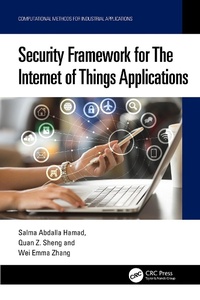
Security Framework for The Internet of Things Applications
1st Edition
Published on 29. May 2024
152 pages
978-1-040-02732-5 (ISBN)
Description

The text highlights a comprehensive survey that focuses on all security aspects and challenges facing the Internet of Things systems, including outsourcing techniques for partial computations on edge or cloud while presenting case studies to map security challenges. It further covers three security aspects including Internet of Things device identification and authentication, network traffic intrusion detection, and executable malware files detection.
This book:
Presents a security framework model design named Behavioral Network Traffic Identification and Novelty Anomaly Detection for the IoT Infrastructures
Highlights recent advancements in machine learning, deep learning, and networking standards to boost Internet of Things security
Builds a near real-time solution for identifying Internet of Things devices connecting to a network using their network traffic traces and providing them with sufficient access privileges
Develops a robust framework for detecting IoT anomalous network traffic
Covers an anti-malware solution for detecting malware targeting embedded devices
It will serve as an ideal text for senior undergraduate and graduate students, and professionals in the fields of electrical engineering, electronics and communication engineering, computer engineering, and information technology.
This book:
Presents a security framework model design named Behavioral Network Traffic Identification and Novelty Anomaly Detection for the IoT Infrastructures
Highlights recent advancements in machine learning, deep learning, and networking standards to boost Internet of Things security
Builds a near real-time solution for identifying Internet of Things devices connecting to a network using their network traffic traces and providing them with sufficient access privileges
Develops a robust framework for detecting IoT anomalous network traffic
Covers an anti-malware solution for detecting malware targeting embedded devices
It will serve as an ideal text for senior undergraduate and graduate students, and professionals in the fields of electrical engineering, electronics and communication engineering, computer engineering, and information technology.
More details
Series
Edition
1. Auflage
Language
English
Place of publication
London
United Kingdom
Publishing group
Taylor & Francis Ltd
Target group
College/higher education
Professional and scholarly
Illustrations
11 Tables, black and white; 24 Line drawings, black and white; 5 Halftones, black and white; 29 Illustrations, black and white
ISBN-13
978-1-040-02732-5 (9781040027325)
Copyright in bibliographic data and cover images is held by Nielsen Book Services Limited or by the publishers or by their respective licensors: all rights reserved.
Schweitzer Classification
Other editions
Additional editions
Salma Abdalla Hamad | Quan Z. Sheng | Wei Emma Zhang
Security Framework for The Internet of Things Applications
Book
approx. 06/2026
1st Edition
CRC Press
€69.00
Not yet published
Salma Abdalla Hamad | Quan Z. Sheng | Wei Emma Zhang
Security Framework for The Internet of Things Applications
Book
05/2024
1st Edition
CRC Press
€99.40
Shipment within 10-20 days
Persons
Salma Abdalla Hamad is currently a Senior Technology Security Compliance Manager at a telecommunication firm.. She received a Ph.D. degree in Computer Science from Macquarie University, Sydney, Australia in 2021. She worked under the supervision of Professor Michael Sheng and Dr. Wei Emma Zhang. Salma obtained her bachelor's and master's degrees in Electronics and Communication Engineering from the Arab Academy for Science, Technology, and Maritime Transport, Egypt with distinctions in 2005 and 2009, respectively. Salma also possesses more than 19 years of working experience in both the government sector and the financial sector, where she executed several projects pertinent to Information Security. Her research interests are concentrated in the domain of Information Security, more specifically, for the Internet of Things, Smart Cities, and Smart Homes.
Quan Z. Sheng is a full Professor and Head of the Department of Computing at Macquarie University, Sydney, Australia. His research interests include the Internet of Things, service-oriented computing, distributed computing, Internet computing, and pervasive computing. Professor Sheng holds a Ph.D. degree in Computer Science from the University of New South Wales (UNSW) and did his post-doc as a research scientist at CSIRO ICT Centre. Professor Sheng is the recipient of the AMiner Most Influential Scholar in IoT Award in 2019, the ARC Future Fellowship in 2014, the Chris Wallace Award for Outstanding Research Contribution in 2012, and a Microsoft fellowship in 2003.
Wei Emma Zhang is currently a Lecturer in the School of Computer Science, at the University of Adelaide. Her research interests include the Internet of Things, text mining, data mining, and knowledge base. She received a Ph.D. degree in Computer Science from the University of Adelaide in 2017. She has authored and co-authored more than 50 papers. She has also served on various conference committees and international journals in different roles such as track chair, proceeding chair, PC member, and reviewer. She is a member of the IEEE and ACM.
Quan Z. Sheng is a full Professor and Head of the Department of Computing at Macquarie University, Sydney, Australia. His research interests include the Internet of Things, service-oriented computing, distributed computing, Internet computing, and pervasive computing. Professor Sheng holds a Ph.D. degree in Computer Science from the University of New South Wales (UNSW) and did his post-doc as a research scientist at CSIRO ICT Centre. Professor Sheng is the recipient of the AMiner Most Influential Scholar in IoT Award in 2019, the ARC Future Fellowship in 2014, the Chris Wallace Award for Outstanding Research Contribution in 2012, and a Microsoft fellowship in 2003.
Wei Emma Zhang is currently a Lecturer in the School of Computer Science, at the University of Adelaide. Her research interests include the Internet of Things, text mining, data mining, and knowledge base. She received a Ph.D. degree in Computer Science from the University of Adelaide in 2017. She has authored and co-authored more than 50 papers. She has also served on various conference committees and international journals in different roles such as track chair, proceeding chair, PC member, and reviewer. She is a member of the IEEE and ACM.
Content
1. Introduction 2. Background and the State-Of-The-Art Security Solutions. 3. IoT Device Identification and Finger-printing. 4. Behavioural Novelty Detection for IoT Network Traffic. 5. Detection of Malware Targeting Embedded Devices. 6. Conclusion and Future Directions References
