

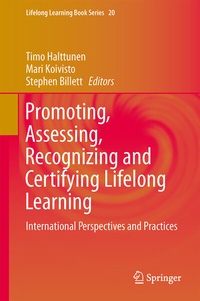
Promoting, Assessing, Recognizing and Certifying Lifelong Learning
Description

More details
Other editions
Additional editions
Content
Preface.- Acknowledgements.- Section 1: Promoting and recognising lifelong learning: Key concepts, practices and emerging and perennial problems.- Chapter 1: Promoting and recognising lifelong learning: Introduction; Timo Halttunen and Mari Koivisto (University of Turku, Finland), and Stephen Billett (Griffith University, Australia).- Chapter 2 : Conceptualising lifelong learning and its recognition in contemporary times; Stephen Billett (Griffith University, Australia .- Chapter 3: New skills for new jobs: Work agency as a necessary condition for successful lifelong learning; Christian Harteis and Michael Goller (University of Paderborn, Germany) .- Section 2: Promoting lifelong learning for economic, social and cultural purposes.- Chapter 4: Evaluating informal learning in the workplace; Karen E. Watkins (The University of Georgia, USA), Victoria J. Marsick (Columbia University, USA) and Miren Fernández de Álava (Autonomous University of Barcelona, Spain) .- Chapter 5: Recognising learning and development in the transaction of personal work practices; Raymond Smith (Griffith University, Australia) .- Chapter 6: Understanding work-related learning: The role of job characteristics and the use of different sources of learning; David Gijbels, Vincent Donche and Piet Van den Bossche (University of Antwerp, Belgium), and Ingrid Ilsbroux and Eva Sammels (University of Leuven, Belgium) .- Chapter 7: Experiential learning: A new higher education requiring new pedagogic skills; Anita Walsh (University of London, UK) .- Chapter 8: How expertise is created in emerging professional fields: Tuire Palonen and Erno Lehtinen (University of Turku, Finland), and Henny P. A. Boshuizen (Open Universiteit in the Netherlands) .- Chapter 9: Continuing education and training at work; Sarojni Choy, Ray Smith and Ann Kelly (Griffith University, Australia) .- Chapter 10: Lifelong learning policies and practices in Singapore:Tensions and challenges; Helen Bound, Magdalene Lin and Peter Rushbrook (Institute for Adult Learning, Singapore) .- Section 3: Recognising and certifying lifelong learning: Policies and practices.- Chapter 11: Professionalisation of supervisors and RPL; Timo Halttunen and Mari Koivisto (University of Turku, Finland) .- Chapter 12: Securing assessors' professionalism: Meeting assessor requirements for the purpose of performing high-quality (RPL) assessments; Antoinette van Berkel (Amsterdam University of Applied Sciences, the Netherlands) .- Chapter 13: Problems and possibilities in recognition of prior learning: A critical social theory perspective; Fredrik Sandberg (Linköping University, Sweden) .- Chapter 14: Changing RPL & HRD discourses: practitioner perspectives; Anne Murphy (Dublin Institute of Technology, Ireland), Oran Doherty (Letterkenny Institute of Technology, Ireland), and Kate Collins (University College Dublin, Ireland) .- Chapter 15: French approaches to Accreditation of Prior Learning: practices and research; Vanessa Remery (University of Geneva, Switzerland) and Vincent Merle (Conservatoire national des arts et métiers, CNAM, France) .- Chapter 16: Recognising and certifying workers' knowledge: Policies, frameworks and practices in prospect: Perspectives from two countries; Stephen Billett (Griffith University, Australia) and Helen Bound and Magdalene Lin (Institute for Adult Learning, Singapore).- Index.
