

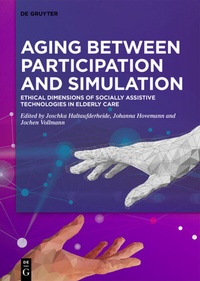
Aging between Participation and Simulation
Description

With increasing urgency, decisions about the digitalized future of healthcare and implementations of new assistive technologies are becoming focal points of societal and scientific debates and addresses large audiences. Decisions require a careful weighing of risks and benefits and contextualizing in-depth ethical analysis with robust empirical data. However, up to now, research on social assistive technologies is mostly dispersed over different academic fields and disciplines. A comprehensive overview on discussions regarding values at stake and ethical assessment of recent developments especially in healthcare is largely missing.
This publication initiates an interdisciplinary discourse on ethical, legal and social implications of socially assistive technologies in healthcare. Contributions include perspectives from nursing science, social sciences, philosophy, medical ethics, economics and law to present an - to our knowledge - first and comprehensive overview on different aspects of the use and implementation of socially assistive technologies from an ethical perspective. It combines practically relevant insights and examples from current research and development with ethical analysis to uncover exemplary moral tipping points between promotion of participation or well-being and risks and damages to these values. Healthcare professionals involved in implementation of smart technologies as well as scholars from the field of humanities, nursing and medicine, interested in the discussions on ethics and technology in healthcare, will benefit from this new contribution.
The publication is part of the international DigitAs conference "Aging between Participation and Simulation - Ethical Dimensions of Socially Assistive Technologies" held at the Institute of Medical Ethics and History of Medicine (Ruhr University Bochum) from 4 February to 8 February 2019. Within this framework, twelve young scholars were invited to discuss their contributions with renowned experts in the field. The Institute of Medical Ethics and History of Medicine is one of the leading institutes in empirically informed ethical analysis in healthcare and medicine and is a member of the European Association of Centres of Medical Ethics (EACME).
More details
Other editions
Additional editions
Persons
Joschka Haltaufderheide, Johanna Hovemann, Jochen Vollmann, Ruhr-University Bochum
