

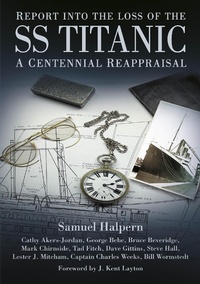
Report into the Loss of the SS Titanic
A Centennial Reappraisal
Published on 8. September 2016
384 pages
978-0-7509-6941-3 (ISBN)
Description

Report into the Loss of the SS Titanic is a complete re-evaluation of the loss of Titanic based on evidence that has come to light since the discovery of the wreck in 1985.
This collective undertaking is compiled by eleven of the world's foremost Titanic researchers - experts who have spent many years examining the wealth of information that has arisen since 1912. Following the basic layout of the 1912 Wreck Commission Report, this modern report provides fascinating insights into the ship itself, the American and British inquiries, the passengers and crew, the fateful journey and ice warnings received, the damage and sinking, rescue of survivors, the circumstances in connection with the SS Californian and SS Mount Temple, and the aftermath and ramifications that followed the disaster.
The book seeks to answer controversial questions, such as whether steerage passengers were detained behind gates, and also reveals the names and aliases of all passengers and crew who sailed on Titanic's maiden voyage. Containing the most extensively referenced chronology of the voyage ever assembled and featuring a wealth of explanatory charts and diagrams, as well as archive photographs, this comprehensive volume is the definitive 'go-to' reference book for this ill-fated ship.
This collective undertaking is compiled by eleven of the world's foremost Titanic researchers - experts who have spent many years examining the wealth of information that has arisen since 1912. Following the basic layout of the 1912 Wreck Commission Report, this modern report provides fascinating insights into the ship itself, the American and British inquiries, the passengers and crew, the fateful journey and ice warnings received, the damage and sinking, rescue of survivors, the circumstances in connection with the SS Californian and SS Mount Temple, and the aftermath and ramifications that followed the disaster.
The book seeks to answer controversial questions, such as whether steerage passengers were detained behind gates, and also reveals the names and aliases of all passengers and crew who sailed on Titanic's maiden voyage. Containing the most extensively referenced chronology of the voyage ever assembled and featuring a wealth of explanatory charts and diagrams, as well as archive photographs, this comprehensive volume is the definitive 'go-to' reference book for this ill-fated ship.
More details
Language
English
Place of publication
Stroud
United Kingdom
Illustrations
130 Illustrations, color
File size
19,76 MB
ISBN-13
978-0-7509-6941-3 (9780750969413)
Copyright in bibliographic data and cover images is held by Nielsen Book Services Limited or by the publishers or by their respective licensors: all rights reserved.
Schweitzer Classification
Other editions
Additional editions
Samuel Halpern | Cathy Akers-Jordan | George Behe
Report into the Loss of the SS Titanic
A Centennial Reappraisal
Book
09/2016
The History Press Ltd
€29.00
Shipment within 10-15 days
Persons
SAMUEL HALPERN has written over 25 articles on Titanic and is a member of the Titanic Historical Society and Titanic International Society. He lives in Chicago.
CATHY AKERS-JORDAN is a professor at University of Michigan-Flint who has presented at the Titanic Symposium at the Maine Maritime Academy. She lives in Davison, Michigan. GEORGE BEHE is a past vice president of the Titanic Historical Society. He has been interviewed and acted as a consultant for many documentaries and Titanic books, and has written numerous articles for the Titanic Historical Society's journal The Commutator. He has also been fortunate to have been able to count more than a dozen Titanic survivors among his personal friends. He has written On Board RMS Titanic and Voices from the Carpathia for The History Press.
BRUCE BEVERIDGE is one of the foremost visual and technical historians of the Olympic-class ships. His highly sought-after General Arrangement plan of Titanic, released in 2003, is one of the most detailed and accurate plans released to date and has subsequently been used by dive teams investigating the wreck. He has advised on Titanic's specifications for news media, publishers, scale-model manufacturers, archivists, exhibitors and television production companies across the world. He frequently gives talks and presentations globally and also makes regular appearances in Titanic documentaries.
MARK CHIRNSIDE is a well-known maritime author. He has previously written RMS Aquitania: The Ship Beautiful, Olympic, Titanic and Britannic: The Olympic Class Ships, RMS Olympic: Titanic's Sister, The 'Big Four' of the White Star Fleet, and Oceanic: White Star's Ship of the Century for The History Press.
TAD FITCH is a member of both the Titanic Historical Society and the Titanic International Aociety, and has appeared in the documentary series Titanic: Stories from the Deep. He has been researching maritime history for over 30 years and has co-authored such books as Report Into the Loss of SS Titanic: A Centennial Reappraisal, Into the Danger Zone: The Lusitania, First Battle of the Atlantic, and Liners During the Great War. His books have twice been nominated for the Mountbatten Award. Alongside J. Kent Layton, he is the author of The Unseen Aquitania (The History Press, 2024) and can be found at wormstedt.com/TadFitch. He lives in Ohio.
DAVE GITTINS is a Titanic scholar. He lives in Adelaide, South Australia.
STEVE HALL is a historian, author, novelist and renowned Titanic researcher. He is one of the world's foremost authorities on her photographic record, having collected, studied and researched the ship for over three decades, and is a recognised authority on the technical aspects of the Olympic-class ships. He is a consultant for media centres, auction houses and museums around the world and is regularly invited to conduct talks with history students. He is a foundation member of the Titanic and Steamship Historical Society of Australia.
Lester J. Mitcham is a Titanic scholar. CPT. CHARLES WEEKS is a professor of marine transportation and nautical science at the Maine Maritime Academy. He lives in Maine. BILL WOMRSTEDT is a Titanic scholar. He has written and co-written many articles and books, including The Lifeboat Launching Sequence Re-Examined, Report Into the Loss of SS Titanic and Titanic: Solving the Mysteries. A retired computer programmer, he lives in South Carolina.
J. KENT LAYTON has been passionate about the great Atlantic liners from a young age and has written prolifically about them ever since. He is the author of The Unseen Mauretania (1907), Transatlantic Liners, and Conspiracies at Sea: Titanic and Lusitania. Together with Tad Fitch and Bill Wormstedt, he co-authored the groundbreaking volume On a Sea of Glass: The Life & Loss of the RMS Titanic (nominated for the 2012 Mountbatten Maritime Award), Recreating Titanic and Her Sisters: A Visual History, and Titanic: Solving the Mysteries. He lives in the Finger Lakes region of Central New York and can be found at atlanticliners.com.
CATHY AKERS-JORDAN is a professor at University of Michigan-Flint who has presented at the Titanic Symposium at the Maine Maritime Academy. She lives in Davison, Michigan. GEORGE BEHE is a past vice president of the Titanic Historical Society. He has been interviewed and acted as a consultant for many documentaries and Titanic books, and has written numerous articles for the Titanic Historical Society's journal The Commutator. He has also been fortunate to have been able to count more than a dozen Titanic survivors among his personal friends. He has written On Board RMS Titanic and Voices from the Carpathia for The History Press.
BRUCE BEVERIDGE is one of the foremost visual and technical historians of the Olympic-class ships. His highly sought-after General Arrangement plan of Titanic, released in 2003, is one of the most detailed and accurate plans released to date and has subsequently been used by dive teams investigating the wreck. He has advised on Titanic's specifications for news media, publishers, scale-model manufacturers, archivists, exhibitors and television production companies across the world. He frequently gives talks and presentations globally and also makes regular appearances in Titanic documentaries.
MARK CHIRNSIDE is a well-known maritime author. He has previously written RMS Aquitania: The Ship Beautiful, Olympic, Titanic and Britannic: The Olympic Class Ships, RMS Olympic: Titanic's Sister, The 'Big Four' of the White Star Fleet, and Oceanic: White Star's Ship of the Century for The History Press.
TAD FITCH is a member of both the Titanic Historical Society and the Titanic International Aociety, and has appeared in the documentary series Titanic: Stories from the Deep. He has been researching maritime history for over 30 years and has co-authored such books as Report Into the Loss of SS Titanic: A Centennial Reappraisal, Into the Danger Zone: The Lusitania, First Battle of the Atlantic, and Liners During the Great War. His books have twice been nominated for the Mountbatten Award. Alongside J. Kent Layton, he is the author of The Unseen Aquitania (The History Press, 2024) and can be found at wormstedt.com/TadFitch. He lives in Ohio.
DAVE GITTINS is a Titanic scholar. He lives in Adelaide, South Australia.
STEVE HALL is a historian, author, novelist and renowned Titanic researcher. He is one of the world's foremost authorities on her photographic record, having collected, studied and researched the ship for over three decades, and is a recognised authority on the technical aspects of the Olympic-class ships. He is a consultant for media centres, auction houses and museums around the world and is regularly invited to conduct talks with history students. He is a foundation member of the Titanic and Steamship Historical Society of Australia.
Lester J. Mitcham is a Titanic scholar. CPT. CHARLES WEEKS is a professor of marine transportation and nautical science at the Maine Maritime Academy. He lives in Maine. BILL WOMRSTEDT is a Titanic scholar. He has written and co-written many articles and books, including The Lifeboat Launching Sequence Re-Examined, Report Into the Loss of SS Titanic and Titanic: Solving the Mysteries. A retired computer programmer, he lives in South Carolina.
J. KENT LAYTON has been passionate about the great Atlantic liners from a young age and has written prolifically about them ever since. He is the author of The Unseen Mauretania (1907), Transatlantic Liners, and Conspiracies at Sea: Titanic and Lusitania. Together with Tad Fitch and Bill Wormstedt, he co-authored the groundbreaking volume On a Sea of Glass: The Life & Loss of the RMS Titanic (nominated for the 2012 Mountbatten Maritime Award), Recreating Titanic and Her Sisters: A Visual History, and Titanic: Solving the Mysteries. He lives in the Finger Lakes region of Central New York and can be found at atlanticliners.com.
Content
- Intro
- Cover
- Title
- Copyright
- Contents
- Foreword
- Preface
- 1 Introduction
- Background and Purpose
- Questions to be Addressed
- A Note About References
- 2 Two Nations, Two Inquiries
- The American Inquiry
- The Board of Trade
- The Origins of the British Inquiry
- The Conduct of the Inquiries
- Findings of the Inquiries
- 3 Description of the Ship
- The White Star Line
- Overall Specifications of the Vessel
- Watertight Subdivision and Floodable Lengths
- Decks and Accommodation
- Access of Passengers and Crew to the Boat Deck
- Structure of the Vessel
- Watertight Bulkheads, Doors and Double Bottom
- Side Doors and Accommodation Ladder
- Masts and Rigging
- Lifesaving Appliances
- Working Arrangement of the Ship
- Navigation Lights
- Electrical Installation
- Communications and Signalling
- Arrangement of Machinery and Pumps
- Plate Section
- 4 Passengers and Crew / Lost and Saved
- 5 Account of the Ship's Journey Across the Atlantic
- Sailing Orders
- The Route Followed and Speed of the Ship
- Time Changes that Took Place
- Weather Encountered Along the Route - George Behe
- Ice Messages Received
- Actions Taken or Not Taken to Avoid Ice
- Visibility Conditions Encountered Sunday Night
- The Row About Missing Binoculars
- The Collision
- 6 Description of the Damage to the Ship
- Extent and Nature of the Damage Caused by the Allision
- Flooding in the Early, Middle and Latter Stages
- Effect of the Flooding on the Ship's Stability
- Stresses Imposed on the Hull and the Observed Breakup
- Fire Down Below
- Location and Time of Foundering
- The Wreck Site
- 7 An Account of the Saving of those on Board
- Order Given to Clear the Boats
- Order Given to Get Passengers on Deck and Wearing Lifebelts
- Order Given to Load the Boats with Women and Children
- Access to the Lifeboats
- Lifeboat Launch Sequence
- Lifeboat Occupancy Estimates
- The Recovery of Titanic's Lifeboats -George Behe
- Means Taken to Procure Assistance
- Reported Incidents and Conduct of Those in the Boats
- 8 Too Few Boats, Too Many Hindrances
- The Origin of the Lifeboat Rules - Dave Gittins
- What Might Have Been - Dave Gittins
- Separation of Classes - Samuel Halpern
- A Question of Locked Gates - Cathy Akers-Jordan and George Behe
- 9 The Rescue By the SS Carpathia
- Rescue by Carpathia
- Carpathia's Navigation
- Carpathia's Mystery Ship
- 10 The Circumstances in Connection with the SS Californian
- Californian's Route of Travel
- Californian's Stopped Dead Reckoning Position
- Summary of Events Seen During the Night
- Summary of Actions Taken at Dawn
- A Closer Look at Stone's Mysterious Tramp
- Where was Californian Relative to Titanic?
- Answers to Objections Raised
- Titanic's Mystery Steamer
- A Few Remaining Issues
- Assessment of Actions Taken by Captain Lord
- 11 The Circumstances in Connection with the SS Mount Temple
- Mount Temple's Route of Travel
- Intercept of Titanic's Distress Signals and Actions Taken
- Location of Mount Temple Relative to Californian and Carpathia
- Reported Sightings from Mount Temple
- Assessment of Actions Taken by Captain Moore
- Plate Section
- 12 The Aftermath of the Disaster
- Effect of the Disaster on Modifications Made to Olympic and Britannic - Mark Chirnside
- The International Convention on the Safety of Life at Sea (SOLAS) - Dave Gittins
- 13 Chronology of Events with References and Notes
- 14 Summary of the Findings of this Report
- About the Ship
- About Passengers and Crew On Board
- About the Route Followed and Warnings Received
- About the Collision and Flooding
- About Taking to the Boats and Calling for Assistance
- About the Rescue and Actions of Other Vessels
- Appendices
- Appendix A - First Class Passengers - Lester J. Mitcham
- Appendix B - Second Class Passengers - Lester J. Mitcham
- Appendix C - Third Class Passengers - Lester J. Mitcham
- Appendix D - Deck Department Crew - Lester J. Mitcham
- Appendix E - Engine Department Crew - Lester J. Mitcham
- Appendix F - Victualling Department Crew - Lester J. Mitcham
- Appendix G - Times Gone Wrong - Samuel Halpern
- Appendix H - A Few Eyewitness Reports - Captain Charles Weeks and Samuel Halpern
- Appendix I - Lifeboat Recovery Times - George Behe
- Appendix J - The Question of Locked Gates - Cathy Akers-Jordan and George Behe
- Bibliography
- Books and Booklets Referenced
- Printed Articles and Documents Referenced
- Referenced Website Articles and Sources
- Other Suggested Reading
- Websites Worth Visiting
