

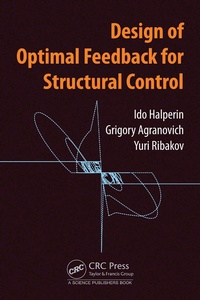
Design of Optimal Feedback for Structural Control
1st Edition
Published on 30. June 2021
194 pages
978-1-000-38089-7 (ISBN)
Description

Structural control is an approach aimed at the suppressing unwanted dynamic phenomena in civil structures. It proposes the use of methods and tools from control theory for the analysis and manipulation of a structure's dynamic behavior, with emphasis on suppression of seismic and wind responses. This book addresses problems in optimal structural control. Its goal is to provide solutions and techniques for these problems by using optimal control theory. Thus, it deals with the solution of optimal control design problems related to passive and semi-active controlled structures. The formulated problems consider constraints and excitations which are common in structural control. Optimal control theory is used in order to solve these problems in a rigorous manner.
Even though there are many works in this field, none comprise optimization techniques with firm theoretical background that address the solution of passive and semi-active structural control design problems. The book begins with a discussion on models which are commonly used for civil structures and control actuators. Modern theoretical notions, such as dissipativity and passivity of dynamic systems are discussed in context of the addressed problems. Optimal control theory and suitable successive methods are reviewed. Novel solutions for optimal passive and semi-active control design problems are derived, based on firm theoretical foundations. These results are verified by numerical simulations of typical civil structures which are subjected to different types of dynamic excitations.
Even though there are many works in this field, none comprise optimization techniques with firm theoretical background that address the solution of passive and semi-active structural control design problems. The book begins with a discussion on models which are commonly used for civil structures and control actuators. Modern theoretical notions, such as dissipativity and passivity of dynamic systems are discussed in context of the addressed problems. Optimal control theory and suitable successive methods are reviewed. Novel solutions for optimal passive and semi-active control design problems are derived, based on firm theoretical foundations. These results are verified by numerical simulations of typical civil structures which are subjected to different types of dynamic excitations.
More details
Edition
1. Auflage
Language
English
Place of publication
London
United Kingdom
Publishing group
Taylor & Francis Ltd
Target group
Professional and scholarly
Product notice
Reflowable
Illustrations
3 Tables, black and white; 5 Line drawings, color; 74 Line drawings, black and white; 5 Illustrations, color; 74 Illustrations, black and white
ISBN-13
978-1-000-38089-7 (9781000380897)
Copyright in bibliographic data and cover images is held by Nielsen Book Services Limited or by the publishers or by their respective licensors: all rights reserved.
Schweitzer Classification
Other editions
Additional editions
Ido Halperin | Grigory Agranovich | Yuri Ribakov
Design of Optimal Feedback for Structural Control
Book
07/2023
1st Edition
CRC Press
€97.60
Shipment within 15-20 days
Ido Halperin | Grigory Agranovich | Yuri Ribakov
Design of Optimal Feedback for Structural Control
Book
07/2021
1st Edition
CRC Press
€244.80
Shipment within 15-20 days
Persons
Dr. Ido Halperin has received the B.Tech. degree in civil engineering (summa cum laude) in 2009, the M.Sc. degree in Electrical and Electronics Engineering in 2013 (summa cum laude) and the Ph.D. degree in structural control in 2018, from Ariel University, Israel. From 2019 he is a faculty member in Ariel University and currently is a Lecturer in the department of civil engineering. His research interests include optimal control theory, structural control and seismic design.
Professor Grigory Agranovich was born in Baku, erstwhile USSR. He received the BSc and MSc degrees in automatic control theory and applications from Polytechnic University, Sevastopol, USSR, in 1971. He received Ph.D. degree in Automatic Control Theory from the University of Avionics, Leningrad, USSR, in 1978. His research interests are in the automatic control and optimal control of hybrid, continuous-time and discrete-time systems, with applications to missile control systems and control systems for structures damping.
Professor Yuri Ribakov has received a PhD degree from the Technion, Israel Institute of Technology in 2001 and joined the Department of Civil Engineering at Ariel University in Israel. Presently he is a Full Professor and Chair of Strucrural Engineering. His research interests include structural control, improving structural response to earthquakes using dampers, seismic isolation, structural concrete, etc. He has published 6 monographs, more than 100 papers in professional journals, presented about 80 lectures in international conferences. Member of EUAS and IPAC.
Professor Grigory Agranovich was born in Baku, erstwhile USSR. He received the BSc and MSc degrees in automatic control theory and applications from Polytechnic University, Sevastopol, USSR, in 1971. He received Ph.D. degree in Automatic Control Theory from the University of Avionics, Leningrad, USSR, in 1978. His research interests are in the automatic control and optimal control of hybrid, continuous-time and discrete-time systems, with applications to missile control systems and control systems for structures damping.
Professor Yuri Ribakov has received a PhD degree from the Technion, Israel Institute of Technology in 2001 and joined the Department of Civil Engineering at Ariel University in Israel. Presently he is a Full Professor and Chair of Strucrural Engineering. His research interests include structural control, improving structural response to earthquakes using dampers, seismic isolation, structural concrete, etc. He has published 6 monographs, more than 100 papers in professional journals, presented about 80 lectures in international conferences. Member of EUAS and IPAC.
Content
Preface. Introduction. Dynamic Models of Structures. Optimal Control. Optimal Control: Successive Solution Methods. Control Using Viscous Dampers. Semi-Active Control. Dampers' Configuration. Bibliography. Index.
