

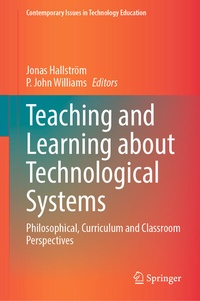
Teaching and Learning about Technological Systems
Description

This book discusses the teaching and learning about technological systems in technology education and adjacent curriculum areas. It describes, analyzes and synthesizes contemporary research on technological systems in technology education. By delving into the philosophy, sociology and history of technology, technology education and the learning and teaching of technological systems, it summarizes prior research and analyzes new research. This book thereby serves as a resource and reference work for professionals in this area of research and education.
More details
Other editions
Additional editions
Persons
Dr Jonas Hallström is Professor of Technology Education and Research Director of technology education at TESER, Technology and Science Education Research, Department of Behavioural Sciences and Learning (IBL), Linköping University, Sweden. There, he does research, supervises doctoral students and teaches technology education. Professor Hallström's research interests primarily relate to the historical emergence of technology as knowledge content in the school, the epistemology and subject philosophy of technology, various subject content such as technological systems and history of technology, as well as the attitudes to, and knowledge of, technology and technology education of students, student teachers and teachers. His research also deals with technology teaching in relation to, for example, design, gender (girls and technology), authentic learning, models and modelling and Science, Technology, Engineering, Mathematics (STEM) education.
Dr P. John Williams is Professor of Education and Director of Graduate Research in the School of Education at Curtin University in Perth, Western Australia. There, he teaches and supervises research students in Science, Technology, Engineering, Mathematics (STEM) and technology education. Apart from Australia, he has worked and studied in New Zealand and the United States and a number of African and Indian Ocean countries. His current research interests include STEM, mentoring beginning teachers, pedagogical content knowledge (PCK) and electronic assessment of performance. He regularly presents at international and national conferences, is consulted on technology education in a number of countries and is a longstanding member of eight professional associations. He is Advisory Editor of the International Journal of Technology and Design Education , Series Editor of the Springer 'Contemporary Issues in Technology Education' book series and is on the editorial board of six other professional journals.
