

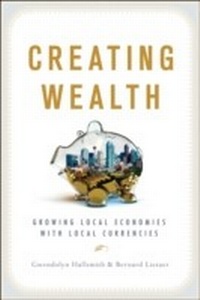
Creating Wealth
Description

The power of local currencies
Communities everywhere are challenged by issues such as health, elder and child care, housing, education, food security and the environment. On the surface, these problems appear to be rooted in economic crisis-forexample budget cuts have triggered reduced public services, soaring food prices have created food security concerns, and the subprime mortgage disaster has spawned record increases in foreclosures and homelessness.
However if communities could match their unmet needs with their underutilized resources, many would find that while their economies may bestruggling when measured in traditional terms, they possess enough genuine wealth to allow all their inhabitants to enjoy a vastly improved quality of life. Creating Wealth demonstrates how a healthy society can beattained through developing new systems of exchange. Using creative initiatives such as time banks, systems of barter and exchange and local currencies, cities and towns can empower themselves and build vibrant, healthy, sustainable local economies.
In addition to presenting many compelling case studies of successful alternative currencies in action, Creating Wealth also explores the different types of capital that communities have to draw on, including natural, built, social, human, institutional, cultural, technological, and financial. This book will appeal to community activists, city planners and other public officials, and anyone interested in developing strong local economies.
Gwendolyn Hallsmith is the founder and director of Global Community Initiatives and the author of The Key to Sustainable Cities .
Bernard Lietaer is the world's leading authority on complementary currencies and the author of The Future of Money .
All prices
More details
Other editions
Additional editions
Persons
Gwendolyn Hallsmith is the Director of Planning and Community Development for the City of Montpelier and the founder and director of Global Community Initiatives. She is an international specialist on sustainable community development with 2 decades of experience working with government at all levels. Gwendolyn is also the author of several well-known books including The Key to Sustainable Cities .
Bernard Lietaer is the world's leading authority on complementary currencies. He was instrumental in the development of the single European currency and is the co-founder of ACCESS Foundation, an educational non-profit organization whose goal is the re-alignment of sustainability and global financial interests. The author of The Future of Money and Of Human Wealth , Bernard has been a monetary consultant on four continents for clients ranging from multinational corporations to developing countries.
Content
Preface by Dennis Meadows Foreword by Hunter Lovins Acknowledgments Introduction: Cities And Economies
PART 1: LOCAL ECONOMICS 1. What Is Wealth? Redefining Wealth A Systems Perspective The Wealth of Cities The Myth (and Potential) of Individual Wealth
2. Crash and Burn Economics The Roller Coaster Economy False Assumption #1: The Economy is Beyond Our Control False Assumption #2: Money is a Neutral Means of Exchange The Building Blocks of the Economy: How Assumptions Create Reality The Banking System The "Free Market" System The Financial Market as a System Systems Change The Vortex of Urbanization Cities, Democracy and Economic Change
3. Community Capitalism Ten Types of Community Capital Exchange as Social Change Tools Available Today An Ecology of Currencies
4. The Possibility of Sufficiency and Abundance Demurrage Currencies Cooperative and Competitive Currencies The Value of Time The Two-Game Economy Unmet Needs and Underutilized Resources The Possibility of Sufficiency and Abundance
PART II: EXAMPLES OF COMPLEMENTARY CURRENCIES 5. Building Equity Neo-feudal Housing: The New Lords and Serfs Sweating the Way to Equity Saving Our Way Out of Poverty
6. Growing Intelligence Educated Indentured Servants The Learning Currency The Brazilian Saber Buckaroos - University of Missouri, Kansas City Learning Our Way to the Future
7. The Creative Economy The Arts: De-cultured Society Art Tokens Living the Dream City Money in History Culture Cards in Flanders Core Support for Artists
8. Exchanging Ecologies Mitigating Carbon Global Cap and Trade: The Kyoto Treaty The Carbon Tax A New Approach: The Vision of a Carbon Currency Other Ecologically-Positive Currencies: The Biwa Kippu System in Japan Conclusion
9. Minding the Community's Business From Social Responsibility to Sustainability Progressive Profitability Businesses that Change the World Rewarding Loyalty Recession-Proof Commerce Commercial Credit Circuits (C3) A Role for Businesses
10. Putting the Care Back In Healthcare In Sickness and in Health Sickness Treatment vs. Wellness Promotion The Scarcity of Health The Cost of Failing Health From Sickness Treatment to Healthcare Wellness Tokens: Promoting Preventive Care
11. Honoring Our Elders, Caring For Children A Scarcity of Care Time Banks and Care Banks The Japanese System
12. Eating Money A Shared Meal From Subsistence to Surplus The Hidden Cost of Cheap Food The Expanding Role of Debt Food Currencies Systemic Interventions Farm Stand: Vermont's Food Currency
PART III: MAKING IT HAPPEN 13. Intentional Cities Mobilizing Collective Action Choice of the Methodology Visionary Cities - Creating Excitement and Momentum The Legacy Project: Burlington, Vermont The Earth Charter
14. A Tale of Three Cities Calgary's 100 Year Plan Integration and Whole Systems Roundtables, Stakeholders and Working Groups Stakeholder Training Plan-It Newburgh enVisioning Montpelier Moving From Vision to Action Community and Resource Mobilization
Conclusion: Toward A Monetary Democracy The Efficiency Argument Marginal Role of Complementary Currencies The Bypass Approach A Vision for a Vibrant Local Economy
Appendix: The Community Currency How-To Manual Endnotes Resources Index About the Authors
