

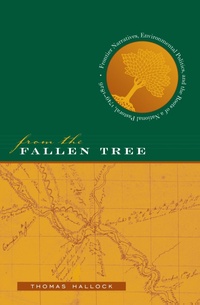
From the Fallen Tree
Description

Anglo-American writers in the revolutionary era used pastoral images to place themselves as native to the continent, argues Thomas Hallock in From the Fallen Tree. Beginning in the mid-eighteenth century, as territorial expansion got under way in earnest, and ending with the era of Indian dispossession, the author demonstrates how authors explored the idea of wilderness and political identities in fully populated frontiers.
Hallock provides an alternative to the myth of a vacant wilderness found in later writings. Emphasizing shared cultures and conflict in the border regions, he reconstructs the milieu of Hector St. John de Crèvecoeur, Thomas Jefferson, Meriwether Lewis and William Clark, William Bartram, and James Fenimore Cooper, as well as lesser-known figures such as Lewis Evans, Jane Colden, Anne Grant, and Elias Boudinot. State papers, treaty documents, maps, and journals provide a rich backdrop against which Hallock reinterprets the origins of a pastoral tradition.
Combining the new western history, ecological criticism, and native American studies, Hallock uncovers the human stories embedded in descriptions of the land. His historicized readings offer an alternative to long-accepted myths about the vanishing backcountry, the march of civilization, and a pristine wilderness. The American pastoral, he argues, grew from the anxiety of independent citizens who became colonizers themselves.
More details
Other editions
Additional editions
Person
Content
- Intro
- Contents
- Illustrations
- Preface
- Notes
- Chronology
- Introduction: Closing the Wilderness, Opening the Frontier
- Meliorem Lapsa Locavit
- Ideas of Nature
- Notes
- Part I. The Western Text
- 1. The Imagined West: Lewis Evans
- A Path Taken Together: Lewis Evans and the Iroquois
- Lewis Evans and the Imagined West
- Thomas Pownall: Revising the Imagined West
- Conclusion: Natives, Nature, and Imperial Geography
- Notes
- 2. The Contested West: John Wilson's Kentucke
- Nature, Nation, and Natural History
- Daniel Boone and the Captive Environment
- Conclusion: ''Avail Yourselves of the Benefits of Nature''
- Notes
- Part II. Improvement
- 3. Textual Boundaries, Discursive Control: Stories of the Land in the Susquehanna Valley
- ''Mammy Where Are We Going?'': The Limits of Frontier Prose in ''Susquehannah''
- The ''Wyomen'' of Treaty Literature
- Notes
- 4. Jefferson's Nature and the Trans-Appalachian West: Notes on the State of Virginia
- Ideological Geography and the Disappearing West
- Jefferson, Logan, and the Vanishing Native
- Conclusion: ''Wherefore the Forgery?''
- Notes
- Part III. Protégés
- 5. Collaboration, Incorporation, and Environmental Discourse: Lewis and Clark, Jane Colden
- Was That a Hoh-host or a Yâck-kâh?
- Fractures in an Imperial Narrative
- Collaboration, Incorporation, Triangulation
- Jane Colden and the Charleston Network
- Alexander Garden's Trip to the Cherokee Mountains
- Notes
- 6. On the Borders of a New World: William Bartram's Travels
- Four Ways of Looking at a Sinkhole: The Construction of a Literary Natural History
- Transformations, Personal and Political
- Four Views of the Alachua Savanna: The Ideological Work of Travels
- Notes
- Part IV. Settlement & Appropriation
- 7. Reversing the Revolution through Nature: Anne Grant, Timothy Dwight
- Anne Grant's Colonial Ecology
- Marking Change, Registering Loss: Timothy Dwight's Travels
- The Roots of a Pastoral
- Notes
- 8. Disappearance and Romance: Cooper's The Pioneers
- Nature, Nostalgia, and Native Americans
- Romancing the Contact Zone
- ''This, Then, Is Thy Indian Blood?'': Becoming Native to Place
- Nostalgia, Guilt, and Nation Building
- Notes
- Coda: Parallel Republics
- Notes
- Notes
- Bibliography
- Index
- A-C
- D-F
- G-L
- M-P
- R-Y
