

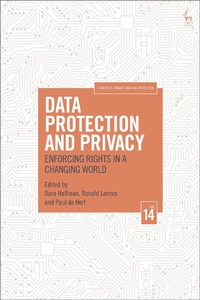
Data Protection and Privacy, Volume 14
Enforcing Rights in a Changing World
1st Edition
Published on 16. December 2021
336 pages
978-1-5099-5453-7 (ISBN)
Description

This book brings together papers that offer conceptual analyses, highlight issues, propose solutions, and discuss practices regarding privacy, data protection and enforcing rights in a changing world. It is one of the results of the 14th annual International Conference on Computers, Privacy and Data Protection (CPDP), which took place online in January 2021.
The pandemic has produced deep and ongoing changes in how, when, why, and the media through which, we interact. Many of these changes correspond to new approaches in the collection and use of our data - new in terms of scale, form, and purpose. This raises difficult questions as to which rights we have, and should have, in relation to such novel forms of data processing, the degree to which these rights should be balanced against other poignant social interests, and how these rights should be enforced in light of the fluidity and uncertainty of circumstances.
The book covers a range of topics, such as: digital sovereignty; art and algorithmic accountability; multistakeholderism in the Brazilian General Data Protection law; expectations of privacy and the European Court of Human Rights; the function of explanations; DPIAs and smart cities; and of course, EU data protection law and the pandemic - including chapters on scientific research and on the EU Digital COVID Certificate framework.
This interdisciplinary book has been written at a time when the scale and impact of data processing on society - on individuals as well as on social systems - is becoming ever starker. It discusses open issues as well as daring and prospective approaches and is an insightful resource for readers with an interest in computers, privacy and data protection.
The pandemic has produced deep and ongoing changes in how, when, why, and the media through which, we interact. Many of these changes correspond to new approaches in the collection and use of our data - new in terms of scale, form, and purpose. This raises difficult questions as to which rights we have, and should have, in relation to such novel forms of data processing, the degree to which these rights should be balanced against other poignant social interests, and how these rights should be enforced in light of the fluidity and uncertainty of circumstances.
The book covers a range of topics, such as: digital sovereignty; art and algorithmic accountability; multistakeholderism in the Brazilian General Data Protection law; expectations of privacy and the European Court of Human Rights; the function of explanations; DPIAs and smart cities; and of course, EU data protection law and the pandemic - including chapters on scientific research and on the EU Digital COVID Certificate framework.
This interdisciplinary book has been written at a time when the scale and impact of data processing on society - on individuals as well as on social systems - is becoming ever starker. It discusses open issues as well as daring and prospective approaches and is an insightful resource for readers with an interest in computers, privacy and data protection.
More details
Series
Edition
1. Auflage
Language
English
Place of publication
London
United Kingdom
Publishing group
Bloomsbury Publishing PLC
Target group
Professional and scholarly
College/higher education
ISBN-13
978-1-5099-5453-7 (9781509954537)
Copyright in bibliographic data and cover images is held by Nielsen Book Services Limited or by the publishers or by their respective licensors: all rights reserved.
Schweitzer Classification
Other editions
Additional editions
Dara Hallinan | Ronald Leenes | Paul de Hert
Data Protection and Privacy, Volume 14
Enforcing Rights in a Changing World
Book
06/2023
Hart Publishing
€54.65
Shipment within 15-20 days
Persons
Dara Hallinan is a Legal Academic working in the Intellectual Property Rights Department at FIZ Karlsruhe - Leibniz Institute for Information Infrastructure, Germany.
Ronald Leenes is Professor in Regulation by Technology at the Tilburg Institute for Law, Technology, and Society, Tilburg University, the Netherlands.
Paul De Hert is Professor at the Law, Science, Technology & Society Research Group, Vrije Universiteit Brussel, Belgium, and Associate Professor at the Tilburg Institute for Law, Technology, and Society, Tilburg University, the Netherlands.
Ronald Leenes is Professor in Regulation by Technology at the Tilburg Institute for Law, Technology, and Society, Tilburg University, the Netherlands.
Paul De Hert is Professor at the Law, Science, Technology & Society Research Group, Vrije Universiteit Brussel, Belgium, and Associate Professor at the Tilburg Institute for Law, Technology, and Society, Tilburg University, the Netherlands.
Content
1. The Norm Development of Digital Sovereignty between China, Russia, the EU and the US: From the Late 1990s to the COVID Crisis 2020/21 as Catalytic Event
Johannes Thumfart, Vrije Universiteit Brussel, Belgium
2. Artountability: Art & Algorithmic Accountability
Peter Booth, BI Norwegian Business School, Norway, Lucas Evers, Waag Technology & Society Foundation, the Netherlands, Eduard Fosch Villaronga, Leiden University, the Netherlands, Christoph Lutz, BI Norwegian Business School, Norway, Fiona McDermott, Trinity College Dublin, Ireland, Piera Riccio, Politecnico di Torino, Italy, Vincent Rioux, National School of Fine Arts, France, Alan M Sears, Leiden University, the Netherlands, Aurelia Tamò-Larrieux, University of St. Gallen, Switzerland, and Maranke Wieringa, Utrecht University, the Netherlands
3. Expectations of Privacy: The Three Tests Deployed by the European Court of Human Rights
Bart Van der Sloot, Tilburg University, the Netherlands
4. Multistakeholderism in the Brazilian General Data Protection Law: History and Learnings
Bruno Bioni, University of Sao Paulo, Brazil, and Mariana Rielli, Data Privacy Brazil Research Association
5. The Dual Function of Explanations: Why Computing Explanations is of Value
Niko Tsakalakis, University of Southampton, UK, Sophie Stalla-Bourdillon, University of Southampton, UK, Laura Carmichael, University of Southampton, UK, Dong Huynh, King's College London, UK, Luc Moreau, King's College London, UK and Ayah Helal, King's College London, UK
6. COVID-19 Pandemic and GDPR: When Scientific Research Becomes a Component of Public Deliberation
Ludovica Paseri, University of Bologna, Italy
7. The Pandemic Crisis as Test Case to Verify the European Union's Personal Data Protection System Ability to Support Scientific Research
Valentina Colcelli, Italian National Research Council
8. Data Protection Law and the EU Digital COVID Certificate Framework
Daniela Dzurakova (nee Galatova), Pan-European University, Slovakia, and Olga Gkotsopoulou,
Vrije Universiteit Brussel, Belgium
9. The DPIA: Clashing Stakeholder Interests in the Smart City?
Laurens Vandercruysse, Michaël Dooms, and Caroline Buts, all at Vrije Universiteit Brussel, Belgium
10. Solidarity - 'The Power of the Powerless': Closing Remarks of the European Data Protection Supervisor Wojciech Wiewiorowski, European Data Protection Supervisor
Johannes Thumfart, Vrije Universiteit Brussel, Belgium
2. Artountability: Art & Algorithmic Accountability
Peter Booth, BI Norwegian Business School, Norway, Lucas Evers, Waag Technology & Society Foundation, the Netherlands, Eduard Fosch Villaronga, Leiden University, the Netherlands, Christoph Lutz, BI Norwegian Business School, Norway, Fiona McDermott, Trinity College Dublin, Ireland, Piera Riccio, Politecnico di Torino, Italy, Vincent Rioux, National School of Fine Arts, France, Alan M Sears, Leiden University, the Netherlands, Aurelia Tamò-Larrieux, University of St. Gallen, Switzerland, and Maranke Wieringa, Utrecht University, the Netherlands
3. Expectations of Privacy: The Three Tests Deployed by the European Court of Human Rights
Bart Van der Sloot, Tilburg University, the Netherlands
4. Multistakeholderism in the Brazilian General Data Protection Law: History and Learnings
Bruno Bioni, University of Sao Paulo, Brazil, and Mariana Rielli, Data Privacy Brazil Research Association
5. The Dual Function of Explanations: Why Computing Explanations is of Value
Niko Tsakalakis, University of Southampton, UK, Sophie Stalla-Bourdillon, University of Southampton, UK, Laura Carmichael, University of Southampton, UK, Dong Huynh, King's College London, UK, Luc Moreau, King's College London, UK and Ayah Helal, King's College London, UK
6. COVID-19 Pandemic and GDPR: When Scientific Research Becomes a Component of Public Deliberation
Ludovica Paseri, University of Bologna, Italy
7. The Pandemic Crisis as Test Case to Verify the European Union's Personal Data Protection System Ability to Support Scientific Research
Valentina Colcelli, Italian National Research Council
8. Data Protection Law and the EU Digital COVID Certificate Framework
Daniela Dzurakova (nee Galatova), Pan-European University, Slovakia, and Olga Gkotsopoulou,
Vrije Universiteit Brussel, Belgium
9. The DPIA: Clashing Stakeholder Interests in the Smart City?
Laurens Vandercruysse, Michaël Dooms, and Caroline Buts, all at Vrije Universiteit Brussel, Belgium
10. Solidarity - 'The Power of the Powerless': Closing Remarks of the European Data Protection Supervisor Wojciech Wiewiorowski, European Data Protection Supervisor
