

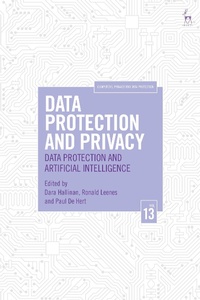
Data Protection and Privacy, Volume 13
Data Protection and Artificial Intelligence
1st Edition
Published on 28. January 2021
320 pages
978-1-5099-4176-6 (ISBN)
Description

This book brings together papers that offer conceptual analyses, highlight issues, propose solutions, and discuss practices regarding privacy, data protection and Artificial Intelligence. It is one of the results of the thirteenth annual International Conference on Computers, Privacy and Data Protection (CPDP) held in Brussels in January 2020.
The development and deployment of Artificial Intelligence promises significant break-throughs in how humans use data and information to understand and interact with the world. The technology, however, also raises significant concerns. In particular, concerns are raised as to how Artificial Intelligence will impact fundamental rights.
This interdisciplinary book has been written at a time when the scale and impact of data processing on society - on individuals as well as on social systems - is becoming ever starker. It discusses open issues as well as daring and prospective approaches and is an insightful resource for readers with an interest in computers, privacy and data protection.
The development and deployment of Artificial Intelligence promises significant break-throughs in how humans use data and information to understand and interact with the world. The technology, however, also raises significant concerns. In particular, concerns are raised as to how Artificial Intelligence will impact fundamental rights.
This interdisciplinary book has been written at a time when the scale and impact of data processing on society - on individuals as well as on social systems - is becoming ever starker. It discusses open issues as well as daring and prospective approaches and is an insightful resource for readers with an interest in computers, privacy and data protection.
More details
Series
Edition
1. Auflage
Language
English
Place of publication
London
United Kingdom
Publishing group
Bloomsbury Publishing PLC
Target group
College/higher education
ISBN-13
978-1-5099-4176-6 (9781509941766)
Copyright in bibliographic data and cover images is held by Nielsen Book Services Limited or by the publishers or by their respective licensors: all rights reserved.
Schweitzer Classification
Other editions
Additional editions
Dara Hallinan | Ronald Leenes | Paul de Hert
Data Protection and Privacy, Volume 13
Data Protection and Artificial Intelligence
Book
07/2022
Hart Publishing
€52.18
Shipment within 15-20 days
Dara Hallinan | Ronald Leenes | Paul de Hert
Data Protection and Privacy, Volume 13
Data Protection and Artificial Intelligence
Book
01/2021
Hart Publishing
€100.47
Shipment within 15-20 days
Persons
Dara Hallinan is a Legal Academic working in the Intellectual Property Rights Department at FIZ Karlsruhe - Leibniz Institute for Information Infrastructure.
Ronald Leenes is Professor in Regulation by Technology at the Tilburg Institute for Law, Technology, and Society, Tilburg University.
Paul de Hert is Professor of Criminal Law and Co-Director of the Law, Science, Technology & Society Research Group, Vrije Universiteit Brussel.
Ronald Leenes is Professor in Regulation by Technology at the Tilburg Institute for Law, Technology, and Society, Tilburg University.
Paul de Hert is Professor of Criminal Law and Co-Director of the Law, Science, Technology & Society Research Group, Vrije Universiteit Brussel.
Content
1. Don't Accept Candy From Strangers: An Analysis of Third-Party Mobile SDKs
Álvaro Feal, IMDEA Networks Institute, Spain, Julien Gamba, IMDEA Networks Institute, Spain, Juan Tapiador, Universidad Carlos III de Madrid, Spain, Primal Wijesekera, University of California, Berkeley, USA, Joel Reardon, University of Calgary, Canada, Serge Egelman, University of California, Berkeley, USA and Narseo Vallina-Rodriguez, University of California, Berkeley, USA
2. AI and the Right to Explanation: Three Legal Bases under the GDPR
Tiago Sérgio Cabral, Vieira de Almeida and Associados, Portugal
3. A Comparison of Data Protection Regulations for Automotive Systems
Ala'a Al-Momani, Ulm University, Germany, Christoph Bösch, Ulm University, Germany and Frank Kargl, Ulm University, Germany
4. Misaligned Union Laws? A Comparative Analysis of Certification in the Cybersecurity Act and the General Data Protection Regulation
Irene Kamara, Vrije Universiteit Brussel, Belgium
5. Aggregation, Synthesisation and Anonymisation: A Call for a Risk-based Assessment of Anonymisation Approaches
Sophie Stalla-Bourdillon,University of Southampton, UK and Alfred Rossi, Ohio State University, USA
6. The Role of the EU Fundamental Right to Data Protection in an Algorithmic and Big Data World
Yordanka Ivanova, Vrije University Brussels, Belgium
7. Implementing AI in Healthcare: An Ethical and Legal Analysis Based on Case Studies
Eduard Fosch-Villaronga, Leiden University, Netherlands,Davit Chokoshvili, Megeno S.A., Luxembourg, Vibeke Binz Vallevik, DNV GL Precision Medicine research program, Marcello Ienca, ETH Zurich, Switzerlandand Robin L Pierce, Tilburg University, Netherlands
8. Technological Experimentation Without Adequate Safeguards? Interoperable EU Databases and Access to the Multiple Identity Detector by SIRENE Bureaux
Diana Dimitrova, FIZ Karlsruhe, Germany and Teresa Quintel, University of Luxembourg
Closing Remarks
Wojciech Wiewiórowski
Álvaro Feal, IMDEA Networks Institute, Spain, Julien Gamba, IMDEA Networks Institute, Spain, Juan Tapiador, Universidad Carlos III de Madrid, Spain, Primal Wijesekera, University of California, Berkeley, USA, Joel Reardon, University of Calgary, Canada, Serge Egelman, University of California, Berkeley, USA and Narseo Vallina-Rodriguez, University of California, Berkeley, USA
2. AI and the Right to Explanation: Three Legal Bases under the GDPR
Tiago Sérgio Cabral, Vieira de Almeida and Associados, Portugal
3. A Comparison of Data Protection Regulations for Automotive Systems
Ala'a Al-Momani, Ulm University, Germany, Christoph Bösch, Ulm University, Germany and Frank Kargl, Ulm University, Germany
4. Misaligned Union Laws? A Comparative Analysis of Certification in the Cybersecurity Act and the General Data Protection Regulation
Irene Kamara, Vrije Universiteit Brussel, Belgium
5. Aggregation, Synthesisation and Anonymisation: A Call for a Risk-based Assessment of Anonymisation Approaches
Sophie Stalla-Bourdillon,University of Southampton, UK and Alfred Rossi, Ohio State University, USA
6. The Role of the EU Fundamental Right to Data Protection in an Algorithmic and Big Data World
Yordanka Ivanova, Vrije University Brussels, Belgium
7. Implementing AI in Healthcare: An Ethical and Legal Analysis Based on Case Studies
Eduard Fosch-Villaronga, Leiden University, Netherlands,Davit Chokoshvili, Megeno S.A., Luxembourg, Vibeke Binz Vallevik, DNV GL Precision Medicine research program, Marcello Ienca, ETH Zurich, Switzerlandand Robin L Pierce, Tilburg University, Netherlands
8. Technological Experimentation Without Adequate Safeguards? Interoperable EU Databases and Access to the Multiple Identity Detector by SIRENE Bureaux
Diana Dimitrova, FIZ Karlsruhe, Germany and Teresa Quintel, University of Luxembourg
Closing Remarks
Wojciech Wiewiórowski
