

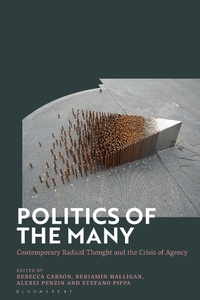
Politics of the Many
Contemporary Radical Thought and the Crisis of Agency
1st Edition
Published on 9. September 2021
248 pages
978-1-350-10563-8 (ISBN)
Description

Politics of the Many draws inspiration from Percy Bysshe Shelley's celebrated call to arms: 'Ye are many - they are few!' This idea of the Many, as a general form of emancipatory subjectivity that cannot be erased for the sake of the One, is the philosophical and political assumption shared by contributors to this book. They raise questions of collective agency, and its crisis in contemporary capitalism, via new engagements with Marxist philosophy, psychoanalysis, theories of social reproduction and value-form, and post-colonial critiques, and drawing on activist thought and strategies.
This book interrogates both established and emergent formations of the Many (the people, classes, publics, crowds, masses, multitudes), tracing their genealogies, their recent failures and victories, and their potentials to change the world. The book proposes and explores an intense and provoking series of new or reinvented concepts, figures, and theoretical constellations, including dividuality, the centaur, unintentional vanguard, insomnia at work, always-on capitalism, multitude (from its 'voiding' to a '(non)emergence'), crowds, necropolitics, and the link between political subjectivity and value-form.
The contributors to Politics of the Many are both acclaimed and emergent thinkers including Carina Brand, Rebecca Carson, Luhuna Carvalho, Lorenzo Chiesa, Jodi Dean, Dario Gentili, Benjamin Halligan, Marc James Léger, Paul Mazzocchi, Alexei Penzin, Stefano Pippa, Gerald Raunig, and Stevphen Shukaitis.
This book interrogates both established and emergent formations of the Many (the people, classes, publics, crowds, masses, multitudes), tracing their genealogies, their recent failures and victories, and their potentials to change the world. The book proposes and explores an intense and provoking series of new or reinvented concepts, figures, and theoretical constellations, including dividuality, the centaur, unintentional vanguard, insomnia at work, always-on capitalism, multitude (from its 'voiding' to a '(non)emergence'), crowds, necropolitics, and the link between political subjectivity and value-form.
The contributors to Politics of the Many are both acclaimed and emergent thinkers including Carina Brand, Rebecca Carson, Luhuna Carvalho, Lorenzo Chiesa, Jodi Dean, Dario Gentili, Benjamin Halligan, Marc James Léger, Paul Mazzocchi, Alexei Penzin, Stefano Pippa, Gerald Raunig, and Stevphen Shukaitis.
More details
Edition
1. Auflage
Language
English
Place of publication
London
United Kingdom
Publishing group
Bloomsbury Publishing PLC
Target group
Professional and scholarly
ISBN-13
978-1-350-10563-8 (9781350105638)
Copyright in bibliographic data and cover images is held by Nielsen Book Services Limited or by the publishers or by their respective licensors: all rights reserved.
Schweitzer Classification
Other editions
Additional editions
Benjamin Halligan | Alexei Penzin | Stefano Pippa
Politics of the Many
Contemporary Radical Thought and the Crisis of Agency
Book
04/2023
Bloomsbury Academic
€55.89
Shipment within 15-20 days
Persons
Benjamin Halligan is Director of the Doctoral College of the University of Wolverhampton, UK.
Alexei Penzin is Reader in Art at the University of Wolverhampton, UK.
Stefano Pippa is Lecturer in Philosophy at the University of Wolverhampton, UK.
Rebecca Carson is a PhD candidate at the Centre for Research in Modern European Philosophy at Kingston, University of London, UK and teaches in the Critical and Historical Studies programme at the Royal College of Art, London, UK.
Alexei Penzin is Reader in Art at the University of Wolverhampton, UK.
Stefano Pippa is Lecturer in Philosophy at the University of Wolverhampton, UK.
Rebecca Carson is a PhD candidate at the Centre for Research in Modern European Philosophy at Kingston, University of London, UK and teaches in the Critical and Historical Studies programme at the Royal College of Art, London, UK.
Content
Introduction: Tarrying with the Many: Against the Few, Beyond the One
Rebecca Carson, Stefano Pippa, Benjamin Halligan, Alexei Penzin
Part One: The One, the Many, and the Multitude
1. Bonds and Dispersion: Prometheus Dividual, Gerald Raunig (Zürich University of the Arts, Switzerland)
2. The Centaur and the Multitude: From Machiavelli to Contemporary Italian Political Thought, Dario Gentili (University of Roma Tre, Italy)
3. Flipping Your Schmitt: Human Nature and the Democracy of the Multitude, Paul Mazzocchi (York University, Canada)
4. UnBuild the Party: Multitude and Autonomia, Luhuna Carvalho (Kingston University, UK)
Part Two: Towards a Politics of the Many
5. Crowds and Publics, Jodi Dean (Hobart and William Smith Colleges, USA)
6. Class Composition and the (Non)Emergence of the Multitude, Stevphen Shukaitis (University of Essex, UK)
7. Multitude Void: The Regal Mode of Imperial Legitimation, Benjamin Halligan (University of Wolverhampton, UK)
8. The Gilets Jaunes as Unintentional Vanguard, Marc James Léger (Independent Scholar, Canada)
Part Three: The Many Under Capital
9. The Necropolitics of Reproduction: Black Feminism, Mothers and the Death Drive, Carina Brand (De Montfort University, UK)
10. Insomnia@Work: Between Neo-Workerism and Psychoanalysis, Lorenzo Chiesa (Genoa School of Humanities, Italy)
11. The Marxism of Post-Marxism: Political Subjectivity and the Monetary Link between Italian Operaismo and Capital Logic, Rebecca Carson (Royal College of Art, London, UK)
12. "Il faut continuer": Always-on Capitalism and Subjectivity, Alexei Penzin(University of Wolverhampton, UK)
Index
Rebecca Carson, Stefano Pippa, Benjamin Halligan, Alexei Penzin
Part One: The One, the Many, and the Multitude
1. Bonds and Dispersion: Prometheus Dividual, Gerald Raunig (Zürich University of the Arts, Switzerland)
2. The Centaur and the Multitude: From Machiavelli to Contemporary Italian Political Thought, Dario Gentili (University of Roma Tre, Italy)
3. Flipping Your Schmitt: Human Nature and the Democracy of the Multitude, Paul Mazzocchi (York University, Canada)
4. UnBuild the Party: Multitude and Autonomia, Luhuna Carvalho (Kingston University, UK)
Part Two: Towards a Politics of the Many
5. Crowds and Publics, Jodi Dean (Hobart and William Smith Colleges, USA)
6. Class Composition and the (Non)Emergence of the Multitude, Stevphen Shukaitis (University of Essex, UK)
7. Multitude Void: The Regal Mode of Imperial Legitimation, Benjamin Halligan (University of Wolverhampton, UK)
8. The Gilets Jaunes as Unintentional Vanguard, Marc James Léger (Independent Scholar, Canada)
Part Three: The Many Under Capital
9. The Necropolitics of Reproduction: Black Feminism, Mothers and the Death Drive, Carina Brand (De Montfort University, UK)
10. Insomnia@Work: Between Neo-Workerism and Psychoanalysis, Lorenzo Chiesa (Genoa School of Humanities, Italy)
11. The Marxism of Post-Marxism: Political Subjectivity and the Monetary Link between Italian Operaismo and Capital Logic, Rebecca Carson (Royal College of Art, London, UK)
12. "Il faut continuer": Always-on Capitalism and Subjectivity, Alexei Penzin(University of Wolverhampton, UK)
Index
