

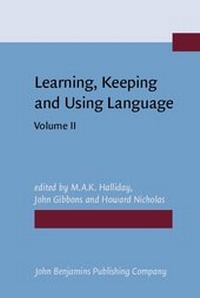
Learning, Keeping and Using Language
Selected papers from the Eighth World Congress of Applied Linguistics, Sydney, 16-21 August 1987. Volume 2
1st Edition
Published on 1. January 1990
XVI, 488 pages
978-90-272-7373-4 (ISBN)
Description

This volume contains selected papers from the Eight World Congress of Applied Linguistics held in Sydney in 1987. Whereas the focus of Volume I is on learning language and the standpoint of the individual learner, the contributions to Volume II are concerned not so much with individuals as with communities, and the reasons for and the nature of language maintenance and shift.
More details
Other editions
Additional editions
M.A.K. Halliday | John Gibbons | Howard Nicholas
Learning, Keeping and Using Language
Selected papers from the Eighth World Congress of Applied Linguistics, Sydney, 16-21 August 1987. Volume 2
Book
01/1990
John Benjamins Publishing Co
€148.40
Shipment within 10-15 days
Content
- LEARNING KEEPING AND USING LANGUAGE
- Title page
- Copyright page
- Table of Contents
- Contributors
- Part II: Keeping Language
- Introduction
- References
- The Uniqueness of the Language Situation in Australia: Its Policy and Research Implications
- Uniqueness
- Policies
- Special Australian Issues
- Australian Challenges
- The Future
- Note
- References
- A General Model for the Lexicographical Treatment of Peripheral vocabulary
- Notes
- References
- Les Mots régionaux, c'est du "chenit" (or What to do with Regionalisms in the Teaching of French as a Foreign Language)
- 1. Topicality of the Question
- 2. The Linguistic Situation in French-speaking Switzerland
- the Status of French
- 3.' Characteristics of Regional French
- A. Sources
- ?. General features
- C. Preferred domains
- 4. Pedagogical Attitude and Practice
- 5. Conclusion
- Notes
- The Influence of Multilingualism on a Northern Norwegian Dialect
- Gender
- Weak/Strong Nouns
- Definite/Indefinite Forms
- Conclusions
- Note
- References
- Language Attitudes and Language Change in the Urban Community of Krefeld, Germany
- References
- Italian Language Attrition in Sydney:The Role of Dialect
- Notes
- References
- Language Maintenance of Overseas Hindi
- 1. Introduction
- 2. The Development of Varieties of Overseas Hindi
- 3. The Role of Standard Hindi/Urdu
- 4. The Current State of OH
- 5. Factors Affecting Language Maintenance and Shift
- 5.1 Social Aspects
- 5.2 Pragmatic Aspects
- 5.3 Education
- 5.4 Attitudes
- 5.5 The Role of Standard Hindi in Language Maintenance/Shift
- 5.6 Summary
- 6. The Future
- References
- Factors Affecting the Successful Development of Spoken Languages into Written Ones
- Introduction
- Factors Inherent in a Language Situation
- The Linguistic Features of the Language
- The Character of the Group Using the Language
- The Extent and Rate of Cultural Change
- The Degree and Pattern of Diglossia Existing
- The Existence of a Natural Framework for the Use of Vernacular Literature
- Factors Inherent in a Literature Development Program
- Adequate Language Studies and Publications
- Government Approval of and Support for the Program
- Mother Tongue Speakers Sharing Responsibility for the Program
- A Weil-Rounded and Well-Implemented Program
- Use of Vernacular Literature within Cultural Institutions
- Ongoing Production and Supply of Relevant Literature
- Summary and Conclusion
- References
- Towards a Model for Predicting the Acceptance of Vernacular Literacy by Minority-Language Groups
- INTRODUCTION
- The Question
- Predicting: The Importance of This Study
- Hypotheses
- A Model for Assessing Language Attitudes
- METHOD
- Criterion Variables
- Predictor Variables
- Analytical Procedures
- RESULTS OF BI-VARIATE ANALYSIS
- Contact with the NL
- Economic Pressure for NL Proficiency
- Attitudes and Policies of Government Toward the VL
- Ethnic Identity
- Language Use
- Religious Makeup
- Orthographic Variables
- Programmatic Variables
- RESULTS OF MULTIPLE REGRESSION ANALYSIS
- Purchase VL Literature (criterion one)
- Use of VL Scriptures in Churches (criterion four)
- Summary
- CONCLUSIONS
- Insights for Planning VL Literacy Programs
- Note
- References
- Evaluating Bilingual Education in the Philippines:Towards a Multidimensional Model of Evaluationin Language Planning
- 1. Background
- 2. The Bilingual Education Policy Evaluation Project
- 3. Some Unexpected Findings
- 4. Some Theoretical and Methodological Innovations
- 5. Conclusion
- References
- Torres Strait Creole:Historical Perspectives and New Directions
- Torres Strait Islanders
- Torres Strait Creole
- Pre-contact
- Contact
- The Present
- New Directions
- Conclusion
- References
- Language and Ideology of a Police Tracker Story in Gooniyandi
- 1. Introduction
- 2. The Text
- 3. Linguistic Expression of Ideology in the Text
- 3.1 Representation of Events
- 3.2 Some Global Patterns
- 4. Summary and Conclusions
- Notes
- References
- Indígenized Englishes and Post-Creole Continua:Similarities and Differences
- References
- Part III: Using Language
- Introduction
- World Englishes and Applied Linguistics
- 1. Introduction
- 2. Major Issues of Concern
- 2.1 Ontological issues: Conflict Between Idealization and Reality
- 2.2 Acquisition and Creativity: The "Leaking" Paradigms
- 2.3 The Pragmatic Contexts: Success vs. Failure
- 2.4 Cultural Content of English
- 2.6 Communicative Competence
- 3. Where Does Applied Linguistics Fail the Outer Circle of English?
- Notes
- References
- Automated Analysis of the Vocabulary of English Texts and Generation of Practice Materials:
- 0. Introduction
- 1. The Project Framework
- 2. The Data Bases
- 2.1 The Leuven Drama Corpus
- 2.2 The Brown Corpus and the LOB Corpus
- 2.3 Richards' Familiarity Count
- 2.5 LDOCE and West's Defining Vocabulary
- 3. The Sub-Projects and Publications
- 3.1 The L.E.T. List
- 3.2 The Text Analysis Program
- 3.3 Further Text Preparation and Formatting
- 3.4 Automatic Generation of Exercises
- 4. Administration of the Exercises
- 5. Evaluation and Spin-off of the Mainframe Stage
- 5.1 Limitations
- 5.2 Student Reactions
- 5.3 An Experimental Service to Teachers
- 5.4 The Teachers' Reactions
- 6. Realisation of a PC Version
- 6.1 A New Name: A.D.A.M. & E.V.E.
- 6.2 The Omissions and Additions
- 6.2.1 The LDOCE Component
- 6.2.2 New Exercises
- 6.2.3 Updating
- 6.2.4 Evaluation
- 6.3 Reviewing Methodological Considerations
- 7. Perspectives
- 8. In Conclusion
- Note
- References
- Isochrony and 'Uncomfortable Moments' in Conversation
- Notes
- References
- Discourse Structure of "Conversation for Action": A Cross-Media View
- Introduction
- Conversation for Action
- Action Bid
- Bid Refuse: Negotiating Conditions of Agreement
- Action Accept
- References
- Instructions for Use: A Macrotextual and Stylistic Analysis
- 1. Introduction
- 2. The Sub-Texts
- 3. Stylistic Norm
- 4. The Directive Sub-Text
- 4.1 'Directivity' and its Justification
- 4.2 Norms Pertaining to the Communicative Process
- 4.3 Norms Pertaining to the Specific Communicative Situation
- 4.4 Norms Pertaining to the Stylistic and the Linguistic Usage
- 5. The Cataloguing Sub-Text
- 6. The Descriptive Sub-Text
- 7. Conclusions
- Notes
- References
- Instructions for Use: From Macro to Micro Linguistic Analysis
- 1. Information and Anaphora
- 2. Subordination
- 2.1 Time Adverbial Clauses
- 2.2 Manner Adverbial Clauses
- 2.3 Purpose Adverbial Clauses
- Notes
- References
- The Analysis of Deixis as a Basis for Discourse Analysis of Dramatic Texts
- 1. Introduction
- 2. Dramatic Texts
- 3. Dramatic World
- 4. Deixis
- 5. Deictic Markers
- 6. The Method
- 6.1 Introduction
- 6.2 An Example
- 6.2.1 The Text
- 7. Comments and Observations
- 8. Performances and Audience Response
- 9. Concluding Words
- Note
- References
- Train Sex Man Fined - Headlines and Cataphoric Ellipsis
- 1. Introduction
- 2. Ellipsis
- 2.1 Determiners
- 2.2 Auxiliaries
- 2.3 Copula
- 2.4 Say
- 2.5 Verb
- 2.6 Conjunctions
- 2.7 Other Ellipsis
- Concluding Remarks
- References
- Toward a Componential Approach to Text
- I. THE SUBSTANCE OF THE ARGUMENTS
- II. THE EVOCATION OF THE ARGUMENTS AND THE COMPATIBILITYSTRATEGY
- III. THE IMPLEMENTATION OF THE ARGUMENTS
- IV. WORDING OF THE NOUN PHRASES
- V. CONCLUSION
- Notes
- References
- Professional vs. Non Professional Translation: A Think-A loud Protocol Study
- 1. Introduction
- 2. The Aim and Experiment Design of the Present Study
- 3. The Method
- 4. The Results
- Note
- References
- The LSP Text and Its Social Context .A Model for Text Analysis
- 1. Introduction
- 2. Context Analysis
- 2.1 Text-External Factors
- 2.2 Intertextual Factors
- 2.3 Intratextual Factors
- 3. Text Analysis
- 3.1 Analysis on Cognitive Level
- 3.2 Analysis on the Pragmatic Level
- 3.3 Analysis on Other Levels
- Notes
- References
- Source and Derived Discourse
- References
- Technical Discourse and Technocratic Ideology
- Technical and Technocratic Discourse
- Heteroglossia and Discourse Analysis
- Technical Features and Technocratic Func
- Thematic Condensation in Technical Discourse
- Axiological Discourse Analysis
- Technocratic Discourse and Its Ideology
- Technocratic Discourse Strategies: The Case of "Home Curriculum
- Technocratic and Value-Centered Ideologies in Conflict
- References
- What Happens when Applied Linguistics goes Critical?
- 1. What Social Theory? The Issue of Cooperativeness and Relevance
- 2. What Relationship Between Communication and Learning? The Issue of Implication and Indirectness
- 3. What Connection Between Product and Process? The Issue of "Structure"and "Procedure" in Discourse
- 4. What Appropriate Data? The Issue of Performance and Introspection
- 5. Conclusion
- References
- Afterword
- References
