

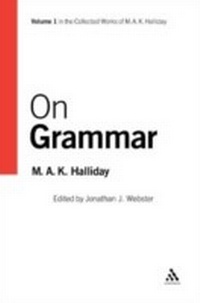
On Grammar
Volume 1
1st Edition
Published on 1. October 2005
454 pages
978-1-4411-2057-1 (ISBN)
Description

For nearly half a century, Professor M. A. K. Halliday has been enriching the discipline of linguistics with his keen insights into the social semiotic phenomenon we call language. This ten volume series presents the seminal works of Professor Halliday.
This first volume contains seventeen papers, including a new chapter entitled 'A Personal Perspective', in which Halliday offers his own current perspective on language and linguistic theory. The first part of the book presents early papers (1957-66) on basic concepts such as system, structure, class and rank. The second part highlights how, over the span of two decades (the 1960s to mid-1980s), Halliday developed systemic theory to account for linguistic phenomena extending upward through the ranks from word to clause to text. The last part, 'Construing and Abstracting', includes more recent work, in which Halliday discusses the issues confronting those who study linguistics, using Firth's description of linguistics - 'language turned back on itself'.
This first volume contains seventeen papers, including a new chapter entitled 'A Personal Perspective', in which Halliday offers his own current perspective on language and linguistic theory. The first part of the book presents early papers (1957-66) on basic concepts such as system, structure, class and rank. The second part highlights how, over the span of two decades (the 1960s to mid-1980s), Halliday developed systemic theory to account for linguistic phenomena extending upward through the ranks from word to clause to text. The last part, 'Construing and Abstracting', includes more recent work, in which Halliday discusses the issues confronting those who study linguistics, using Firth's description of linguistics - 'language turned back on itself'.
Reviews / Votes
"This first volume in the Collected Works of M. A. K. Halliday series contains fifteen papers, with the addition of a new piece entitled ''A personal perspective'' as the introduction. The papers are pieced together chronologically according to topic, and divided into 3 sections. The whole volume is oriented towards his comprehensive depiction of language, that is, the systemic functional grammar (SFG)." -Linguist List, April 2006 A wonderful collection of work by Michael Halliday, undoubtedly one of the most original and influential linguists of the twentieth century. This volume illustrates the astonishing breadth and depth of his thinking about language structure, often challenging and always interesting - for example, his view of language as "an infinite system that generates only a finite body of texts" or "a system of meanings, with forms attached to express them". This collection ranges from details of English clause structure, through his classic "Spoken and written modes of meaning", to the influence of language on thought. * Richard A Hudson, Emeritus Professor, University College London, UK *More details
Series
Edition
1. Auflage
Language
English
Place of publication
New York
United States
Target group
Professional and scholarly
ISBN-13
978-1-4411-2057-1 (9781441120571)
Copyright in bibliographic data and cover images is held by Nielsen Book Services Limited or by the publishers or by their respective licensors: all rights reserved.
Schweitzer Classification
Other editions
Additional editions
Book
10/2005
Continuum International Publishing Group Ltd.
€125.20
Shipment within 15-20 days
Person
M.A.K. Halliday was Emeritus Professor of Linguistics at the University of Sydney.
Content
- Cover
- Contents
- Preface
- Acknowledgements
- Introduction: a personal perspective
- SECTION ONE: EARLY PAPERS ON BASIC CONCEPTS
- Editor's Introduction
- 1 Some aspects of systematic description and comparison in grammatical analysis
- 2 Categories of the theory of grammar
- 3 Class in relation to the axes of chain and choice in language
- 4 Some notes on 'deep' grammar
- 5 The concept of rank: a reply
- Appendix to Section One
- SECTION TWO: WORD-CLAUSE-TEXT
- Editor's Introduction
- 6 Lexis as a linguistic level
- 7 Language structure and language function
- 8 Modes of meaning and modes of expression: types of grammatical structure and their determination by different semantic functions
- 9 Text semantics and clause grammar: how is a text like a clause?
- 10 Dimensions of discourse analysis: grammar
- SECTION THREE: CONSTRUING AND ENACTING
- Editor's Introduction
- 11 On the ineffability of grammatical categories
- 12 Spoken and written modes of meaning
- 13 How do you mean?
- 14 Grammar and daily life: concurrence and complementarity
- 15 On grammar and grammatics
- Bibliography
- Index
- A
- B
- C
- D
- E
- F
- G
- H
- I
- J
- L
- M
- N
- O
- P
- Q
- R
- S
- T
- U
- V
- W
- Z
