

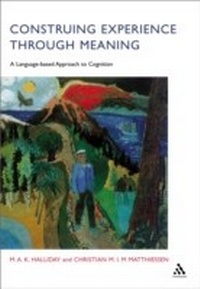
Construing Experience Through Meaning
A Language-Based Approach to Cognition
1st Edition
Published on 16. May 2006
672 pages
978-1-4411-3173-7 (ISBN)
Description

The subject of this book is how human beings construe their experience of the world. The construction of experience is usually thought of as knowledge, represented in the form of conceptual taxonomies, schemata, scripts and the like. The authors offer an interpretation that is complementary to this, treating experience not as knowing but as meaning; and hence as something that is construed in language. In other words, the concern is with the construal of human experience as a semantic system; and since language plays the central role not only in storing and exchanging experience but also in construing it, language is taken as the interpretative base.
The focus of the book is both theoretical and descriptive. The authors consider it important that theory and description should develop in parallel, with constant interchange between the two. The major descriptive component is an account of the most general features of the ideational semantics of English, which is then exemplified in two familiar text types (recipes and weather forecasts). There is also a brief reference to the semantics of Chinese. Theoretical issues are raised throughout as they become relevant to the discussion, with the theoretical base being drawn from systemic functional linguistics. Both the theoretical and descriptive proposals offered in the book are compared and contrasted with approaches deriving from AI, cognitive science and cognitive linguistics.
The focus of the book is both theoretical and descriptive. The authors consider it important that theory and description should develop in parallel, with constant interchange between the two. The major descriptive component is an account of the most general features of the ideational semantics of English, which is then exemplified in two familiar text types (recipes and weather forecasts). There is also a brief reference to the semantics of Chinese. Theoretical issues are raised throughout as they become relevant to the discussion, with the theoretical base being drawn from systemic functional linguistics. Both the theoretical and descriptive proposals offered in the book are compared and contrasted with approaches deriving from AI, cognitive science and cognitive linguistics.
More details
Edition
1. Auflage
Language
English
Place of publication
New York
United States
ISBN-13
978-1-4411-3173-7 (9781441131737)
Copyright in bibliographic data and cover images is held by Nielsen Book Services Limited or by the publishers or by their respective licensors: all rights reserved.
Schweitzer Classification
Other editions
Additional editions
M.A.K. Halliday | Christian Matthiessen
Construing Experience Through Meaning
A Language-Based Approach to Cognition
Book
05/2006
Continuum International Publishing Group Ltd.
€106.50
Shipment within 15-20 days
Persons
M.A.K. Halliday was Emeritus Professor of Linguistics at the University of Sydney. Christian M.I.M. Matthiessen is Chair Professor and Head in the Department of English at The Hong Kong Polytechnic University, Hong Kong.
Content
Part I: Introduction
1. Theoretical preliminaries
Part II: The ideation base
2. Overview of the general ideational potential
3. Sequences
4. Figures
5. Elements
6. Grammatical metaphors
7. Comparison with Chinese
Part III: The meaning base as a resource in language processing systems
8. Building an ideation base
9. Using the ideation base in text processing
Part IV: Theoretical and descriptive alternatives
10. Alternative approaches to meaning
11. Distortion and transformation
12. Figures and processes
Part V: Language and the construal of experience
13. Language as a multifunctional system and process
14. Construing ideational models: consciousness in daily life and in cognitive science
15. Language and the making of meaning
1. Theoretical preliminaries
Part II: The ideation base
2. Overview of the general ideational potential
3. Sequences
4. Figures
5. Elements
6. Grammatical metaphors
7. Comparison with Chinese
Part III: The meaning base as a resource in language processing systems
8. Building an ideation base
9. Using the ideation base in text processing
Part IV: Theoretical and descriptive alternatives
10. Alternative approaches to meaning
11. Distortion and transformation
12. Figures and processes
Part V: Language and the construal of experience
13. Language as a multifunctional system and process
14. Construing ideational models: consciousness in daily life and in cognitive science
15. Language and the making of meaning
