

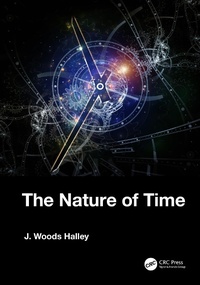
The Nature of Time
1st Edition
Published on 2. December 2022
166 pages
978-1-000-68809-2 (ISBN)
Description

This book reviews and contrasts contemporary and historical perceptions of time from scientific and intuitive human points of view. Ancient and modern clocks, Augustinian ideas, the deterministic Newtonian universe, biological clocks, deep time, thermodynamics, quantum mechanics, and relativity all contribute to the perspective. The focus is on what can be inferred from established technologies and science as opposed to futuristic speculation.
Chapter 1 describes clocks, including the cesium atomic clocks establishing the current global time standard, a history of clock development, biological clocks, phylogenetic trees, radioactive dating, and astronomical methods to determine the age of the universe. Chapter 2 poses ancient questions about time not fully addressed by an understanding of the technical nature of clocks. An early summary of some of these questions as described by Augustine in the 3rd century CE is followed by a description of how Newton, 1300 years later, introduced a conception of time which provided some answers, such as the nature of an infinitesimally short present. Implications concerning the reality of events in the past, present, and future are also discussed. The Newtonian picture is contrasted with the intuitive human one and the possibilities of time travel and temporal recurrence are briefly discussed. Chapter 3 introduces the second law of thermodynamics and addresses how it is compatible with a time-reversible Newtonian description of a universe, even though it appears to define an "arrow of time." The nature of entropy and its relation to coarse graining and emergence play a central role in the discussion. Chapter 4 discusses ways in which quantum mechanics has altered the Newtonian perspective, accounting for various interpretations of the meaning of quantum mechanics with regard to time. Chapter 5 describes basic elements of special relativity and their implications for the nature of time. Examples of time dilation and the changing order of space, such as separated events in different frames, are described. The examples are chosen to avoid evocation of currently unattainable technologies. An afterword in chapter 6 reviews questions raised by Augustine and summarizes how the development of science since then has addressed them.
This book was originally developed for an interdisciplinary seminar for beginning undergraduates at the University of Minnesota. It uses a small amount of algebra, mainly in supplementary appendices, and does not assume any prior knowledge of physics, chemistry, biology, or astronomy. In contrast to many semipopular books on time, it avoids speculation either about engineering (techno-optimism) or physical theory (strings, loop quantum gravity, black hole entropy). Instead, it takes a more grounded approach and describes what is currently known (and not known) to help both students and the general reader make better sense of time.
Chapter 1 describes clocks, including the cesium atomic clocks establishing the current global time standard, a history of clock development, biological clocks, phylogenetic trees, radioactive dating, and astronomical methods to determine the age of the universe. Chapter 2 poses ancient questions about time not fully addressed by an understanding of the technical nature of clocks. An early summary of some of these questions as described by Augustine in the 3rd century CE is followed by a description of how Newton, 1300 years later, introduced a conception of time which provided some answers, such as the nature of an infinitesimally short present. Implications concerning the reality of events in the past, present, and future are also discussed. The Newtonian picture is contrasted with the intuitive human one and the possibilities of time travel and temporal recurrence are briefly discussed. Chapter 3 introduces the second law of thermodynamics and addresses how it is compatible with a time-reversible Newtonian description of a universe, even though it appears to define an "arrow of time." The nature of entropy and its relation to coarse graining and emergence play a central role in the discussion. Chapter 4 discusses ways in which quantum mechanics has altered the Newtonian perspective, accounting for various interpretations of the meaning of quantum mechanics with regard to time. Chapter 5 describes basic elements of special relativity and their implications for the nature of time. Examples of time dilation and the changing order of space, such as separated events in different frames, are described. The examples are chosen to avoid evocation of currently unattainable technologies. An afterword in chapter 6 reviews questions raised by Augustine and summarizes how the development of science since then has addressed them.
This book was originally developed for an interdisciplinary seminar for beginning undergraduates at the University of Minnesota. It uses a small amount of algebra, mainly in supplementary appendices, and does not assume any prior knowledge of physics, chemistry, biology, or astronomy. In contrast to many semipopular books on time, it avoids speculation either about engineering (techno-optimism) or physical theory (strings, loop quantum gravity, black hole entropy). Instead, it takes a more grounded approach and describes what is currently known (and not known) to help both students and the general reader make better sense of time.
More details
Edition
1. Auflage
Language
English
Place of publication
London
United Kingdom
Publishing group
Taylor & Francis Ltd
Target group
College/higher education
Product notice
Reflowable
Illustrations
1 Tables, black and white; 20 Line drawings, color; 18 Line drawings, black and white; 12 Halftones, color; 2 Halftones, black and white; 32 Illustrations, color; 20 Illustrations, black and white
ISBN-13
978-1-000-68809-2 (9781000688092)
Copyright in bibliographic data and cover images is held by Nielsen Book Services Limited or by the publishers or by their respective licensors: all rights reserved.
Schweitzer Classification
Other editions
Additional editions

J. Woods Halley
The Nature of Time
Book
12/2022
1st Edition
CRC Press
€163.80
Shipment within 15-20 days
Person
J. Woods Halley is a Professor at the University of Minnesota in Minneapolis. His research group studies electrochemical phenomena, including the origin of life, as well as low temperature phases of many-body systems, including superfluidity and superconductivity, using analytical theory and computer simulation. He was educated at the University of California, Berkeley and the Massachusetts Institute of Technology and is a Fellow of the American Physical Society. He has previously published books on the likelihood of extraterrestrial life and statistical mechanics.
Content
1. Clocks: The Nature of Time Measurement 2. Issues in the Nature of Time 3. Thermodynamics, Irreversibility, and Time 4. Quantum Mechanics and Time 5. Relativity and Time 6. Afterword Appendix 1.1 Some Atomic Physics of the Cesium Clock Appendix 1.2 A Few Facts About Molecular Biology Appendix 1.3 Determining the Age of the Earth Appendix 1.4 Doppler Shifts Appendix 1.5 Determination of Distances of Galaxies from Earth and Estimates of the Age of the Universe Appendix 2.1 Defining the Instantaneous Present and Predicting the Future with Newtonian Physics Appendix 3.1 Coarse Graining in Card Games Appendix 5.1 Michelson Morley Experiment Appendix 5.2 The 'G' in the Lorentz Transformation Appendix 5.3 Proper Time Intervals Are the Same in All Frames
