

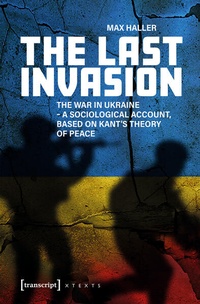
The Last Invasion
The War in Ukraine - A Sociological Account, Based on Kant's Theory of Peace
1st Edition
Published on 17. October 2025
326 pages
978-3-8394-3604-2 (ISBN)
Description

Russia's attack on Ukraine in 2022 was called a watershed in postwar European history. The West sees Putin's Russia on the way to restoring the former Soviet Union. But Putin's increasingly aggressive stance was also a reaction to Western politics. The real possibility of a new security and peace order in Europe opening in the 1990s was not pursued. Instead, NATO was enlarged to the east. Now, a massive arms build-up is on the way. Using historical sources, international news media, representative surveys, and personal interviews with people in Ukraine, Max Haller shows that this war has not been predetermined and - following Kant - peace initiatives are possible even now. In these, the European Union should assume a leading role.
Reviews / Votes
»I read the book with great interest; it is an excellent sociological >contextualization< of the war in Ukraine.«More details
Series
Edition
Auflage - Neueauflage
Language
English
Place of publication
Bielefeld
Germany
Target group
Professional and scholarly
Illustrations
19
12 s/w Abbildungen, 7 farbige Abbildungen
File size
8,71 MB
ISBN-13
978-3-8394-3604-2 (9783839436042)
DOI
10.14361/9783839436042
Schweitzer Classification
Other editions
Additional editions
Max Haller
The Last Invasion
The War in Ukraine - A Sociological Account, Based on Kant's Theory of Peace
Book
11/2025
1st Edition
transcript
€99.00
Available immediately
Person
Author
Max Haller, Österreichische Akademie der Wissenschaften (Wien), Österreich
Max Haller, geb. 1947, forscht an der Österreichischen Akademie für Wissenschaften (Wien). Er war Soziologieprofessor in Graz und Gastprofessor an mehreren Universitäten in Europa, den USA sowie Afrika. Der Soziologe war Mitbegründer des »International Social Survey Programme« und der »European Sociological Association«.
Content
- Cover
- Contents
- List of boxes, charts, photos and tables
- Foreword
- Introduction
- Chapter 1: The difficult birth and development of the Ukrainian nation
- The geographical openness and vulnerability of the country
- The historically delayed emergence of national consciousness
- Tragedies in the 20th Century: World War I, Holodomor, World War II and Holocaust
- The political and national development after the dissolution of the Soviet Union
- The socio-economic crash during the transformation process
- Concluding remarks
- Chapter 2: Western explanations and narratives on Putin's invasion of Ukraine
- Clash of systems and cultures?
- The insurrection in Eastern Ukraine as a 'new war'?
- A historical 'turning point'?
- The (neo-) realist theory of international relations
- A pacifist illusion in Europe?
- Russia as a persistent evil empire with a population submissive to authority?
- Concluding remarks
- Chapter 3: Immanuel Kant's theory of war and peace
- The historical context and the reception of Kant's theory
- Prerequisites and necessary conditions for peace
- The class interest thesis
- The Democratic Peace thesis
- Excursus: Are democracies really more peaceful?
- Publicity and the moral foundation of politics
- Personalities as masters of war and peace
- Peacemaking as a discrete and permanent task
- Concluding remarks
- Chapter 4: Putin's rise, his networks and Great Russian nationalism
- Understanding Putin does not mean justifying his actions or taking side with his defenders in the west
- Stalin as a more adequate object of comparison than Hitler
- Origin and career: (Not so) mysterious rise, acclaimed start, authoritarian turn
- The elimination of democracy: The attack on Ukraine as a preventive strike
- Reconstitution of the Soviet empire or Great Russian nationalism?
- The degradation of a grand power and its leader
- Concluding remarks
- Chapter 5: How a world-historical opportunity for lasting peace in Europe was missed
- A realistic vision to create a peaceful Europe stretching from the Atlantic to the Urals
- Reunification immediately - whatever the consequences elsewhere. A bull in a China shop
- An alliance between enemies of Russia in Europe and America
- Fatal splits about national identity of the Ukraine
- Political trench warfare among Ukrainian political elites
- Concluding remarks
- Chapter 6: From a war of independence to a proxy war
- Types of wars and lessons from research on their continuation and termination
- How the defensive fight of the Ukrainians became also a proxy war
- The failures and devastating consequences of proxy wars
- Military build-up and support for Ukraine as an imperial interest of the USA
- The EU narrative: The Ukraine as defender of European values
- The reserved attitude of the countries of the Global South
- The main victims of the war: The country and the people of Ukraine
- Concluding remarks
- Chapter 7: War as a social catalyst
- War until victory over the Russians! Survey results on the uncompromising attitude of the Ukrainians
- Fatalism, retreat to private life, courage of despair: Results from open-ended interviews
- Behavioural indicators for attitudes towards war
- How the war strengthened patriotism, support for democracy and confidence in the future
- Attitudes and behaviours of the elites. An outstanding president
- Reasons for people's support of wars
- Concluding remarks
- Chapter 8: Negotiations as a Way Out of the Impasse of a Military Stalemate
- 'Help us win!' - Why there were no serious peace efforts during the First World War
- The failure of the peace negotiations in Minsk and its causes
- Current calls for peace negotiations and their defamation
- Necessity of negotiations in the face of the military stalemate
- Supply weapons or abandon Ukraine? A false alternative
- Eight conditions and steps for a sustainable ceasefire and peace
- Could Russia agree to a ceasefire and peace negotiations?
- Concluding remarks
- Final conclusions and outlook
- References
- Notes
- Foreword
- Introduction
- Chapter 1: The difficult birth and development of the Ukrainian nation
- Chapter 2: Western explanations and narratives on Putin's invasion of Ukraine
- Chapter 3: Immanuel Kant's theory of war and peace
- Chapter 4: Putin's rise, his networks and Great Russian nationalism
- Chapter 5: How a world-historical opportunity forlasting peace in Europe was missed
- Chapter 6: From a war of independence to a proxy war
- Chapter 7: War as a social catalyst
- Chapter 8: Negotiations as a Way Out of the Impasse of a Military Stalemate
- Final conclusions and outlook
