

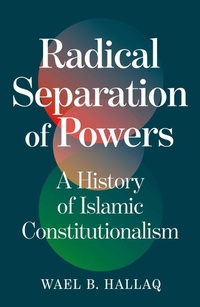
Radical Separation of Powers
A History of Islamic Constitutionalism
Published on 8. January 2026
592 pages
978-1-83643-118-3 (ISBN)
Description

Two centuries of Orientalist scholarship have denied that Islam has a constitutional concept. Premodern Islamic political practice has been subject to mistranslation, misinterpretation and condescension through the eyes of colonisers, and judged inferior to the norms of Western liberalism. Wael Hallaq, a leading scholar of Islamic law, sets the record straight in this groundbreaking volume. Traumatised by the tyranny of absolute monarchies, Europe came to see in Islam everything that it despised about itself. By seeking to understand Islamic governance from within its own tradition of reason, Hallaq reveals premodern Islam to have a rich and distinctive constitutional tradition: starting from the individual as a political subject up to the power of executives.
Reviews / Votes
'Hallaq has already authored definitive books on how Islamic civilisation articulated law and how both Western scholarship and many Islamist movements have grossly misunderstood Islamic law and the premodern state. Now this latest, fascinating volume draws on a career of expertise to bring these studies together, laying out how the Shariah and state fit together and should be understood today.' Jonathan A. C. Brown, author of Islam & Blackness 'Hallaq offers a much-needed corrective to the Orientalist narratives, which do not provide a viable foundation for historical inquiry nor serve as building blocks for new scholarship. In their place, he presents a panoramic account of constitutionalism and the separation of powers, giving readers a fine-grained perspective on the primacy of law in curbing, limiting, and guiding executive authority. Spanning the millennium from the tenth to the eighteenth century, Hallaq not only presents a historical account of constitutional practice but also offers a narrative infused with theoretical inquiry and multidimensional critique. The reader will appreciate the book's explication of a Shari?a-oriented, ulema-led mode of political thought in relation to recent scholarly interventions on the secular adab al-siyasa discourses of good governance in Islamic history.' Hayrettin Yuecesoy, author of Disenchanting the Caliphate 'This is Wael Hallaq at his provocative and erudite best. He re-imagines Arabic philology as an empathetic praxis, shows how modern scholars must re-integrate the fields of Islamic learning artificially separated by Orientalism, and in the process re-writes the history of Islamic political thought to make a powerful case for a distinctive Islamic constitutionalism rooted in prophethood, ethics, and above all the Shari'a. His reassessment of Islamic constitutional structures, from the Qur'an to the Ottomans, aims also to lay the groundwork-in ways likely to be equally controversial and generative-for a sober appraisal of the constitutional disappointments and dilemmas that we confront today.' Joseph E. Lowry, translator of The Epistle on Legal Theory 'The breadth of Hallaq's analysis of Islamic constitutionalism and the philosophical depth that he brings to it open new vistas on political thought in pre-modern Islam. His brilliant readings of key texts in Islamic political theory serve to peel off thick layers of misrepresentation, bringing those texts to life and allowing us to view them with fresh eyes. Along the way, he offers a trenchant critique of both Orientalism and liberalism. This book will have a transformative impact on the study of Islamic political thought, but its arguments speak to a much wider audience, which, too, will be in Hallaq's debt.' Muhammad Qasim Zaman, author of Islam in Pakistan: A HistoryMore details
Language
English
Place of publication
London
United Kingdom
Target group
College/higher education
File size
1,44 MB
ISBN-13
978-1-83643-118-3 (9781836431183)
Copyright in bibliographic data and cover images is held by Nielsen Book Services Limited or by the publishers or by their respective licensors: all rights reserved.
Schweitzer Classification
Other editions
Additional editions
Book
approx. 01/2026
Oneworld Publications
€74.50
Not yet published
Person
Wael B. Hallaq is the Avalon Foundation Professor in the Humanities at Columbia University. He is a leading authority in Islamic law, and has published widely on legal theory, Orientalism and the critical problems of modernity. His previous books include Restating Orientalism and The Impossible State.
