

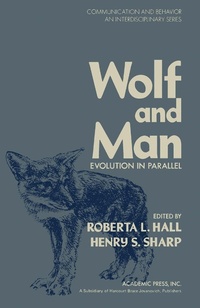
Wolf and Man
Evolution in Parallel
Published on 10. May 2014
224 pages
978-1-4832-6783-8 (ISBN)
Description

Wolf and Man: Evolution in Parallel is a collection of papers that discusses certain crucial attributes of humans including traits that are shared with other social predators. Some papers describe the wolf as the equal of man-the animal is a social hunter of large game, disregards human boundaries and properties, and consume livestock when it is necessary. The wolf's will to survive is as great as that of man, and brings along many resources to the competition. Several papers review the behavior and culture of man, wolf, dog, and the Chipewyan people who hunted caribou. Another paper examines the communication, cognitive mapping, and strategy in wolves and hominids. Hominids have developed cognitive maps, forced by their predation on large animals to cover wider ranges, to communicate and form complex sequences of utterances. One paper notes that the wolf was able to penetrate on every continent except Australia and Africa due to the Australian continent's isolation. In Africa, there is no ecological space for another highly organized social hunter of large game. The collection can be appreciated by anthropologists, sociologists, psychologists, and scientists involved in paleontology and human evolution.
More details
Other editions
Additional editions

Book
01/1978
Academic Press
€65.72
Article exhausted; check different version
Content
¿List of ContributorsPrefaceIntroduction The Anthropology of the WolfPart I Behavior and Culture 1 Man, Wolf, and Dog Domestication and Civilization: Some Analogies Early Man-Wolf Relationships Social Organization and Ecology Human Hunting Communities Concluding Remarks References 2 Variability in the Wolf, a Group Hunter Group Hunting Aggressive Behavior within the Pack Reproduction Individuality of Wolves References 3 Natural History of the Coyote 4 Comparative Ethnology of the Wolf and the Chipewyan The Region of Analysis The Chipewyan and the Caribou The Wolf The Wolf and the Caribou The Wolf and the Chipewyan Concluding Remarks ReferencesPart II Communication and Cognition Evolution of the Brain and Consciousness Exploring the Evolution of Consciousness References 5 Communication, Cognitive Mapping, and Strategy in Wolves and Hominids Communication in Wolves and Hominids Cognitive Maps of Wolves and Hominids Strategy in Wolves and Hominids Strategy and Cognitive Maps in Hominid Communication References 6 Wolf Vocalization The Growl The Whimper The Bark The Howl Concluding Remarks References 7 Scent-Marking in Wolves The Scent-Marking Study Distribution of Olfactory Sign Stimuli for Scent-Marking Functions of Scent-Marking ReferencesPart III Paleobiology 8 Variability and Speciation in Canids and Hominids Variability and Speciation in Canids and Hominids Pleistocene Glaciations and Coyote Evolution Variation in Modern Canids Australopithecine Variation The Genus Homo and Two Taxonomic Models Concluding Remarks References 9 Dire Wolf Systematics and Behavior History of Investigation Wolf, Dire Wolf, and Coyote Evolution Morphology of the Wolf, Dire Wolf, and Coyote Pleistocene Ranges of the Wolf, the Dire Wolf, and the Coyote Extinction of the Pleistocene Dire Wolf A Model for Dire Wolf Social Organization Models for Early Hominid Evolution Concluding Remarks References Conclusion Wolf and Human Behavior and Culture Cognition and Communication Paleobiology The Path Ahead ReferencesIndex
