

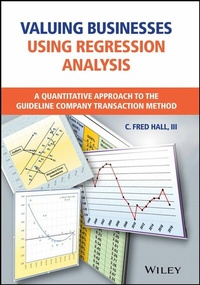
Valuing Businesses Using Regression Analysis
Description

Current methodologies using median, quartiles, or standard deviations to calculate revenue multipliers and cash flow multipliers often produce values that are wildly divergent. This forces the appraiser to choose between a very high or a very low value or consider averaging the values, opening the possibility for the appraiser to be challenged. On the surface, regression analysis appears to be the more complex, mathematical model, so many professionals shy away from using it out of fear that readers will be confused and reject the results of the appraisal. Valuing Businesses Using Regression Analysis solves this issue by breaking down regression to its simplest terms and providing easy-to-read charts and explanations that can be understood by all.
Since regression analysis does not come pre-installed in Excel, this book will show you how to enable Excel's regression in your computer. Then you'll learn four different Regression tools that can be used for business valuations or for forecasting in general. As an added perk, this book also comes with a template that simplifies the entire regression methodology into the click of one button. With a minimal amount of work, you can use this template to produce a compelling four-page valuation report.
* See why current valuation methodologies can be wildly inaccurate and why regression analysis is a practical and preferable alternative
* Learn how to set up Regression in Excel and use single-variable linear regression to predict revenue and cash flow multipliers
* Walk through the process for conducting more advanced analyses, including curved regression with outliers and multiple variable regression
* Use the bonus template to create attractive four-page valuation reports using regression analysis in Excel
This book is an excellent choice for valuators and other financial professionals ready to take the leap into regression analysis for more accurate, more objective business valuations.
More details
Other editions
Additional editions
Person
Content
Preface i
CHAPTER 1: Current Methodologies 1
CHAPTER 2: The Solution 15
CHAPTER 3: Identifying Outliers Using Re-gression 26
CHAPTER 4: Cash Flow Multiplier Regression 31
CHAPTER 5: Enterprise Multiplier 41
CHAPTER 6: Polynomial Regressions 45
CHAPTER 7: Multiple Variable Regression 50
CHAPTER 8: Selection of Transactions in the Sample 62
CHAPTER 9: Regression 2.0 92
CHAPTER 10: Using Excel's Regression Utility 107
CHAPTER 11: Excel Valuation Template 125
CHAPTER 12: Conclusion
Acknowledgments 142
Preface
After finishing my MBA, I went to work for a major west coast bank. I chose the bank because it had one of the top management training programs in the industry. This was important to me because I felt that my MBA training left me clueless about businesses. I was right. The bank's management training program was an intense nine-month, 40-hours-a-week class, on analyzing businesses. It was equivalent to a second MBA degree. Upon completion of the training I was confident that I now understood businesses. I was wrong. It wasn't until I owned my own business (I must clarify that my wife and I owned it) that some of the lights went on. However, it wasn't until we sold that business after 27 years and I then went to work as a business broker for a major brokerage firm in northern California that I began to really understand businesses.
MBA education was largely theoretical in those days, and banking was the technical application of that theory. However, owning your own business teaches you many things you would never learn in school: that education is largely on the fly. As a sole proprietor, your skillset, for the most part, is self-taught, and class is in session 60 hours a week for the entire period of ownership. I thought all that knowledge was unique and original. However, after 18 years of being a business broker and business appraiser and having worked with over 800 business owners, I find that we all seemed to think alike. We made similar choices and similar mistakes.
When I was considering selling my business, my first choice of potential buyers was my general manager. He worked for me for over 20 years. He was very loyal and made me a lot of money. I thought I owed him the opportunity to buy my business. This was me being an incredibly generous person. Come to find out, every owner thinks like this. In actuality it was not an act of generosity or loyalty on my part. It was my desire to create the simplest exit strategy whereby I could get the price I wanted for the business without any negotiations.
Sadly, once the excitement of buying my company wore off, my manager realized he didn't have the money or the intestinal fortitude to run an $8 million business with 30 employees. He subsequently declined my offer, and a few months later he quit because he felt that he had failed in my eyes. I was more disappointed in this decision than he was; I lost the best employee I ever had.
Over the last 18 years I have worked with hundreds of business owners wanting to sell their businesses. I found that the majority of them approached their managers first. Not only were few owners successful, but amazingly, most reported that their manager subsequently quit as well. In many of those cases where the owner and manager actually reached an agreement, the bank appraisal for the acquisition loan came in significantly lower than the seller wanted, thus killing the deal. The owner never considered getting an appraisal for the business. The asking price was based on the amount needed for retirement, not what the business was worth.
The second mistake sellers frequently make when selling their businesses may appear to have little to do with the value of the businesses. However, I mention it because owners should approach this choice with extreme caution. After I was unsuccessful selling my business to my manager, I felt that one of my competitors was the next most logical suitor. In retrospect, it was my desire to create the easiest exit strategy and maximize my selling price. The competitor would certainly be aware of the many strengths of my business. In addition, there would not be a need for training, thus, providing me with a quick exit. The owner would also want my business so badly, he or she would pay any amount that I asked, and, of course, the owner had the deep pockets to pay that price. Again, the actual value of the business did not enter into my decision.
The result of my decision to approach my competitor turned out to be textbook-I've seen it happen many times over the last 18 years. It never occurred to me that there are unscrupulous business owners out there. The manager of my competitor knew I took Mondays off. He came into the store on my day off and passed out business cards to all my employees. He told them that when I sold the store, the buyer would be so strapped with debt payments they would not get pay raises for years. Their best choice was to come work for him. The manager then sent his sales force out to all my customers and told them that I was leaving and he was now the best choice of suppliers. I lost employees and customers, which impacted the value of my business.
Just make sure that when you approach a competitor, have him or her sign a non-disclosure agreement that has significant penalties for talking to your employees, customers, suppliers, or other competitors.
In addition, no matter who the potential buyer may be, ask a price that is fair and reasonable. Buyers are not dumb. If they feel that the asking price is not reasonable, they will not try to negotiate. They will simply walk away. You will call, text, and email, but believe me, they will not respond. You will have no idea that the reason they stopped communicating was that your price was too high. As a business broker, I have seen this happen hundreds of times.
Hence, one of the main concerns of all business owners should be, "What is my business worth?" As a business owner, I relied on business brokers and CPAs for information on the value of my business. As a business broker, the most common question I was asked was, "What is the multiplier for my business?" The assumption of most business owners is that a single multiplier exists for his or her type of business that can be applied to its level of profits in order to determine the value of the business. The assumption follows that as an appraiser, I can merely open a textbook on business multipliers and give the owner an answer in a few seconds. If business appraisals were that simple, we would all be out of work and Wall Street would be nonexistent.
After many years of research on the subject, I find that every business is unique and will have its own set of multipliers. Those multipliers are derived from the company's level of profitability and revenue. Hence, I am incredulous to find business brokers and business consultants who offer up multipliers to their clients without even knowing what the company's level of revenue and profits are and how they compare to the competition.
Unfortunately, there are a few industry textbooks on rules of thumb, which are collections of thousands of brokers' opinions of the multipliers for hundreds of business classifications. These "rules of thumb" books are used extensively by brokers to estimate the value of their client's business. The textbooks, however, should not be used as a substitute for a quantitative business analysis and valuation. To do so would quite possibly over- or undervalue a business 10 to 20%. For a million-dollar business, 20% is a significant sum of money. If the business is overvalued, it may result in an unsuccessful attempt to sell the business.
The saddest case in which I was involved was a business where an unseasoned business broker had recommended a $1 million listing price based on some rule of thumb. The owners were a couple in their 70s who wanted to retire. After wasting a year and a half waiting for an offer that never materialized, they called on me to value the business. I determined that their business was worth only $500,000. The couple was convinced (or should I say, hoped) the broker was right and refused to accept my opinion. They spent another year and a half trying to sell the business. During that time, the husband passed away and the wife ultimately sold the business for roughly what I had appraised it. The couple wasted over three years and never got to enjoy retirement together.
PEER REVIEWING THE REGRESSION METHODOLOGY
A question I frequently am asked when presenting my regression methodology is, "Will this procedure pass a Daubert challenge?" A Daubert challenge is a hearing in a court of law in which the validity and admissibility of expert testimony is challenged by opposing counsel. Even if the method used by the expert appears to be scientifically sound and reasonable, the fact that it has not been vetted by the industry peers may lead to it being thrown out of court.
I am not an attorney or a judge, but my response would be, "Yes, my methodology would survive a Daubert challenge." During the last eight years, I have written over 400 appraisals using the regression methodology. Half those valuations were for partnership splits or divorces, many of which involved contentious partners and their attorneys. I have submitted over 100 appraisals to eight different banks in northern California for their SBA loans. I have also submitted a dozen valuations to the IRS for estate valuations or gifting purposes. Out of all those valuations, I have not received a single credible challenge. As you will see later in this book, the methodology is so compelling that it is difficult to find an issue to challenge.
More importantly, my regression methodology has been published in most of the industry's leading trade journals including:
- IBA's (Institute of Business Appraisers) "Business Appraisal Practice," second quarter 2012
- Business Valuation Resources - "Best of 2012-What's It Worth?"
- NACVA's (National...
