

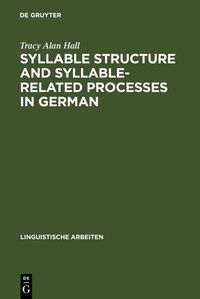
Syllable Structure and Syllable-Related Processes in German
1st Edition
Published on 20. April 2011
VII, 246 pages
978-3-11-165788-2 (ISBN)
Description

No detailed description available for "Syllable Structure and Syllable-Related Processes in German".
More details
Other editions
Additional editions
Tracy Alan Hall
Syllable Structure and Syllable-Related Processes in German
Book
01/1992
1st Edition
De Gruyter
€169.95
Article exhausted; check different version
Tracy Alan Hall
Syllable Structure and Syllable-Related Processes in German
Book
01/1992
1st Edition
De Gruyter
€119.95
Shipment within 7-9 days
Content
- Intro
- Acknowledgments
- Introduction
- Chapter 1: Theoretical principles and background on German phonology
- 1.1 Theoretical overview
- 1.2 Background on German phonology
- Notes to Chapter 1
- Chapter 2: German syllable structure and syllabification
- 2.1 Syllabification model and theoretical assumptions
- 2.2 Further remarks on syllable structure
- 2.3 On ambisyllabicity
- 2.4 Syllable- and foot-sensitive rules
- 2.5 Syllable Structure Algorithm
- 2.6 The sonority hierarchy
- 2.7 The German onset
- 2.8 On the cyclicity of syllabification
- 2.9 Fast Speech Resyllabification
- 2.10 Rubach (1990)
- 2.11 On compounds and prefixed words and postlexical resyllabification
- 2.12 The German coda
- 2.13 Devoicing and Coronal Obstruent Adjunction
- 2.14 Remarks on the syllable structure of monomorphemes
- Notes to Chapter 2
- Chapter 3: The syllabification of glides and vowels
- 3.1 Hiatus sequences and the German diphthongs
- 3.2 The syllabification of diphthongs
- 3.3 On the voiced fricatives [j] and [v]
- 3.4 Prevocalic glides
- 3.5 On Structure Preservation
- Notes to Chapter 3
- Chapter 4: The velar nasal and the representation of schwa
- 4.1 Lexical processes involving nasal consonants
- 4.2 Postlexical processes involving nasal consonants
- 4.3 The velar nasal
- 4.4 The representation of schwa
- 4.5 Cyclic syllabification and Schwa Epenthesis
- 4.6 On Structure Preservation
- Notes to Chapter 4
- Chapter 5: The distribution of [ç] and [x]
- 5.1 Background and data
- 5.2 DFA and the German lexicon
- 5.3 [ç] - [g] alternations
- 5.4 On Structure Preservation
- Notes to Chapter 5
- References
