

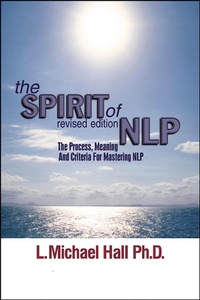
The Spirit of NLP
The Process, Meaning & Criteria for Mastering NLP
Published on 22. August 1996
352 pages
978-1-84590-758-7 (ISBN)
Description

This fully revised edition brings you a brilliant Richard Bandler master training and significant contributions from Eric Robbie, Wyatt Woodsmall, Tad James, Christina Hall and the late Will MacDonald. "No other book covers this breadth of NLP Master Practitioner material." Frank Daniels, NLP trainer
More details
Language
English
Place of publication
Carmarthen
United Kingdom
Target group
College/higher education
Professional and scholarly
File size
1,42 MB
ISBN-13
978-1-84590-758-7 (9781845907587)
Copyright in bibliographic data and cover images is held by Nielsen Book Services Limited or by the publishers or by their respective licensors: all rights reserved.
Schweitzer Classification
Other editions
Additional editions
Book
08/1996
Crown House Publishing
€27.20
Shipment within 3-4 weeks
Person
L. Michael Hall is a Cognitive Psychologist who through research into NLP and Self-Actualization Psychology is now a modeler of human excellence; he has completed 15 modeling projects from Resilience, Women in Leadership, Self-Actualization, Coaching, Self-Actualizing Leaders, Managers, and Companies, Selling, Defusing, Wealth Creation, etc. He has authored 50 NLP books and a series on Meta-Coaching. Michael co-founded the ISNS (International Society of Neuro-Semantics) and the MCF (Meta-Coaching Foundation) and is an internationally renowned trainer.
Content
- Cover
- Title Page
- Dedications
- Table of Contents
- List of figures
- Acknowledgments
- Foreword : Introducing The Spirit of NLP
- Part One : Programming
- Chapter One : Developing an Internal Propulsion System
- Chapter Two : Learning the Art of Trance
- Chapter Three : Formatting the Language and State of Trance
- Part Two : Linguistics
- Chapter Four : Mastering NLP Linguistics (the Meta-Model)
- Chapter Five : Master Level Persuasive Reframing
- Part Three : Neurology
- Chapter Six : Mastering the Neurology of NLP
- Chapter Seven : The Wild and Wonderful World of Submodalities
- Chapter Eight : Tracking Down Where Brains Go
- Chapter Nine : Visiting More Exotic and Empowering States
- Chapter Ten : NLP Meta-Programs
- Chapter Eleven : Kinesthetic Time-Lines
- Appendix A : Why I Used E-Prime in Writing this Book
- Appendix B : The New NLP Domain of Meta-States
- Bibliography
- Copyright
