

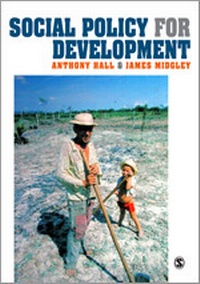
Social Policy for Development
1st Edition
Published on 31. March 2004
304 pages
978-1-4129-3231-8 (ISBN)
Description

'Strong social policy is essential for sustainable growth. This book is an extremely useful overview of social policy issue for policy makers and anyone who wants to understand the true roots of successful sustainable development' - Ian Johnson, Vice President for Sustainable Development, The World Bank
'Throughout the world issues of social development have now taken centre stage. There is no more comprehensive and readable guide to the choices and conflicts of this global drama. This book is essential reading for all students and practitioners of social development - and for every World Bank economist'
- David Piachaud, Professor of Social Policy, London School of Economics
This much-needed textbook fulfils a major gap in providing a complete up-to-date guide and introduction to the increasingly important role of social policy in the context of development processes and practice.
Across a number of key sectors and areas of social policy concern, the authors accessibly introduce and explain the main conceptual debates, the most recent policy discussions, and provide applied examples to illustrate the latest developments in the social policy and planning field. Central topics covered include:
- poverty
- rural development
- urban development
- education
- health
- social work
- social welfare
- international development and cooperation.
Social Policy for Development is an essential text for all students and practitioners alike seeking a deeper understanding of the issues of poverty, social exclusion and deprivation across social policy and development studies internationally.
'Throughout the world issues of social development have now taken centre stage. There is no more comprehensive and readable guide to the choices and conflicts of this global drama. This book is essential reading for all students and practitioners of social development - and for every World Bank economist'
- David Piachaud, Professor of Social Policy, London School of Economics
This much-needed textbook fulfils a major gap in providing a complete up-to-date guide and introduction to the increasingly important role of social policy in the context of development processes and practice.
Across a number of key sectors and areas of social policy concern, the authors accessibly introduce and explain the main conceptual debates, the most recent policy discussions, and provide applied examples to illustrate the latest developments in the social policy and planning field. Central topics covered include:
- poverty
- rural development
- urban development
- education
- health
- social work
- social welfare
- international development and cooperation.
Social Policy for Development is an essential text for all students and practitioners alike seeking a deeper understanding of the issues of poverty, social exclusion and deprivation across social policy and development studies internationally.
All prices
More details
Edition
First Edition
Language
English
Place of publication
London
United Kingdom
Publishing group
Sage Publications Ltd (Digital)
Target group
College/higher education
ISBN-13
978-1-4129-3231-8 (9781412932318)
Copyright in bibliographic data and cover images is held by Nielsen Book Services Limited or by the publishers or by their respective licensors: all rights reserved.
Schweitzer Classification
Other editions
Additional editions
Anthony Hall | James O. Midgley
Social Policy for Development
Book
03/2004
1st Edition
SAGE Publications Inc
€270.37
Shipment within 15-20 days
Anthony Hall | James O. Midgley
Social Policy for Development
Book
03/2004
1st Edition
SAGE Publications Inc
€113.30
Shipment within 15-20 days
Persons
James Midgley is the Harry and Riva Specht Professor of Public Social Services and Dean Emeritus at the University of California, Berkeley. Originally from South Africa, he studied at the University of Cape Town and the London School of Economics and held academic appointments at both universities before moving to the United States 1985 where he served as as Dean of the School of Social Work and Associate Vice Chancellor for Research at Louisiana State University. He accepted the appointment as Specht Professor and Dean of the School of Social Welfare Berkeley in 1997.
He has published widely on issues of social development, social policy, social work and international social welfare. His major books include Professional Imperialism: Social Work in the Third World. Heinemann, 1981; Social Security, Inequality and the Third World, Wiley, 1984; Comparative Social Policy and the Third World, Harvester, 1987 (with Stewart MacPherson); The Social Dimensions of Development: Social Policy and Planning in the Third World, Gower, 1989 (with Margaret Hardiman); Social Development: The Developmental Perspective in Social Welfare, Sage, 1995; Social Welfare in Global Context, Sage, 1997; Social Policy for Development, Sage, 2004 (with Anthony Hall) and Social Development: Theory and Practice, Sage, 2014.
In addition, he has edited or co-edited many books on international social welfare and social development. Among the most recent are Social Work and Social Development: Theories and Skills for Developmental Social Work, Oxford University Press, 2010 (with Amy Conley); Social Policy and Poverty in East Asia: The Role of Social Security, Routledge, 2010 (with K. L. Tang); Grassroots Social Security in Asia, Routledge, 2011 (with Mitsuhiko Hosaka); Colonialism and Welfare: Social Policy and the British Imperial Legacy. Edward Elgar, 2011 (with David Piachaud); Planning and Community Development: Case Studies. Madrid: Technical University of Madrid, GrupoGESPLAN-UPM, 2012 (with Adolfo Carzola); Social Protection, Economic Growth and Social Change: Goals, Issues and Trajectories in China, India, Brazil and Africa. Edward Elgar, 2013 (with David Piachaud); Social Protection in Southern Africa: New Opportunities for Social Development. Routledge, 2014 (with Leila Patel and Marian Ulricksen) and Social Policy and Social Change in East Asia. Lexington Books, 2014 (with James Lee and Yapeng Zhu).
He is a Fellow of the American Academy of Social Work and Social Welfare and holds Honorary Professorial appointments at the University of Johannesburg in South Africa, Nihon Fukushi University in Japan, Sun Yat-sen University in China and the Hong Kong Polytechnic University.
He has published widely on issues of social development, social policy, social work and international social welfare. His major books include Professional Imperialism: Social Work in the Third World. Heinemann, 1981; Social Security, Inequality and the Third World, Wiley, 1984; Comparative Social Policy and the Third World, Harvester, 1987 (with Stewart MacPherson); The Social Dimensions of Development: Social Policy and Planning in the Third World, Gower, 1989 (with Margaret Hardiman); Social Development: The Developmental Perspective in Social Welfare, Sage, 1995; Social Welfare in Global Context, Sage, 1997; Social Policy for Development, Sage, 2004 (with Anthony Hall) and Social Development: Theory and Practice, Sage, 2014.
In addition, he has edited or co-edited many books on international social welfare and social development. Among the most recent are Social Work and Social Development: Theories and Skills for Developmental Social Work, Oxford University Press, 2010 (with Amy Conley); Social Policy and Poverty in East Asia: The Role of Social Security, Routledge, 2010 (with K. L. Tang); Grassroots Social Security in Asia, Routledge, 2011 (with Mitsuhiko Hosaka); Colonialism and Welfare: Social Policy and the British Imperial Legacy. Edward Elgar, 2011 (with David Piachaud); Planning and Community Development: Case Studies. Madrid: Technical University of Madrid, GrupoGESPLAN-UPM, 2012 (with Adolfo Carzola); Social Protection, Economic Growth and Social Change: Goals, Issues and Trajectories in China, India, Brazil and Africa. Edward Elgar, 2013 (with David Piachaud); Social Protection in Southern Africa: New Opportunities for Social Development. Routledge, 2014 (with Leila Patel and Marian Ulricksen) and Social Policy and Social Change in East Asia. Lexington Books, 2014 (with James Lee and Yapeng Zhu).
He is a Fellow of the American Academy of Social Work and Social Welfare and holds Honorary Professorial appointments at the University of Johannesburg in South Africa, Nihon Fukushi University in Japan, Sun Yat-sen University in China and the Hong Kong Polytechnic University.
Content
Social Policy for Development
Local, National and Global Dimensions
Poverty and Development
The Challenge for Social Policy
Social Policy and Rural Development
From Modernization to Sustainable Livelihoods
Social Policy and Urban Development
Basic Education for Social Development
Health Systems in Developing Countries
Social Work and the Human Services
Social Security Policies and Programmes
International Development Co-Operation and Social Policy
Local, National and Global Dimensions
Poverty and Development
The Challenge for Social Policy
Social Policy and Rural Development
From Modernization to Sustainable Livelihoods
Social Policy and Urban Development
Basic Education for Social Development
Health Systems in Developing Countries
Social Work and the Human Services
Social Security Policies and Programmes
International Development Co-Operation and Social Policy
