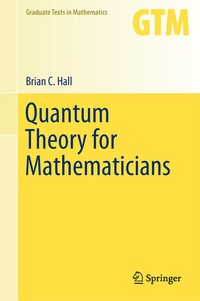
Quantum Theory for Mathematicians
Description

Although ideas from quantum physics play an important role in many parts of modern mathematics, there are few books about quantum mechanics aimed at mathematicians. This book introduces the main ideas of quantum mechanics in language familiar to mathematicians. Readers with little prior exposure to physics will enjoy the book's conversational tone as they delve into such topics as the Hilbert space approach to quantum theory; the Schrödinger equation in one space dimension; the Spectral Theorem for bounded and unbounded self-adjoint operators; the Stone-von Neumann Theorem; the Wentzel-Kramers-Brillouin approximation; the role of Lie groups and Lie algebras in quantum mechanics; and the path-integral approach to quantum mechanics.
The numerous exercises at the end of each chapter make the book suitable for both graduate courses and independent study. Most of the text is accessible to graduate students in mathematics who have had a first course in real analysis, covering the basics of L2 spaces and Hilbert spaces. The final chapters introduce readers who are familiar with the theory of manifolds to more advanced topics, including geometric quantization.
Reviews / Votes
"This book is an introduction to quantum mechanics intended for mathematicians and mathematics students who do not have a particularly strong background in physics. . A well-qualified graduate student can learn a lot from this book. I found it to be clear and well organized, and I personally enjoyed reading it very much." (David S. Watkins, SIAM Review, Vol. 57 (3), September, 2015)
"This textbook is meant for advanced studies on quantum mechanics for a mathematical readership. The exercises at the end of each chapter make the book especially valuable." (A. Winterhof, Internationale Mathematischen Nachrichten, Issue 228, 2015)
"There are a few textbooks on quantum theory for mathematicians who are alien to the physical culture . but this modest textbook will surely find its place. All in all, the book is well written and accessible to any interested mathematicians and mathematical graduates." (Hirokazu Nishimura, zbMATH, Vol. 1273, 2013)
More details
Other editions
Additional editions