

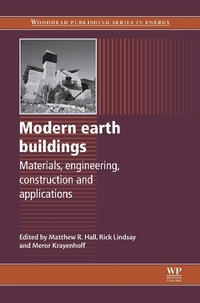
Modern Earth Buildings
Materials, Engineering, Constructions and Applications
Published on 11. July 2012
800 pages
978-0-85709-616-6 (ISBN)
Description

The construction of earth buildings has been taking place worldwide for centuries. With the improved energy efficiency, high level of structural integrity and aesthetically pleasing finishes achieved in modern earth construction, it is now one of the leading choices for sustainable, low-energy building. Modern earth buildings provides an essential exploration of the materials and techniques key to the design, development and construction of such buildings.Beginning with an overview of modern earth building, part one provides an introduction to design and construction issues including insulation, occupant comfort and building codes. Part two goes on to investigate materials for earth buildings, before building technologies are explored in part three including construction techniques for earth buildings. Modern earth structural engineering is the focus of part four, including the creation of earth masonry structures, use of structural steel elements and design of natural disaster-resistant earth buildings. Finally, part five of Modern earth buildings explores the application of modern earth construction through international case studies.With its distinguished editors and international team of expert contributors, Modern earth buildings is a key reference work for all low-impact building engineers, architects and designers, along with academics in this field.
- Provides an essential exploration of the materials and techniques key to the design, development and construction of modern earth buildings
- Comprehensively discusses design and construction issues, materials for earth buildings, construction techniques and modern earth structural engineering, among other topics
- Examines the application of modern earth construction through international case studies
More details
Other editions
Additional editions
Matthew R. Hall | R. Lindsay | Meror Krayenhoff
Modern Earth Buildings
Materials, Engineering, Constructions and Applications
Book
07/2012
Woodhead Publishing Ltd
€334.81
Shipment within 10-15 days
Content
Contributor contact details
Woodhead Publishing Series in Energy
Preface
Part I: Introduction to modern earth buildings
Chapter 1: Overview of modern earth building
Abstract:
1.1 Introduction
1.2 Definition of modern earth building
1.3 The significance of modern earth building in the current and future construction industries
1.4 Changes in the modern earth building industry
1.5 Managing the demands of the modern construction industry
Chapter 2: Hygrothermal behaviour and occupant comfort in modern earth buildings
Abstract:
2.1 Introduction
2.2 Hygrothermal loads and modelling
2.3 Thermal and hygric properties of earth materials
2.4 Hygrothermal behaviour and passive air conditioning
2.5 Indoor health and air quality
2.6 Sources of further information
2.8 Appendix: nomenclature
Chapter 3: Fabric insulation, thermal bridging and acoustics in modern earth buildings
Abstract:
3.1 Introduction
3.2 Approaches to fabric insulation
3.3 Thermal bridging theory
3.4 Thermal bridging simulation tools
3.5 Acoustic reverberation
3.6 Sources of further information
3.8 Appendix: nomenclature
Chapter 4: Modern earth building codes, standards and normative development
Abstract:
4.1 Introduction: a short history of building codes for using earth as a building material
4.2 Types of 'standards' for earth buildings
4.3 Normative documents for earth building
4.4 Selecting the parameters for earth building standards
4.5 New developments in earth building standards
4.6 Conclusions
Chapter 5: Passive house design: a benchmark for thermal mass fabric integration
Abstract:
5.1 Introduction
5.2 Description of Passive House
5.3 Functional principles of Passive House
5.4 Case studies of Passive Houses in different climates
5.5 Examples of Passive House architecture in Germany
5.6 Future trends
5.7 Sources of further information
Part II: Earth materials engineering and earth construction
Chapter 6: Soil materials for earth construction: properties, classification and suitability testing
Abstract:
6.1 Introduction
6.2 Soil formation
6.3 Soil types
6.4 Soil consistency
6.5 Compaction of soil
6.6 Conclusion
6.8 Appendix
Chapter 7: Alternative and recycled materials for earth construction
Abstract
7.1 Introduction
7.2 Classification
7.3 Types of alternative material
7.4 Characteristics of alternative and recycled materials
7.5 Form of recycled and alternative materials: bulk or binder
7.6 Leaching
7.7 Physical and mechanical properties of alternative and recycled materials
7.8 The use and reuse life cycle
7.9 Future trends and conclusions
7.10 Sources of further information
7.12 Appendix
Chapter 8: Soil mechanics and earthen construction: strength and mechanical behaviour
Abstract:
8.1 Introduction
8.2 Basic mechanics
8.3 Fundamental soil behaviour
8.4 Effective stress
8.5 Models of shear strength for soils
8.6 Unsaturated soil behaviour
8.7 The use of soil mechanics in earthen construction
8.8 Future trends
8.9 Sources of further information
Chapter 9: Soil stabilisation and earth construction: materials, properties and techniques
Abstract:
9.1 Introduction
9.2 Lime stabilisation
9.3 Cement and pozzolans
9.4 Bituminous binders and emulsions
9.5 Synthetic binders, polymers and adhesives
9.6 Fibre reinforcement
9.7 Selection tool for modern stabilised earth construction
Chapter 10: Integral admixtures and surface treatments for modern earth buildings
Abstract:
10.1 Introduction
10.2 Integral admixtures for modern earth construction
10.3 Surface treatment for modern earth buildings
10.4 Future trends
10.5 Sources of information
Chapter 11: Weathering and durability of earthen material and structures
Abstract:
11.1 Introduction
11.2 Water content increase in earthen walls
11.3 Strategies to increase the durability of earth walls
11.4 Current tests for assessing the durability of earthen materials
11.5 Surface coatings and finishes of earth structures
11.6 Long-term performance testing of earth walls
11.7 Future trends and conclusions
11.
