

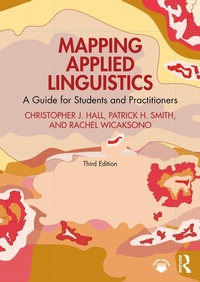
Mapping Applied Linguistics
A Guide for Students and Practitioners
3rd Edition
Published on 30. January 2026
536 pages
978-1-040-36358-4 (ISBN)
Description

Mapping Applied Linguistics: A Guide for Students and Practitioners, Third Edition, provides a newly updated, wide-ranging introduction to the full scope of applied linguistics. This innovative book maps the diverse and constantly expanding range of theories, methods and issues faced by students and practitioners around the world, integrating both sociocultural and cognitive perspectives. Practically oriented and ideally suited to students new to the discipline, Mapping Applied Linguistics provides in-depth coverage of:
* multilingualism, language variation, and Global Englishes
* literacy, language teaching, and bilingual education
* discourse analysis
* language policy and planning
* lexicography and translation
* language pathology and forensic linguistics
The third edition integrates new developments such as activist applied linguistics, raciolinguistics, translanguaging, and generative AI. It includes many new references and weblinks, completely updated further reading (including several open source books), as well as revised activity suggestions for each chapter. The online support material has been fully updated, providing a wealth of additional learning material, including activities, flashcards and links to the latest online resources.
Mapping Applied Linguistics is essential reading for students studying applied linguistics, TESOL, general linguistics and language and literacy education at the advanced undergraduate or master's degree level. It also provides a gateway for practitioners and specialists seeking to better understand the wider scope of their work.
* multilingualism, language variation, and Global Englishes
* literacy, language teaching, and bilingual education
* discourse analysis
* language policy and planning
* lexicography and translation
* language pathology and forensic linguistics
The third edition integrates new developments such as activist applied linguistics, raciolinguistics, translanguaging, and generative AI. It includes many new references and weblinks, completely updated further reading (including several open source books), as well as revised activity suggestions for each chapter. The online support material has been fully updated, providing a wealth of additional learning material, including activities, flashcards and links to the latest online resources.
Mapping Applied Linguistics is essential reading for students studying applied linguistics, TESOL, general linguistics and language and literacy education at the advanced undergraduate or master's degree level. It also provides a gateway for practitioners and specialists seeking to better understand the wider scope of their work.
Reviews / Votes
"This unique book is a comprehensive and insightful resource for anyone in the field of applied linguistics. It bridges theory and practice, offers valuable tools and includes contemporary issues such as translanguaging, raciolinguistics and the impact of technology. A must-read for anyone exploring the dynamic nature of language studies."Deena Boraie, International Research Foundation for English Language Education, Former president, TESOL International Organization
"The book is beneficial to both the student and seasoned applied linguist because it provides a bird's eye view of applied linguistics, covering some of the major fields: lexicography, discourse analysis and other topics which are rapidly having an impact on applied linguistics, such as language pathology. The book clearly captures applied linguistics as both an established and growing field."
Sinfree Makoni, Pennsylvania State University, USA
"Mapping Applied Linguistics (third edition) delivers a thorough, engaging, and no-nonsense overview of the field. With expanded insights on sign languages, raciolinguistics, and translanguaging, it addresses contemporary language-related issues with clarity and depth. It is an essential guide for applied linguistics students and practitioners alike."
Zhu Hua, University College London, UK, Former chair, British Association for Applied Linguistics
"Mapping Applied Linguistics offers an insightful and comprehensive exploration of the dynamic and ever-evolving field of applied linguistics, systematically navigates through complex topics like language learning, translation, literacy, and the challenges faced by endangered language communities, and captures the essence of applied linguistics as it intersects with crucial global issues, including migration, technological advancements, and environmental changes."
Fuad Abdul Hamied, Universitas Pendidikan Indonesia, President, Asia-TEFL
More details
Edition
3rd edition
Language
English
Place of publication
London
United Kingdom
Publishing group
Taylor & Francis Ltd
Target group
College/higher education
Professional and scholarly
Illustrations
12 Tables, black and white; 29 Line drawings, black and white; 40 Halftones, black and white; 69 Illustrations, black and white
File size
12,23 MB
ISBN-13
978-1-040-36358-4 (9781040363584)
Copyright in bibliographic data and cover images is held by Nielsen Book Services Limited or by the publishers or by their respective licensors: all rights reserved.
Schweitzer Classification
Other editions
Additional editions
Christopher J. Hall | Patrick H. Smith | Rachel Wicaksono
Mapping Applied Linguistics
A Guide for Students and Practitioners
Book
approx. 01/2026
3rd Edition
Routledge
€65.50
Not yet published
Christopher J. Hall | Patrick H. Smith | Rachel Wicaksono
Mapping Applied Linguistics
A Guide for Students and Practitioners
Book
approx. 01/2026
3rd Edition
Routledge
€212.60
Not yet published

Book
06/2025
Routledge
Unfortunately, price unknown
Available (delivery time upon request)
Persons
Christopher J. Hall is Professor of Applied Linguistics at York St John University.
Patrick H. Smith is Professor of Bilingual & ESL Education and Honorary Professor of International Studies at Texas State University.
Rachel Wicaksono is Professor of TESOL and Applied Linguistics and Head of the School of Education, Language and Psychology at York St John University.
Patrick H. Smith is Professor of Bilingual & ESL Education and Honorary Professor of International Studies at Texas State University.
Rachel Wicaksono is Professor of TESOL and Applied Linguistics and Head of the School of Education, Language and Psychology at York St John University.
Content
List of figures
List of tables
Preface to the third edition
How is the book organized?
How can the book be used?
Acknowledgements
Chapter 1 Introduction
PART A LANGUAGE IN EVERYDAY USE
Chapter 2 Language variation
Chapter 3 Key populations
Chapter 4 Discourse analysis
Chapter 5 Language policy and planning
PART B LANGUAGE, LEARNING, AND EDUCATION
Chapter 6 Literacy
Chapter 7 Language and education
Chapter 8 Bilingual and multilingual education
Chapter 9 Additional language education
PART C LANGUAGE AND SPECIALIZED USES
Chapter 10 Translation
Chapter 11 Lexicography
Chapter 12 Forensic linguistics
Chapter 13 Language pathology
Chapter 14 Key predictions and future directions
Glossary
References
General index
Index of languages
Index of places
List of tables
Preface to the third edition
How is the book organized?
How can the book be used?
Acknowledgements
Chapter 1 Introduction
PART A LANGUAGE IN EVERYDAY USE
Chapter 2 Language variation
Chapter 3 Key populations
Chapter 4 Discourse analysis
Chapter 5 Language policy and planning
PART B LANGUAGE, LEARNING, AND EDUCATION
Chapter 6 Literacy
Chapter 7 Language and education
Chapter 8 Bilingual and multilingual education
Chapter 9 Additional language education
PART C LANGUAGE AND SPECIALIZED USES
Chapter 10 Translation
Chapter 11 Lexicography
Chapter 12 Forensic linguistics
Chapter 13 Language pathology
Chapter 14 Key predictions and future directions
Glossary
References
General index
Index of languages
Index of places
