

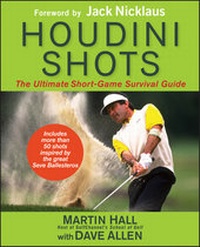
Houdini Shots
Description

Presents easy-to-follow techniques for improving your short game, with more than fifty shots inspired by five-time major winner Seve Ballesteros
Offers valuable insights into the imagination and thought process of Ballesteros, one of golf's greatest innovators, as well as tips for the average golfer on how to escape the most difficult short-game situations
Written by Martin Hall, one of Golf Magazine's Top 100 Teachers and the 2008 PGA Teacher of the Year
Draws on Hall's hours of experience watching Ballesteros hit balls and create shots up close while playing on the European PGA Tour
Includes never-before published photos of Ballesteros at the peak of his career, hitting many of the shots in the book
All prices
More details
Other editions
Additional editions
Persons
DAVE ALLEN has spent more than a dozen years as an instruction writer/editor for Golf Magazine, Golf for Women magazine, and GolfChannel.com. He has cowritten several golf books, including Play Golf the Pebble Beach Way and Golf Annika's Way.
Content
Acknowledgments xiii
Introduction 1
1 Martin's 7 Maxims of the Short Game 9
2 How to Cash in Your Chips 27
3 Pitching from 50 Yards and In 47
4 Great Sand Escapes 73
5 Long, Short, and Breaking Putts 101
6 Various Other Houdini-Like Escapes 121
7 Short-Game Skills and Practice Drills 145
Afterword 167
Index 171
Introduction
The first time I saw Severiano Ballesteros was at the World Match Play Championship in 1975. At the time, I was an assistant professional at the Wentworth Club outside of London, and there was this young, dashing Spaniard with jet-black hair hitting balls on the driving range. I watched him for a few minutes and walked away, thinking, “Hmm, that’s impressive,” and then went about my business.
It wasn’t until the following year that I really took notice of the same player who would soon become the Arnold Palmer of European golf. I was loosening up on the range in my very first European Tour event in Portugal, when suddenly I heard this extremely loud thwack . . . thwack . . . thwack sound emanating from behind me. It was a much different sound than I’d ever heard before, one I later learned could be created only if you are hitting the ball smack-bang in the middle of the clubface with a tremendous amount of clubhead speed. I turned around to see what it was, and there was Seve in a bright red Slazenger sweater, hitting shots the likes of which I’d never seen before. I can remember it to this very day.
I stopped hitting balls myself and watched intently for several minutes, something I would become accustomed to doing with Seve during the next thirty-odd years. I remember calling my dad from the course after missing the third-round cut, saying, “There’s some Spanish chap named ‘Boldarino’ or ‘Ballarama’ or something other out here, and I’m going to follow him for a bit. He looks good to me.” So I watched him over the final six holes and, when it was over, couldn’t help but think, “Wow, if this is the future of European golf, then perhaps I better go back into teaching.” Holes that I would hit a driver and a 6-iron to, he was cutting the corners on and driving his ball on the front of the green. There was one hole, about 520 yards, which was a driver-3-wood-pitching wedge for almost everyone in the field. Word got around the clubhouse that Seve knocked it on the green in two, which was unheard of back then with persimmon woods and balata balls. He was just so powerful.
Outside of Pedrena, Spain, and the players on the European Tour, few people knew just how good this nineteen-year-old was, or how good he was about to become. That all changed a few months later when he tied for second in the British Open at Royal Birkdale, finishing six shots behind Johnny Miller. From that moment forward, the whole world took notice, and his career took off like a rocket.
I never had the pleasure of playing with Seve, who passed away from brain cancer in May 2011, but I watched him hit hundreds and hundreds of balls, and not just on the range. I recall Seve and seven or eight of his fellow countrymen hanging around the practice green early one evening at the German Open, hitting all types of impossible chip shots for several hours. I don’t know what they were playing for—a beer, a soda, bragging rights—but they were laughing and enjoying every moment of it like a group of young children on a playground. During one rain delay in Holland, they took their game inside the clubhouse, pushed aside some chairs, and took turns trying to pitch a ball into a round ashtray. Sometimes they would do it. It wasn’t the easiest thing in the world to nip the ball off a bare carpet, but to Seve it seemed routine.
Although Seve could hit the ball farther than most people, it was his flair for the short game and his ability to create something out of nothing that made him stand out. Inside 60 yards, he was Houdini with a golf club. Anyone who watched or played against the Spaniard was left mesmerized by his finesse and shotmaking abilities around the green, which produced some of the bravest and unlikeliest recovery shots in golf history.
The great Jack Nicklaus mused how he once saw Seve hitting soft, greenside bunker shots with a 1-iron “just fooling around” in practice. Television commentator David Feherty recalled how Seve once thumped a 4-iron into the face of a cavernous bunker at St. Andrews, getting the ball to drop softly over the lip and trickle down just 4 feet from the hole. I’ll never forget the pitch-and-run shot (what I like to call “the chip and bumble”) he hit from just left of the green on the final hole at the ’76 British Open, threading a 9-iron between two greenside bunkers and taking just enough speed off the ball to leave himself with a short 4-footer for birdie. The ensuing putt allowed Seve to tie Nicklaus for second.
Everyone from my generation has a favorite Ballesteros story, and it usually involves Seve pulling off some kind of short-game shot that nobody else in the world could fathom. Probably my favorite Seve story comes from Billy Foster, Seve’s one-time caddie. Ballesteros had knocked his approach shot through the back of the 16th green at Wentworth, leaving himself with virtually no green to work with and seemingly no shot—because the flagstick was also positioned in the back. Billy turned to Seve and asked, “What do you think?” Seve replied, “No problem, I will hit the flag.” A puzzled Billy thought he meant the flagstick, which was a risky play because the ball could deflect anywhere if it indeed hit the stick. What he didn’t know was that Seve meant the actual cloth of the flag. Sure enough, Seve popped the ball up in the air, hit the flag, and landed the ball a few inches from the hole.
Who’s to say where he learned that one? Perhaps it was during one of many late afternoons on the chipping green with the other Spaniards, or it was on the local golf course in his hometown of Pedrena, where he and the other caddies would rise before dawn and often attempt such unorthodox shots. One thing is certain: Seve wasn’t afraid of any shot, and he had the imagination and skills to pull it off. Whether you were a fan, a budding young pro like myself, or a fellow competitor, you hung on every move he made.
“The imaginative player sees several ways to recover from a situation,” Seve once said, “while the mechanical player sees only one.”
Seve wasn’t just a master of the impossible shot, he was a terrific putter, and his pitching, chipping, and overall play from inside 100 yards were brilliant. There was no one better in the late 1970s and throughout the 1980s at getting the ball up-and-down from around the green. And if that meant getting it up-and-down from the ball washer, he’d do it. Seve had an innate ability to put the middle of the clubface on the ball every time, no matter what the lie. He never mis-hit a short-game shot; thus, he had as good a short game as anyone who’s ever played the game.
Said six-time major winner Nick Faldo, who like Ballesteros won three Open Championships: “For golf, he was the greatest show on earth. I was a fan and so fortunate I had a front row seat.”
Ballesteros won eighty-seven times around the world, including five major championships, and played on eight European Ryder Cup teams. During one nine-year stretch from 1979 through 1987, Seve won forty-two tournaments worldwide, including four of his five major titles (the 1980 and 1983 Masters; the 1979 and 1984 British Open). He was far and away the best golfer in Europe during this period, and many would argue he was the most dominant player in the world.
During the 1980s, Seve served as a playing editor for Golf Magazine. His byline appeared on many instruction articles, most having to do with the short game. In 1986, Golf Magazine staff photographer Leonard Kamsler was sent to Spain to shoot a series of instruction tips with Seve under the tentative title, or theme, of “Houdini Shots.” These would focus on some of Seve’s greatest escape acts—from hitting the ball out from under the lip of a bunker to playing an intentional hook out of the trees. The story never ran, nor did any of the pictures, which you will see for the very first time in this book. The photos taken for this article were the inspiration behind Houdini Shots, which features more than sixty images of Seve in his prime, each in some small way providing a hint at his brilliance and, more important, just how he was always able to get himself out of trouble.
Seve was unquestionably the greatest shotmaker and innovator of his generation.
This is especially true when it came to the short game: Whether his ball was buried in a greenside bunker, nestled down in ankle-deep rough, or up against a tree, Seve found a way to get the ball on the green. As a result, he was one of the very best ever at playing “scoring golf.” This is when you scuff your 3-wood down the fairway on a par 5, gouge the ball up to about 80 yards, stick your approach to 4 feet, and make your birdie. Most amateurs spend too much time working on their full swing, giving their short game and scoring skills no attention at all. Successful professionals do exactly the opposite—they spend a lot more time on the short game than they do on the full swing. Professionals are playing scoring golf, whereas amateurs are trying to play what I like to call “exhibition golf.” When all is said and done, the score matters most.
I can’t overemphasize the importance of a good short game. The great Phil Rodgers once said that “the two most important shots on a hole are always the last two.” I couldn’t agree more. Most people who shoot 85 or higher would be shocked if they really knew how poor their short game was. They’re under the assumption that their driver or...
