

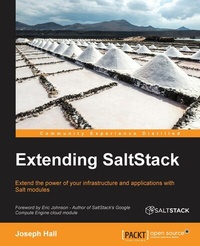
Extending SaltStack
Build and write salt modules
Published on 8. July 2025
240 pages
978-1-78588-816-8 (ISBN)
Description

Extend the power of your infrastructure and applications with Salt modules
Key Features
[*] Get the most up-to-date practical resource on writing new Salt modules and extending Salt
[*] Learn through use cases and encounter both commonly-used modules as well as advanced ones
[*] Effectively troubleshoot problems and hiccups encountered while building and putting modules to work
Book DescriptionSalt already ships with a very powerful set of tools, but that doesn't mean that they all suit your needs perfectly. By adding your own modules and enhancing existing ones, you can bring the functionality that you need to increase your productivity. Extending SaltStack follows a tutorial-based approach to explain different types of modules, from fundamentals to complete and full-functioning modules. Starting with the Loader system that drives Salt, this book will guide you through the most common types of modules. First you will learn how to write execution modules. Then you will extend the configuration using the grain, pillar, and SDB modules. Next up will be state modules and then the renderers that can be used with them. This will be followed with returner and output modules, which increase your options to manage return data. After that, there will be modules for external file servers, clouds, beacons, and finally external authentication and wheel modules to manage the master. With this guide in hand, you will be prepared to create, troubleshoot, and manage the most common types of Salt modules and take your infrastructure to new heights!What you will learn
[*] Understand the working of Salt s Loader system
[*] Write several of the most common types of Salt modules
[*] Interact between different kinds of modules and build new ones
[*] Submit open source modules upstream to the Salt project
[*] Make Salt interact with third-party services and applications
Who this book is forThis book is for both new and existing Salt developers who are looking to build and write new Salt modules. Some prior Python development experience is expected.
Key Features
[*] Get the most up-to-date practical resource on writing new Salt modules and extending Salt
[*] Learn through use cases and encounter both commonly-used modules as well as advanced ones
[*] Effectively troubleshoot problems and hiccups encountered while building and putting modules to work
Book DescriptionSalt already ships with a very powerful set of tools, but that doesn't mean that they all suit your needs perfectly. By adding your own modules and enhancing existing ones, you can bring the functionality that you need to increase your productivity. Extending SaltStack follows a tutorial-based approach to explain different types of modules, from fundamentals to complete and full-functioning modules. Starting with the Loader system that drives Salt, this book will guide you through the most common types of modules. First you will learn how to write execution modules. Then you will extend the configuration using the grain, pillar, and SDB modules. Next up will be state modules and then the renderers that can be used with them. This will be followed with returner and output modules, which increase your options to manage return data. After that, there will be modules for external file servers, clouds, beacons, and finally external authentication and wheel modules to manage the master. With this guide in hand, you will be prepared to create, troubleshoot, and manage the most common types of Salt modules and take your infrastructure to new heights!What you will learn
[*] Understand the working of Salt s Loader system
[*] Write several of the most common types of Salt modules
[*] Interact between different kinds of modules and build new ones
[*] Submit open source modules upstream to the Salt project
[*] Make Salt interact with third-party services and applications
Who this book is forThis book is for both new and existing Salt developers who are looking to build and write new Salt modules. Some prior Python development experience is expected.
All prices
More details
Edition
Digital original
Language
English
Place of publication
Birmingham
United Kingdom
Target group
US School Grade: College Graduate Student
Edition type
Digital original
File size
1,10 MB
ISBN-13
978-1-78588-816-8 (9781785888168)
Copyright in bibliographic data and cover images is held by Nielsen Book Services Limited or by the publishers or by their respective licensors: all rights reserved.
Schweitzer Classification
Other editions
Additional editions
Person
Hall Joseph :
Starting as a support technician and progressing to being a web programmer, QA engineer, systems administrator, Linux instructor, and cloud engineer, Joseph Hall has touched just about every area of the modern technology world. He is currently a senior cloud and integrations engineer at SaltStack. Joseph enjoys working with some of the best minds in the business with his coworkers and SaltStack's partners. He is also the author of Extending SaltStack, Packt Publishing. You can find him on LinkedIn at https://www.linkedin.com/in/techhat and on GitHub at https://github.com/techhat.
Starting as a support technician and progressing to being a web programmer, QA engineer, systems administrator, Linux instructor, and cloud engineer, Joseph Hall has touched just about every area of the modern technology world. He is currently a senior cloud and integrations engineer at SaltStack. Joseph enjoys working with some of the best minds in the business with his coworkers and SaltStack's partners. He is also the author of Extending SaltStack, Packt Publishing. You can find him on LinkedIn at https://www.linkedin.com/in/techhat and on GitHub at https://github.com/techhat.
Content
Table of Contents
Starting with the Basics
Writing Execution Modules
Extending Salt Configuration
Wrapping States around Modules
Rendering Data
Handling Return Data
Scripting with Runners
Adding External File Servers
Connecting to the Cloud
Monitoring with Beacons
Extending the Master
Appendix A: Connecting Different Modules
Appendix B: Contributing Code Upstream
Starting with the Basics
Writing Execution Modules
Extending Salt Configuration
Wrapping States around Modules
Rendering Data
Handling Return Data
Scripting with Runners
Adding External File Servers
Connecting to the Cloud
Monitoring with Beacons
Extending the Master
Appendix A: Connecting Different Modules
Appendix B: Contributing Code Upstream

