

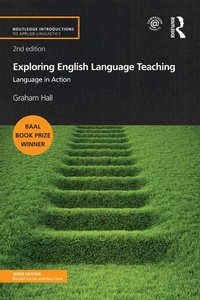
Exploring English Language Teaching
Language in Action
2nd Edition
Published on 18. September 2017
328 pages
978-1-351-75792-8 (ISBN)
Description

Routledge Introductions to Applied Linguistics is a series of introductory level textbooks covering the core topics in Applied Linguistics, primarily designed for those entering postgraduate studies and language professionals returning to academic study. The books take an innovative 'practice to theory' approach, with a 'back-to-front' structure. This leads the reader from real-world problems and issues, through a discussion of intervention and how to engage with these concerns, before finally relating these practical issues to theoretical foundations. Additional features include tasks with commentaries, a glossary of key terms, and an annotated further reading section.
Exploring English Language Teaching provides a single volume introduction to the field of ELT from an applied linguistics perspective. The book addresses four central themes within English language teaching: 'Classroom interaction and management'; 'Method, Postmethod and methodology'; 'Learners'; and the 'Institutional frameworks and social contexts' of ELT. For each, the book identifies key dilemmas and practices, examines how teachers and other language teaching professionals might intervene and deal with these concerns, and explores how such issues link to and inform applied linguistic theory.
This second edition has been extensively revised and updated to explore the latest practical developments and theoretical insights in the field of ELT. With new material, including expanded discussions of CLIL, the role of new technologies in ELT, and the teaching of large classes in difficult circumstances, and with an updated glossary and suggestions for additional reading, this is an indispensable textbook for language teachers and students studying in the areas of Applied Linguistics, Language Teacher Education, and ELT/TESOL.
Exploring English Language Teaching provides a single volume introduction to the field of ELT from an applied linguistics perspective. The book addresses four central themes within English language teaching: 'Classroom interaction and management'; 'Method, Postmethod and methodology'; 'Learners'; and the 'Institutional frameworks and social contexts' of ELT. For each, the book identifies key dilemmas and practices, examines how teachers and other language teaching professionals might intervene and deal with these concerns, and explores how such issues link to and inform applied linguistic theory.
This second edition has been extensively revised and updated to explore the latest practical developments and theoretical insights in the field of ELT. With new material, including expanded discussions of CLIL, the role of new technologies in ELT, and the teaching of large classes in difficult circumstances, and with an updated glossary and suggestions for additional reading, this is an indispensable textbook for language teachers and students studying in the areas of Applied Linguistics, Language Teacher Education, and ELT/TESOL.
Reviews / Votes
"This book is clearly one that should be on the reading list of second language instructors, those preparing to teach and other interested individuals. It covers a range of complex material in a concise and well organized manuscript. It promotes thinking and does so by treating the topics with great clarity and in a framework that refers to an extensive body of literature. Those who read it will gain insights, both theoretical and practical."- Linguist List, Martin R. Gitterman, Lehman College and The Graduate Center, The City University of New York
More details
Series
Edition
2nd edition
Language
English
Place of publication
London
United Kingdom
Publishing group
Taylor & Francis Ltd
Target group
College/higher education
Illustrations
7 s/w Tabellen
5 Tables, black and white
File size
1,38 MB
ISBN-13
978-1-351-75792-8 (9781351757928)
Copyright in bibliographic data and cover images is held by Nielsen Book Services Limited or by the publishers or by their respective licensors: all rights reserved.
Schweitzer Classification
Other editions
Additional editions
Book
10/2017
2nd Edition
Routledge
€215.41
Shipment within 10-20 days
Book
10/2017
2nd Edition
Routledge
€73.22
Shipment within 10-20 days
Person
Graham Hall is Senior Lecturer in Applied Linguistics/TESOL at Northumbria University, UK. He is the author of Exploring English Language Teaching: Language in Action (Routledge, 2011), the winner of the 2012 British Association for Applied Lingusitics (BAAL) book prize. He is also the editor of The Routledge Handbook of English Language Teaching (Routledge, 2016).
Content
PART I: Classroom interaction and management
The language classroom: roles, relationships and interactions
Intervening in the language classroom: classroom management, interaction and learning opportunities
The language classroom in theory and practice: complex, diverse and 'local'
PART II: Method, Postmethod and methodology
Language, language learning and Method: dilemmas and practices
Language teaching methods: perspectives and possibilities
Theoretical insights for a Postmethod era
PART III: Learners
Focus on the language learner: individual attributes and attitudes
Learner diversity and development: considerations for the language classroom...and beyond
Images of language learners: from individual to social, and universal to specific
PART IV: Institutional frameworks and social contexts
From global trends to local contexts: language dilemmas in the ELT classroom
Planning and organizing L2 learning and teaching: contexts and curriculum, possibilities and realities
ELT in the world: education and politics, context and goals
Commentary on selected tasks
Glossary
Further reading
References
Index
The language classroom: roles, relationships and interactions
Intervening in the language classroom: classroom management, interaction and learning opportunities
The language classroom in theory and practice: complex, diverse and 'local'
PART II: Method, Postmethod and methodology
Language, language learning and Method: dilemmas and practices
Language teaching methods: perspectives and possibilities
Theoretical insights for a Postmethod era
PART III: Learners
Focus on the language learner: individual attributes and attitudes
Learner diversity and development: considerations for the language classroom...and beyond
Images of language learners: from individual to social, and universal to specific
PART IV: Institutional frameworks and social contexts
From global trends to local contexts: language dilemmas in the ELT classroom
Planning and organizing L2 learning and teaching: contexts and curriculum, possibilities and realities
ELT in the world: education and politics, context and goals
Commentary on selected tasks
Glossary
Further reading
References
Index
