

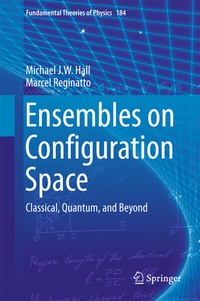
Ensembles on Configuration Space
Description

This book describes a promising approach to problems in the foundations of quantum mechanics, including the measurement problem. The dynamics of ensembles on configuration space is shown here to be a valuable tool for unifying the formalisms of classical and quantum mechanics, for deriving and extending the latter in various ways, and for addressing the quantum measurement problem. A description of physical systems by means of ensembles on configuration space can be introduced at a very fundamental level: the basic building blocks are a configuration space, probabilities, and Hamiltonian equations of motion for the probabilities. The formalism can describe both classical and quantum systems, and their thermodynamics, with the main difference being the choice of ensemble Hamiltonian. Furthermore, there is a natural way of introducing ensemble Hamiltonians that describe the evolution of hybrid systems; i.e., interacting systems that have distinct classical and quantum sectors, allowing for consistent descriptions of quantum systems interacting with classical measurement devices and quantum matter fields interacting gravitationally with a classical spacetime.
Reviews / Votes
"This is an indepth discussion of multidimensional physics in the classic and quantum interpretations of the energy principles. It is a very advanced text for serious physicists and engineers." (Joseph J. Grenier, Amazon.com, July, 2016)
More details
Other editions
Additional editions
Persons
Michael Hall works at the Centre for Quantum Dynamics at Griffith University in Brisbane, Australia. His research covers many areas of the foundations of quantum mechanics, including quantum information theory, quantum metrology, uncertainty relations, quantum time observables and interpretational aspects.
Marcel Reginatto is a physicist at the Physikalisch-Technische Bundesanstalt (PTB) in Braunschweig, Germany. His research in theoretical physics focuses on foundations of physics, with emphasis on quantum theory and general relativity. His work in applied physics concerns analysis of data and mathematical models of experiments.
