

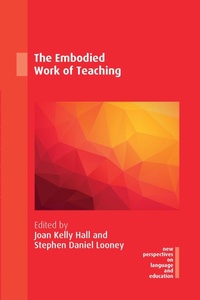
The Embodied Work of Teaching
Published on 16. September 2019
248 pages
978-1-78892-551-8 (ISBN)
Description

The chapters in this volume build on a growing body of ethnomethodological conversation analytic research on teaching in order to enhance our empirical understandings of teaching as embodied, contingent and jointly achieved with students in the complex management of various courses of action and larger instructional projects. Together, the chapters document the embodied accomplishment of teaching by identifying specific resources that teachers use to manage instructional projects; demonstrate that teaching entails both alignment and affiliation work; and show the significance of using high-quality audiovisual data to document the sophisticated work of teaching. By providing analytic insight into the highly-specialized work of teaching, the studies make a significant contribution to a practice-based understanding of how the life of the classroom, as lived by its members, is accomplished.
Reviews / Votes
Drawing on a range of empirical settings, the studies in this volume show that teaching is skillful doing-in-the-world and illuminate how teachers' full embodied repertoires are crucial in the accomplishment of the locally contextualized, yet recognizable acts, that instantiate their metier. The volume is of immense value to practitioners, researchers and educators alike. * Soren Wind Eskildsen, University of Southern Denmark, Denmark * This collection offers a diverse array of studies which encapsulates how teaching and learning are accomplished in their local orders of production. With their wide angle on the issues and their focused analytic lenses, the authors deftly zoom in on talk and embodied practices that are important and integral to giving readers an unobstructed aerial view of the 'how' that makes teaching and learning happen, again and again. * Jean Wong, The College of New Jersey, USA * This thought-provoking volume offers a glimpse into the ways we incorporate our bodies into what we do, say and teach. Its fine-grained analysis of real instances of talk demonstrates how teachers draw on gestures, gaze and the like to deal with the interactional challenges of the classroom ecology. * Tim Greer, Kobe University, Japan * [This book] is a valuable contribution to research on interaction in classrooms and similar pedagogical contexts. In particular, it shows how teaching and learning involve a multiplicity of participation frameworks and contingencies for both teachers and students to manage as they cooperate, or disengage and do not cooperate, or at least limit their cooperation, in the co-construction of the multimodal interaction through which teaching and learning are accomplished. -- Eric Hauser, The University of Electro-Communications, Japan; University of Hawai ? i at Manoa, USA * Discourse Studies 22(3) *More details
Series
Language
English
Place of publication
Bristol
United Kingdom
Target group
College/higher education
ISBN-13
978-1-78892-551-8 (9781788925518)
Copyright in bibliographic data and cover images is held by Nielsen Book Services Limited or by the publishers or by their respective licensors: all rights reserved.
Schweitzer Classification
Other editions
Additional editions
Joan Kelly Hall | Stephen Daniel Looney
The Embodied Work of Teaching
Book
09/2019
Multilingual Matters
€56.00
Shipment within 3-4 weeks
Persons
Joan Kelly Hall is Professor of Applied Linguistics and Director of the Center for Research on English Language Learning and Teaching (CRELLT) at the Pennsylvania State University, USA. Her research centers on documenting the specialized interactional practices and actions of teaching-and-learning found in instructional settings. Her most recent book is Essentials of SLA for L2 Teachers: A Transdisciplinary Framework (2019, Routledge).
Stephen Daniel Looney is an Associate Teaching Professor in Applied Linguistics and Director of the International Teaching Assistant (ITA) Program in the Department of Applied Linguistics at the Pennsylvania State University, USA. His research analyzes teacher-student interaction in university STEM classrooms. He is coeditor of A Transdisciplinary Approach to International Teaching Assistants (Multilingual Matters, 2019) and has recent publications in Journal of Pragmatics and Linguistics and Education.
Stephen Daniel Looney is an Associate Teaching Professor in Applied Linguistics and Director of the International Teaching Assistant (ITA) Program in the Department of Applied Linguistics at the Pennsylvania State University, USA. His research analyzes teacher-student interaction in university STEM classrooms. He is coeditor of A Transdisciplinary Approach to International Teaching Assistants (Multilingual Matters, 2019) and has recent publications in Journal of Pragmatics and Linguistics and Education.
Content
Chapter 1. Joan Kelly Hall and Stephen Daniel Looney: Introduction: The Embodied Work of Teaching
Chapter 2. Nadja Tadic and Catherine DiFelice Box. Attending to the Interpersonal and Institutional Contingencies of Interaction in an Elementary Classroom
Chapter 3. Joan Kelly Hall, Taiane Malabarba, and Daisuke Kimura: What's Symmetrical?: A Teacher's Cooperative Management of Learner Turns in a Read-Aloud Activity
Chapter 4. Stephen Daniel Looney and Jamie Kim: Managing Disaligning Responses: Sequence and Embodiment in Third Turn Teases
Chapter 5. Elizabeth Reddington, Di Yu, and Nadja Tadic: A Tale of Two Tasks: Facilitating Storytelling in the Adult ESL Classroom
Chapter 6. Drew Fagan: Teacher Embodied Responsiveness to Student Displays of Trouble Within Small-Group Activities
Chapter 7. Hansun Zhang Waring and Lauren B. Carpenter: Gaze Shifts as a Resource for Managing Attention and Recipiency
Chapter 8. Olcay Sert: Mutual Gaze, Embodied Go-aheads, and their Interactional Consequences in L2 Classrooms
Chapter 9. Innhwa Park: The Use of Embodied Self-directed Talk in Teaching Writing
Chapter 10. Yumi Matsumoto: Embodied Actions and Gestures as Interactional Resources for Teaching in a L2 Writing Classroom
Chapter 11. Abby Mueller Dobs: Collective Translations: Translating Together in a Chinese Foreign Language Class
Chapter 12. Stephen Daniel Looney: The Embodied Accomplishment of Teaching: Challenges for Research and Practice
Chapter 2. Nadja Tadic and Catherine DiFelice Box. Attending to the Interpersonal and Institutional Contingencies of Interaction in an Elementary Classroom
Chapter 3. Joan Kelly Hall, Taiane Malabarba, and Daisuke Kimura: What's Symmetrical?: A Teacher's Cooperative Management of Learner Turns in a Read-Aloud Activity
Chapter 4. Stephen Daniel Looney and Jamie Kim: Managing Disaligning Responses: Sequence and Embodiment in Third Turn Teases
Chapter 5. Elizabeth Reddington, Di Yu, and Nadja Tadic: A Tale of Two Tasks: Facilitating Storytelling in the Adult ESL Classroom
Chapter 6. Drew Fagan: Teacher Embodied Responsiveness to Student Displays of Trouble Within Small-Group Activities
Chapter 7. Hansun Zhang Waring and Lauren B. Carpenter: Gaze Shifts as a Resource for Managing Attention and Recipiency
Chapter 8. Olcay Sert: Mutual Gaze, Embodied Go-aheads, and their Interactional Consequences in L2 Classrooms
Chapter 9. Innhwa Park: The Use of Embodied Self-directed Talk in Teaching Writing
Chapter 10. Yumi Matsumoto: Embodied Actions and Gestures as Interactional Resources for Teaching in a L2 Writing Classroom
Chapter 11. Abby Mueller Dobs: Collective Translations: Translating Together in a Chinese Foreign Language Class
Chapter 12. Stephen Daniel Looney: The Embodied Accomplishment of Teaching: Challenges for Research and Practice
