

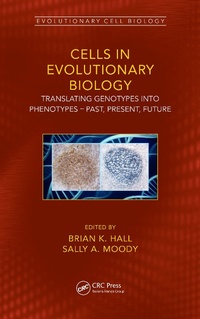
Cells in Evolutionary Biology
Translating Genotypes into Phenotypes - Past, Present, Future
1st Edition
Published on 12. June 2018
294 pages
978-1-4987-8787-1 (ISBN)
Description

This book is the first in a projected series on Evolutionary Cell Biology, the intent of which is to demonstrate the essential role of cellular mechanisms in transforming the genotype into the phenotype by transforming gene activity into evolutionary change in morphology. This book -Cells in Evolutionary Biology - evaluates the evolution of cells themselves and the role cells have been viewed to play as agents of change at other levels of biological organization. Chapters explore Darwin's use of cells in his theory of evolution and how Weismann's theory of the separation of germ plasm from body cells brought cells to center stage in understanding how acquired changes to cells within generations are not passed on to future generations.
Chapter 7 of this book is freely available as a downloadable Open Access PDF at http://www.taylorfrancis.com under a Creative Commons Attribution-Non Commercial-No Derivatives (CC-BY-NC-ND) 4.0 license.
Chapter 7 of this book is freely available as a downloadable Open Access PDF at http://www.taylorfrancis.com under a Creative Commons Attribution-Non Commercial-No Derivatives (CC-BY-NC-ND) 4.0 license.
Reviews / Votes
"... the book is a very welcome collection of chapters that offers a good overview of the role of cells in EvoDevo. It can be recommended to anyone starting to do research in this field and should be on the bookshelf in all laboratories working in fields related to its contents. In short, a great book that taught me a lot about both subjects I thought I knew something about, and about new and exciting aspects of the role of cells in EvoDevo." Lennart Olsson. 2020. In Evolution & Development, 22.Cells in Evolutionary Biology is the first volume in a series. It provides a valuable historical context and review not only of the cell and evolutionary biology fields, but of developmental and molecular biology as well. Readers will gain an appreciation for the history and philosophy underlying their fields, a perspective less frequently covered in the basic textbooks used in coursework. The volume includes chapters from authors specializing not only in biology and its subfields, but in culture and philosophy. It opens with the origins of cell theory and germ plasm theory, ideas that laid the groundwork for our modern understanding of evolution. It covers historical debate regarding the origin of eukaryotic cells and of multicellular organisms with differentiated tissue types. It successfully dissects topics generally accepted as fact and guides the reader through the thought process that led to that status. To appreciate this text, a solid understanding of the current science is prerequisite. As such, this extremely interesting volume is best suited to graduate level students and established researchers.
--D. Schulman, Lake Erie College
Summing Up: Recommended. Graduate students through faculty and professionals. "... the book is a very welcome collection of chapters that offers a good overview of the role of cells in EvoDevo. It can be recommended to anyone starting to do research in this field and should be on the bookshelf in all laboratories working in fields related to its contents. In short, a great book that taught me a lot about both subjects I thought I knew something about, and about new and exciting aspects of the role of cells in EvoDevo." Lennart Olsson. 2020. In Evolution & Development, 22.
"Cells in Evolutionary Biology is the first volume in a series. It provides a valuable historical context and review not only of the cell and evolutionary biology fields, but of developmental and molecular biology as well. Readers will gain an appreciation for the history and philosophy underlying their fields, a perspective less frequently covered in the basic textbooks used in coursework. The volume includes chapters from authors specializing not only in biology and its subfields, but in culture and philosophy. It opens with the origins of cell theory and germ plasm theory, ideas that laid the groundwork for our modern understanding of evolution. It covers historical debate regarding the origin of eukaryotic cells and of multicellular organisms with differentiated tissue types. It successfully dissects topics generally accepted as fact and guides the reader through the thought process that led to that status. To appreciate this text, a solid understanding of the current science is prerequisite. As such, this extremely interesting volume is best suited to graduate level students and established researchers." --D. Schulman, Lake Erie College
Summing Up: Recommended. Graduate students through faculty and professionals.
More details
Series
Edition
1. Auflage
Language
English
Place of publication
London
United Kingdom
Publishing group
Taylor & Francis Ltd
Target group
College/higher education
Illustrations
3 Tables, black and white; 15 Illustrations, color; 13 Illustrations, black and white
File size
13,42 MB
ISBN-13
978-1-4987-8787-1 (9781498787871)
Copyright in bibliographic data and cover images is held by Nielsen Book Services Limited or by the publishers or by their respective licensors: all rights reserved.
Schweitzer Classification
Other editions
Additional editions
Brian K. Hall | Sally A. Moody
Cells in Evolutionary Biology
Translating Genotypes into Phenotypes - Past, Present, Future
Book
03/2021
1st Edition
CRC Press
€65.71
Shipment within 15-20 days
Brian K. Hall | Sally A. Moody
Cells in Evolutionary Biology
Translating Genotypes into Phenotypes - Past, Present, Future
Book
06/2018
1st Edition
CRC Press
€208.40
Shipment within 15-20 days
Persons
Brian K. Hall, University Research Professor Emeritus at Dalhousie University, was trained in Australia as an experimental embryologist. His research concentrated on the differentiation of skeletal tissues, especially, how epithelial-mesenchymal signaling initiates osteogenesis and chondrogenesis through the formation of cellular condensations. These studies led him to earlier stages of development and the origin and function of skeletogenic neural crest cells. Comparative studies, using embryos from all five classes of vertebrates provided a strong evolutionary component to his research. These studies, along with analyses of the developmental basis of homology, played significant roles in the establishing of evolutionary developmental biology. He is a Fellow of the Royal Society of Canada, Foreign Fellow of the American Academy of Arts and Science, and recipient of a Killam Prize. He was one of eight individuals awarded the first Kovalevsky Medals in 2000 to recognize the most distinguished scientists of the twentieth century in comparative zoology and evolutionary embryology.
Sally A. Moody, Professor and Chair of the Department of Anatomy and Regenerative Biology at George Washington University, received her PhD in Neuroscience during which she studied motor axon guidance cues in the trigeminal system of the chick embryo. Throughout her career, she has continued her interest in understanding the mechanisms of axon guidance, studying the role of lineage factors in Xenopus, extracellular matrix proteins in chick, and genetic mutations in mouse. As a postdoctoral fellow, Sally was introduced to Xenopus embryos, which has remained a favorite. She made extensive fate maps of cleavage stage Xenopus embryos, identified maternal mRNAs that contribute to neural fate, elucidated proteomic and metabolomic changes that occur within specific lineages during cleavage, and demonstrated lineage influences on the determination of amacrine cell fate in the retina. Currently, her laboratory is studying the gene regulatory network that stabilizes neural fate downstream of neural induction, and identifying novel factors that are required for cranial sensory placode development. Dr. Moody has served on several editorial boards in the fields of neuroscience and developmental biology, on the board of directors of several societies focused on developmental processes, and edited the books: Cell Fate and Lineage Determination and Principles in Developmental Genetics.
Sally A. Moody, Professor and Chair of the Department of Anatomy and Regenerative Biology at George Washington University, received her PhD in Neuroscience during which she studied motor axon guidance cues in the trigeminal system of the chick embryo. Throughout her career, she has continued her interest in understanding the mechanisms of axon guidance, studying the role of lineage factors in Xenopus, extracellular matrix proteins in chick, and genetic mutations in mouse. As a postdoctoral fellow, Sally was introduced to Xenopus embryos, which has remained a favorite. She made extensive fate maps of cleavage stage Xenopus embryos, identified maternal mRNAs that contribute to neural fate, elucidated proteomic and metabolomic changes that occur within specific lineages during cleavage, and demonstrated lineage influences on the determination of amacrine cell fate in the retina. Currently, her laboratory is studying the gene regulatory network that stabilizes neural fate downstream of neural induction, and identifying novel factors that are required for cranial sensory placode development. Dr. Moody has served on several editorial boards in the fields of neuroscience and developmental biology, on the board of directors of several societies focused on developmental processes, and edited the books: Cell Fate and Lineage Determination and Principles in Developmental Genetics.
Content
The role and autonomy of cells in phylogeny and evolution circa 1840-1865. Germ plasm theory and cells in evolutionary biology. The discovery of genes and the rise of genetics from 1900 in usurped cells in evolutionary biology. The study of cells, embryos and evolution through identification of cell lineages. Experimental embryology, nuclear or cytoplasmic control of development. Cytoplasmic inheritance in protozoans and divergent evolution of prokaryotes and eukaryotes. Structural (TEM) analyses of cells: evolution of cells, organelles and cell number. Recognition of the Archaea, different relationships and kingdoms of life. Cellular condensations, modularity and evolution of the phenotype.
